Isobaric Subwoofer Box Calculator
Size a coupled driver pair, compare sealed or vented targets, and check net volume, port length, and shell weight before you cut.
📦 Presets
🔧 Setup
📊 Material Specs
Coverage and capacity guide
| Driver pair | Effective Vas | Sealed band | Vented band |
|---|---|---|---|
| 8 in class | about 9 L | 0.20-0.35 | 0.40-0.70 |
| 10 in class | about 16 L | 0.35-0.65 | 0.60-1.10 |
| 12 in class | about 29 L | 0.55-1.00 | 1.00-1.80 |
| 15 in class | about 56 L | 0.90-1.70 | 1.60-2.80 |
Coupling and alignment comparison
| Mode | Vas factor | Response | Use |
|---|---|---|---|
| Push-pull | 0.50x | -3 dB | Low distortion |
| Cone-to-cone | 0.50x | -3 dB | Compact pair |
| Sealed pair | 0.50x | Qtc focus | Small boxes |
| Vented pair | 0.50x | Fb focus | Deeper bass |
Common build sizes
| Project | Internal size | Primary result | Secondary result |
|---|---|---|---|
| Slim 8 pair | 20 x 13 x 10 | 0.28 ft3 | Sealed |
| Daily 10 pair | 22 x 15 x 11 | 0.42 ft3 | Qtc 0.75 |
| Low-tune 12 | 28 x 16 x 14 | 1.20 ft3 | Fb 30 Hz |
| Deep 15 pair | 34 x 20 x 16 | 2.10 ft3 | Fb 28 Hz |
Isobaric loading involve placing two subwoofers in an enclosure so that the two subwoofers face each other and move in tandem with each other. Using this configuration, the enclosure that is needed for the subwoofers can be smaller by utilizing one subwoofer with half of the original Vas value of the speaker. The Vas value of a speaker are the volume of air that is compliant to the movement of the subwoofer.
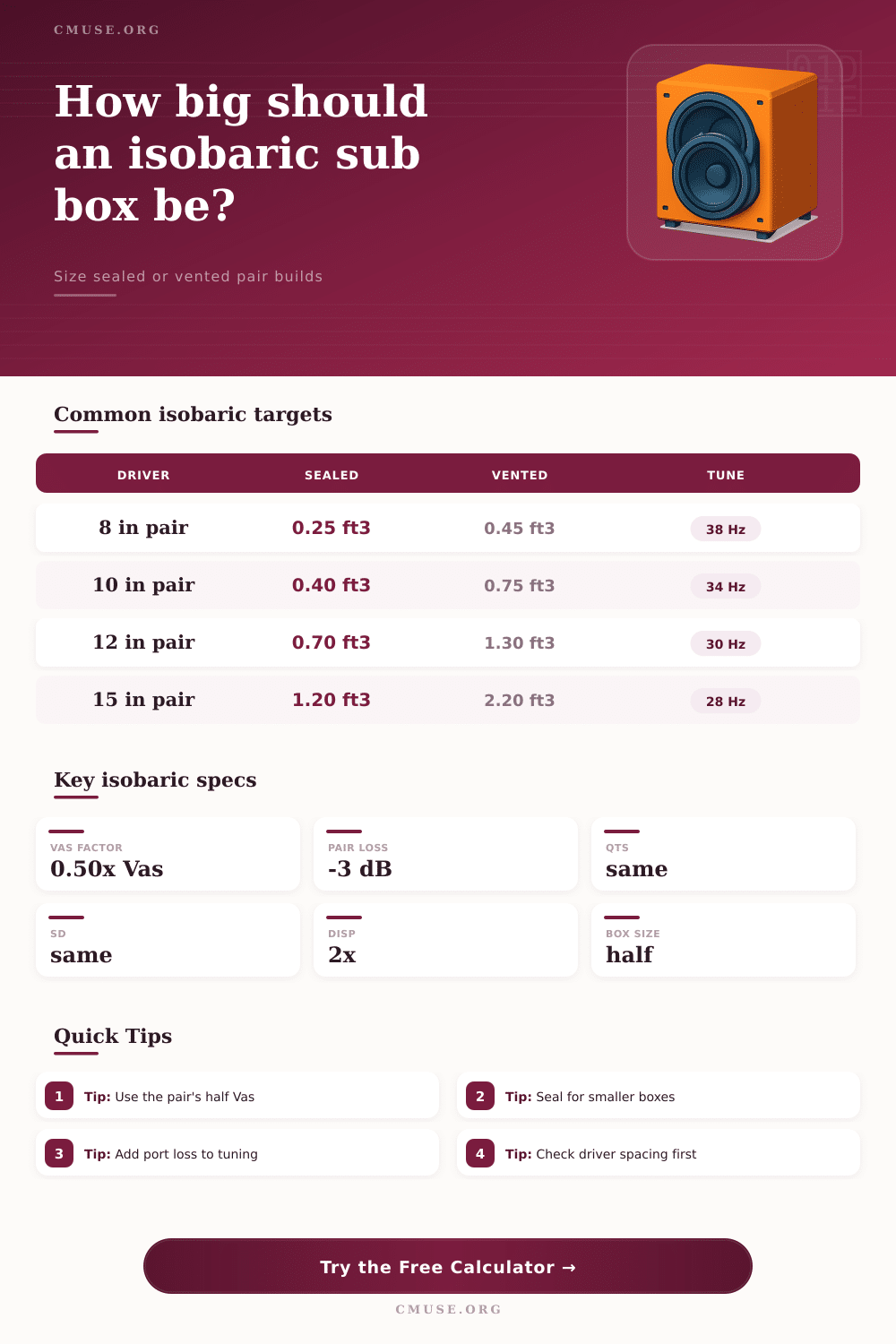
Thus, by using half of the Vas value, the enclosure that is required for the subwoofers to effectively operate can be smaller. Additionally, the surface area, or Sd, of the two subwoofers together doubles as part of the system, but the sensitivity of the system to the subwoofers decreases by 3 dB because the system is driving two motor instead of one. The physics behind isobaric loading is that the back wave of one subwoofer push against the front wave of the other subwoofer, equalizing the pressure within the enclosure that is created by the two subwoofers.
Isobaric Loading: How Two Subwoofers Use a Smaller Box
Because the pressure within that enclosure is equalized, the air within that enclosure is acting as a constant pressure, which is why the volume of that enclosure can be reduced by half. You must understand that while the volume of the enclosure is halved, the power that is required to drive the subwoofers will increase. In addition to the fact that the subwoofers must face each other in an isobaric loading system, there are different ways to couple those two subwoofers.
Each type of coupling will change the dimension of the enclosure that is required for the system to be constructed. A push-pull configuration of the subwoofers will allow for each subwoofer’s magnets to be offset from each other, and this configuration will minimize the distortion that can be caused by rocking modes of the subwoofers. A cone-to-cone configuration will allow for the two subwoofers to be positioned in a way that the cones of each subwoofer face each other, and this configuration will save the most depth for the enclosure.
Finally, a spacer-coupled configuration will allow for a thin ring of material to be placed between the two subwoofers, and this configuration will provide the enclosure with rigidity while increasing the depth of the enclosure relative to the cone to cone configuration. Each of these configurations results in the Vas value of the system being halved, but each adds a different amount of displacement to the enclosure that must be provided. In addition to the type of coupling for the subwoofers, there are different ways to build the enclosure itself.
For instance, you can build the enclosure as a sealed box, or the enclosure can be a vented box with a port for the low-frequency sounds to emerge from the box. A sealed isobaric loading system will often require an enclosure that is smaller than that required for a single-driver subwoofer. Additionally, sealed enclosures will have a smooth rolloff of the low frequencies.
An alternative to sealed enclosures is the use of a vented enclosure, which will allow the system to produce lower frequency sounds different than sealed enclosures, but which will require a larger area for the port through which the sound emerges from the enclosure. Thus, sealed enclosures are best used if you want a simple and punchy bass response from your system and a vented enclosure should be used if deeper infrasonic sounds is desired. The size of the subwoofers will determine the volume of the enclosure.
For instance, a pair of 8-inch subwoofers may require 0.25 cubic feet of volume for their enclosure, but a pair of 15-inch subwoofers may require 1.2 cubic feet of volume. The volume of the enclosure is calculated by determining the gross volume of the enclosure and subtracting the volume of each subwoofer, the volume of each set of brace for the enclosure, the volume of each port for a vented enclosure, and a buffer for the polyfill that will be added to the enclosure and for potential air leak. In addition to the size and shape of the enclosure, the material of the enclosure will affect the system.
For instance, 18 mm MDF can be used for its added mass and durability, but birch plywood can be used to create an enclosure that is lighter and more portability. Rectangular shapes are standard for most baffles and enclosures, though wedge shapes may be required for enclosures that must fit into angled areas, such as a car trunk. Finally, the internal bracing for the enclosure should be ensured to handle the opposing forces created by each of the two subwoofers; if the walls of the enclosure begin to vibrate due to these opposing force, the enclosure will create noise itself.
However, there are some mistake that should be avoided when building the enclosure. One mistake that is common is placing the subwoofers too close together within the enclosure; this may cause the subwoofers to collide with each other while in operation. Another mistake that is common is forgetting one of the adjustments to the gross volume of the enclosure, such as the displacement of the port through which sound will emerge from the enclosure.
Additionally, another mistake is forgetting that the 3 dB loss in sensitivity will require a more powerful amplifier to provide the same amount of energy to the enclosure. If you perform the mathematical calculations required to determine the dimensions and components of the enclosure prior to beginning construction, you can avoid wasting materials, such as plywood. Overall, isobaric loading is a method that allows bass to be produced at low frequencies within a smaller enclosure.
Thus, using two subwoofers within an enclosure that is half of the size as a single-driver enclosure will allow for deeper bass to be created within smaller areas.