Transmission Line Subwoofer Box Calculator
Use this transmission line subwoofer box calculator to size line length, cross-section, stuffing, and folded volume before you cut.
📦 Transmission Line Presets
🔧 Line Geometry Inputs
📈 Reference Tables
Driver class guide
| Driver | Straight TL net | Folded TL net | Disp. |
|---|---|---|---|
| 8 in class | 0.45-0.90 | 0.75-1.25 | 0.03 ft3 |
| 10 in class | 0.75-1.40 | 1.10-1.80 | 0.05 ft3 |
| 12 in class | 1.00-2.00 | 1.80-3.50 | 0.08 ft3 |
| 15 in class | 1.80-3.50 | 3.00-5.80 | 0.13 ft3 |
| 18 in class | 2.80-5.00 | 5.00-9.00 | 0.20 ft3 |
Line tuning guide
| Alignment | Tune | Volume band | Use |
|---|---|---|---|
| Straight TL | N/A | 0.45-2.00 | Tight bass |
| Folded TL | 33-35 Hz | 1.10-3.50 | Balanced |
| Low-tune | 28-32 Hz | 1.80-5.80 | Deeper low end |
| SPL TL | 36-40 Hz | 2.50-9.00 | Upper-bass hit |
Fill material guide
| Material | Thick. | Density | Note |
|---|---|---|---|
| 15 mm MDF | 15 mm | 740 kg/m3 | Light MDF |
| 19 mm MDF | 19 mm | 760 kg/m3 | Common build |
| 12 mm birch ply | 12 mm | 620 kg/m3 | Thin shell |
| 18 mm birch ply | 18 mm | 650 kg/m3 | Strong all-round |
| 18 mm Baltic birch | 18 mm | 680 kg/m3 | Premium panel |
| 19 mm marine ply | 19 mm | 660 kg/m3 | Moisture ready |
| 12 mm HDF | 12 mm | 880 kg/m3 | Very stiff |
| 15 mm composite | 15 mm | 720 kg/m3 | Stable board |
Line profile guide
| Driver | Area | Tune | Note |
|---|---|---|---|
| 8 in class | 12-16 in2 | 34-38 Hz | Small cabin |
| 10 in class | 16-22 in2 | 32-36 Hz | Tight daily |
| 12 in class | 22-30 in2 | 30-34 Hz | Most builds |
| 15 in class | 32-42 in2 | 28-32 Hz | Large trunk |
| 18 in class | 44-60 in2 | 26-30 Hz | Big output |
💡 Transmission Line Build Tips
A transmission line subwoofer enclosure are a specific type of speaker box that use a long path. Many people attempt build transmission line subwoofer enclosures because transmission line subwoofer enclosures can create a smooth bass response. However, a transmission line subwoofer enclosure can also produce poor sound if the transmission line isnt sized correct.
A transmission line subwoofer enclosure allows sound wave to travel through a path, or transmission line. The length of the transmission line determine the frequency of bass the subwoofer enclosure will produce. If the transmission line is too short, the enclosure will produce upper bass frequency but will not produce low bass frequencies.
How to Build a Transmission Line Subwoofer Box
If the transmission line is too long, the transmission line will lose energy due to friction between the sound waves and the interior of the transmission line. As a result, the transmission line subwoofer enclosure will lose efficiency. The size of the driver in the subwoofer enclosure should match the volume of the transmission line subwoofer enclosure.
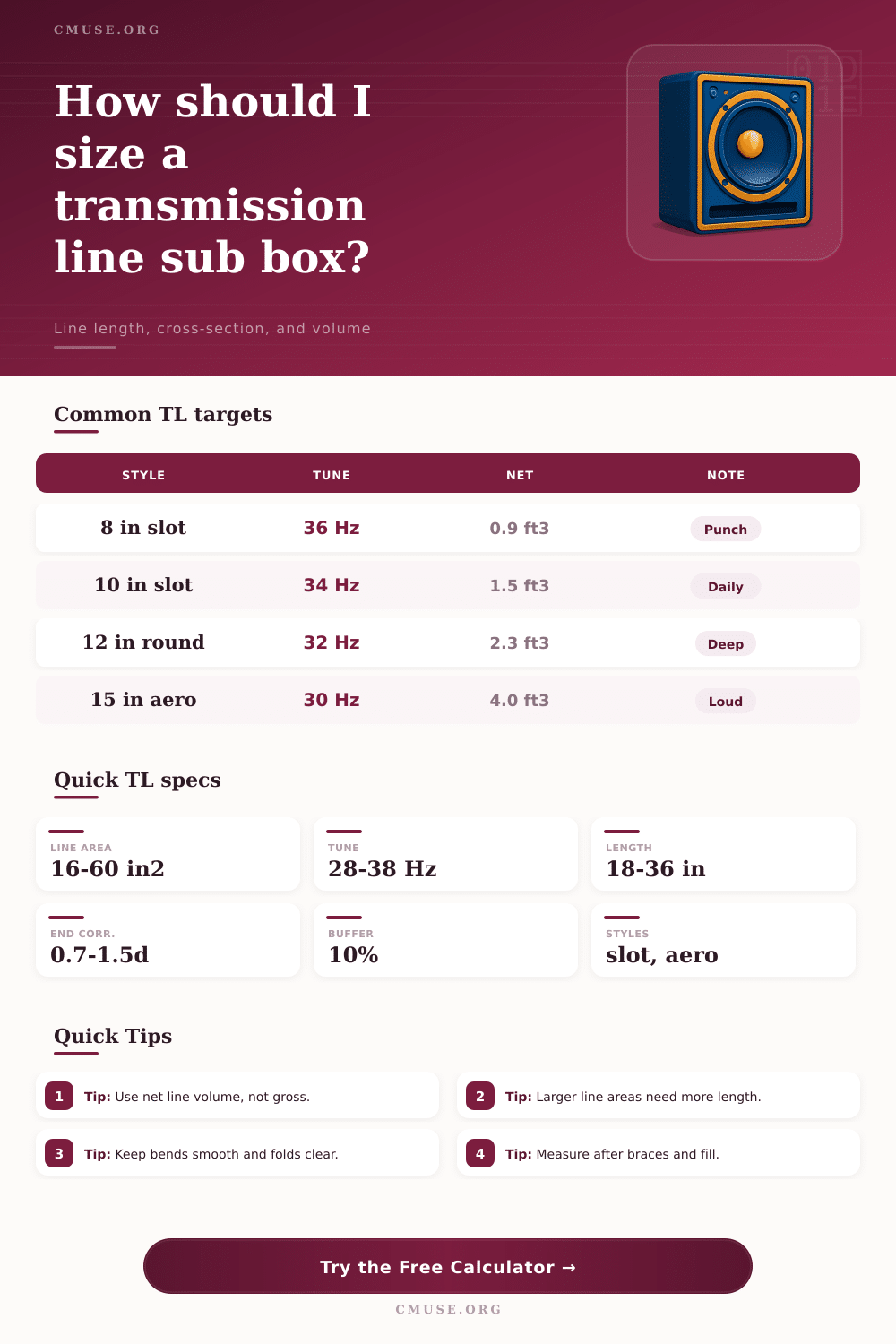
An 8-inch driver work best in a small transmission line subwoofer enclosure. A 12-inch or an 15-inch driver require a larger transmission line subwoofer enclosure. This is because the more larger the driver, the more area is required in the transmission line for the driver to move the air in and out of the enclosure.
If the air move too quickly in the transmission line, it will create air turbulence. Air turbulence can reduce the sound output of the transmission line subwoofer enclosure. By adding stuffing to the transmission line, such as polyfill or denim, the stuffing will absorb the middle frequencies of sound create by the subwoofer.
Additionally, by adding stuffing to the transmission line, it will act as if the transmission line is 20 to 30 percent longer then the actual length of the transmission line. The materials out of which a person builds a transmission line subwoofer enclosure are also important for the performance of the subwoofer enclosure. One of the most common material used to build the enclosure is birch plywood.
This is done because birch plywood resist warping. Another common material for building transmission line subwoofer enclosures is Medium Density Fiberboard (MDF). A person should use brace inside the transmission line subwoofer enclosure to prevent the panels of the enclosure from vibrating.
However, every time a person add a brace to the enclosure, that brace takes up some of the volume of the enclosure. In addition to the volume that the braces take up, a person must also account for the volume that the driver of the subwoofer take up inside the enclosure. To calculate the net volume of the transmission line subwoofer enclosure, a person must subtract the volume of the driver, the volume of the braces, and the volume of the stuffing from the gross volume of the enclosure.
The design of the transmission line will determine the type of bass that is emit from the transmission line subwoofer enclosure. If a person want tight bass sounds from their subwoofer, they should use a straight transmission line. If, however, a person want deeper bass sounds from their subwoofer, they should use a folded transmission line.
Additionally, depending on what type of bass a person wants to hear from their subwoofer, they will need to adjust the length of the transmission line. For example, someone who wants bass between 30 and 35 Hz will need a different length of transmission line than someone who want bass between 36 and 40 Hz. Finally, a person must also decide whether the transmission line will have a rectangular or triangular shape.
Finally, a person must avoid certain mistake when building the transmission line subwoofer enclosure. Using too much stuffing inside of the transmission line will reduce the output of the subwoofer enclosure. Another mistake that a person should avoid is not adding enough bracing to the enclosure.
Without the bracing, the panels of the enclosure will flex and create resonance within the enclosure. Finally, another mistake that a person must avoid is failing to test the subwoofer enclosure with an impedance sweep. An impedance sweep will allow a person to determine the frequency peak of the subwoofer.
Knowing these frequencies will allow a person to adjust the stuffing or the design of the transmission line subwoofer enclosure to increase its overall performance.