6th Order Subwoofer Box Calculator
Split rear and front chambers, estimate vent length, and check fit before you build.
| Driver | Vas | Qts | Fs | Bandpass use |
|---|---|---|---|---|
| 8 in long throw | 22 L | 0.44 | 39 Hz | Small hatch and quick punch |
| 10 in daily motor | 38 L | 0.41 | 33 Hz | Daily trunk with clean peak |
| 12 in daily motor | 66 L | 0.39 | 28 Hz | Balanced street and low bass |
| 15 in loud daily | 145 L | 0.36 | 24 Hz | Big trunk or wall style build |
| 18 in competition motor | 230 L | 0.33 | 22 Hz | Large wall and lane peak use |
| Style | Area factor | End corr. | Best use | Tone |
|---|---|---|---|---|
| Balanced slot | 0.20x Sd | 0.92 | Daily driver | Easy to build |
| Wide slot | 0.24x Sd | 0.95 | Lower noise | Longer length |
| Single round | 0.16x Sd | 0.78 | Compact wall | Simple cutout |
| Dual round | 0.22x Sd | 0.82 | High output | Better load split |
| Flared aero | 0.18x Sd | 0.76 | Cleaner airflow | Less chuffing |
| SPL tunnel | 0.28x Sd | 1.02 | Competition | Very long vent |
| Sheet | Thick. | Density | Mass note |
|---|---|---|---|
| 18 mm MDF | 18 mm | 720 kg/m3 | Rigid and heavy |
| 15 mm birch ply | 15 mm | 650 kg/m3 | Lighter daily build |
| 18 mm birch ply | 18 mm | 680 kg/m3 | Good all around |
| 18 mm marine ply | 18 mm | 640 kg/m3 | Moisture safe |
| 22 mm void-free | 22 mm | 610 kg/m3 | Stiff shell panel |
| 25 mm double MDF | 25 mm | 760 kg/m3 | Very heavy shell |
| Layout | Footprint | Rear Qtc | Front tune | Fit note |
|---|---|---|---|---|
| Urban 8 | 15 x 12 in | 0.74 | 42 Hz | Short vent |
| Tight 10 | 18 x 13 in | 0.80 | 40 Hz | Daily trunk |
| Daily 12 | 21 x 15 in | 0.88 | 36 Hz | Balanced fit |
| Street 15 | 26 x 18 in | 0.98 | 32 Hz | More depth |
| SPL 18 | 32 x 22 in | 1.08 | 28 Hz | Big wall shell |
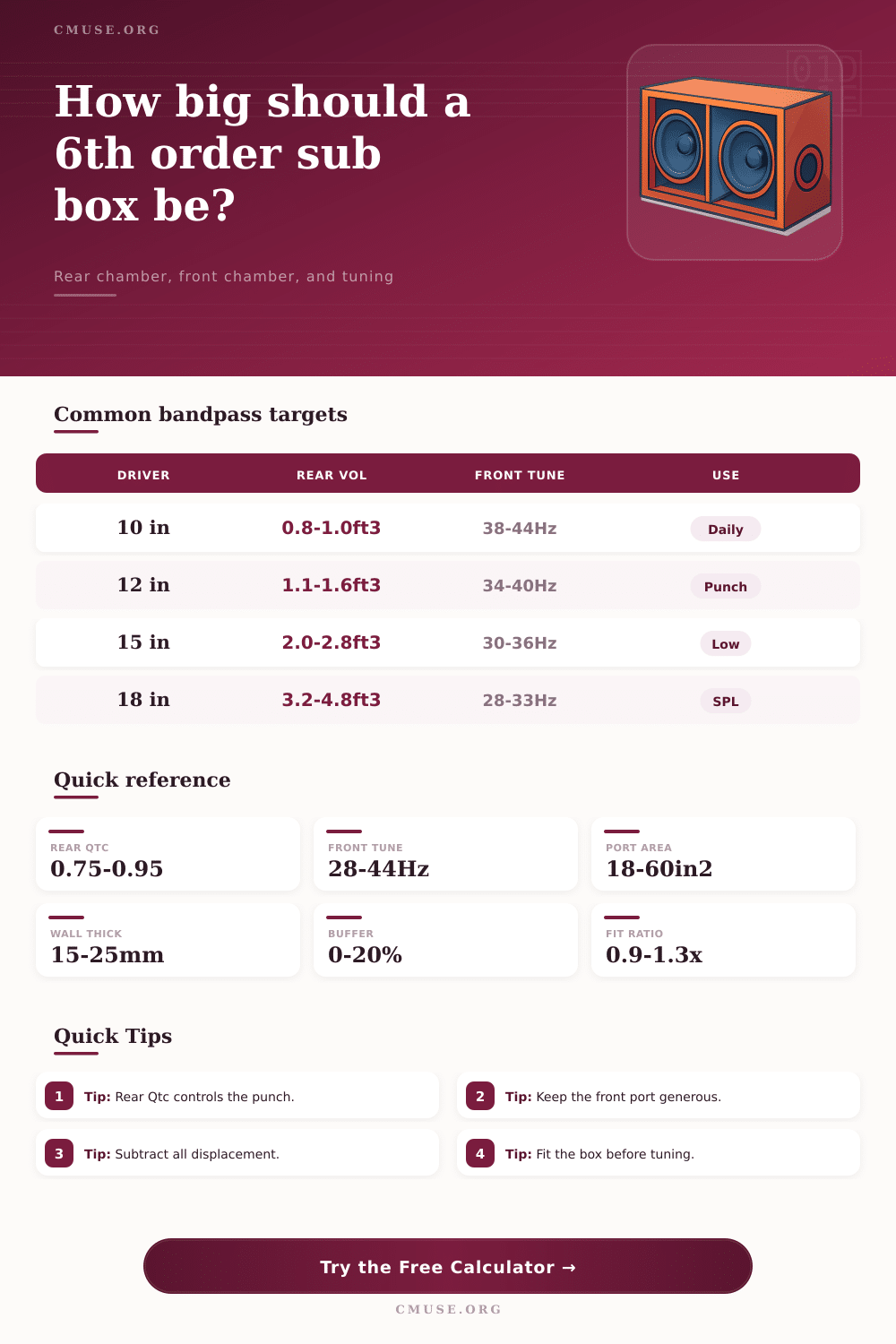
A 6th order bandpass enclosure contain two chambers, one sealed chamber and one vented chamber. The sealed rear chamber and the vented front chamber of a 6th order bandpass enclosure work together to trap the subwoofers between the two chambers. This type of enclosure will allow the subwoofer to produce high output within a narrow band of frequencies, while preventing other frequencies from passing through the subwoofer.
The rear chamber of a 6th order bandpass enclosure is used to set the systems Qtc. The system’s Qtc determine whether the bass output of the system sounds punchily or extended. If the system’s Qtc is set too high, it will produce a sharp peak in the bass frequencies that will end quickly below 40Hz.
How to Build a 6th Order Bandpass Subwoofer Box
If the system’s Qtc is set to a lower value, the bass will contain deeper frequencies but have less impact in the midbass range. Most subwoofers requires that the rear chamber’s Qtc is higher than the native Qts of the subwoofer. If the rear chamber’s Qtc is not higher than the native Qts of the subwoofer, the subwoofer will produce a resonant sound that isnt properly control.
The front chamber of a 6th order bandpass enclosure is usually ported to allow for shaping of the upper edge of the frequency band. In order to effectively produce the desired bass frequencies, you must calculate the volumes of the front and rear chambers correctly; otherwise, the port may make noise within the enclosure or may allow the subwoofer to move a very large amount of air. Prior to beginning to build the 6th order bandpass enclosure, you must plan the physical dimension of the enclosure.
You must size the footprint of the 6th order bandpass enclosure to fit within your vehicle; an enclosure that is too large for your vehicle will not be able to fit into your trunk or hatchback. 6th order bandpass enclosures can have rectangular, wedge, or round shapes. Each of these shape can be constructed from a variety of materials, including plywood and MDF.
MDF is more denser than plywood and will prevent vibration within the enclosure, but plywood is much easier to install within a vehicle. You must account for the amount of volume that the braces will take up while securing the enclosure, as well as the volume of the subwoofer itself. The port in the front chamber of a 6th order bandpass enclosure is used to determine the tuning of the system.
A slot port of an area that is approximately one-fifth of the area of the subwoofer cone will help to keep the air velocity within the enclosure low. A wider port will allow competition subwoofers to produce high-output bass, but will require a longer physical length to create such a wider port. The end corrections that are created at the openings of the port will allow for fine adjustments in the tuning of the system without having to physically alter the length of the cut port.
The goal of the system is to create a Helmholtz resonance that will allow the system to produce bass frequencies between 30Hz to 50Hz. If the band of frequencies created by the enclosure is too narrow, it will produce bass that is peakily. If the band of frequencies produced by the enclosure is too broad, the system will lose its ability to focus upon and play the desired band of frequencies.
The size of the subwoofer that is to be used in the 6th order bandpass enclosure will dictate the size of the chambers that is created within the enclosure. An 8-inch subwoofer can work well with a rear chamber of approximately 20 liters in volume. A 12-inch subwoofer with a large Vas will have requirements of a larger rear chamber, and often for a trunk-mounted 6th order bandpass enclosure.
An 18-inch subwoofer will require very large rear chamber, potentially with a volume that exceeds 200 liters. The size of the subwoofer is only one of the factors that must be considered when building a 6th order bandpass enclosure; the other factor is the Fs and the Qts of the subwoofer. Many people make mistakes when building their 6th order bandpass enclosures.
One of the most common mistake is making the footprint of the bandpass enclosure too small for the size of the subwoofer. If the footprint is too small, it will not allow for the necessary amount of space for the port or the braces. If the front chamber is tuned to produce frequencies above 50Hz, the system will have a nasal sound in the midbass range.
Another of the mistakes that people make is ignoring the mass of the enclosure materials. If the enclosure is not heavy enough, it may flex when bass frequencies are played, which will ruin the tuning of the 6th order bandpass enclosure. It is important to always subtract the volume of the subwoofer and the volume of the port from the total volume of the box.
Additionally, braces will ensure that the box is strong and rigid. One means of finding the correct tuning for the 6th order bandpass enclosure is the use of alignment targets. For example, if an individual desires bass that is punchy, the target for the system’s Qtc will be a value higher than.8, such as.9.
For those that desire a balanced sound system, a target of.8 for the system’s Qtc is all that is require. Another option is the use of aero flares at the ports to reduce the noise that the system makes. Additionally, using dual round ports can help to even split the air load that is created by large subwoofers.
The weight of the MDF may also have an impact on the installation of the 6th order bandpass enclosure into the individual’s car. As such, it is important to consider the weight that the 6th order bandpass enclosure will add to the car. A well-built 6th order bandpass enclosure will allow the subwoofer to produce high amounts of output due to the way that the chambers help to create pressure between the two chambers.
If constructed correctly, such a system will amplify the frequencies that is desired from the subwoofer, as well as filter out road noise. If the 6th order bandpass enclosure is incorrectly built, it will create phase issue within the system. The best way to begin building a 6th order bandpass enclosure is to first consider the size of the available space for the system.
Based off the size of the space that is available, you can select the subwoofer. Finally, the volumes of the chambers can be adjusted to allow for the best 6th order bandpass enclosure possible.