dB to Sones Calculator
Convert loudness into phons and sones, compare against a target, and see how distance, source count, and room coupling change the reading.
🔊 Loudness Presets
🔧 Conversion Inputs
📊 Loudness Spec Grid
📈 Phon-to-Sone Anchors
| Phons | Sones | Level step | Meaning |
|---|---|---|---|
| 20 phons | 0.25 sone | -20 phons | Very faint |
| 30 phons | 0.5 sone | -10 phons | Soft room |
| 40 phons | 1 sone | Baseline | Reference anchor |
| 50 phons | 2 sones | +10 phons | Twice as loud |
🔊 Common Source Examples
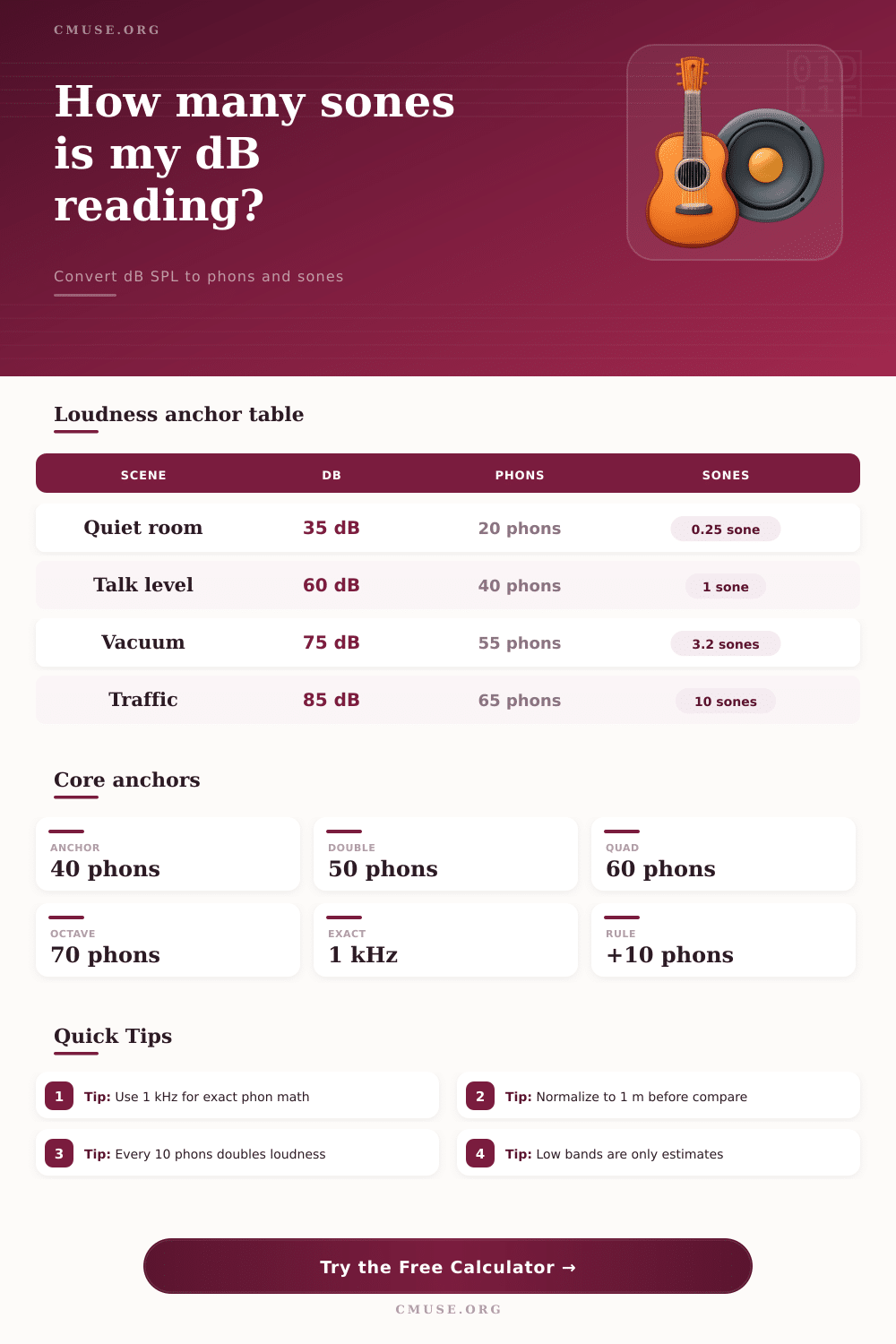
| Scene | dB SPL | Phons | Sones |
|---|---|---|---|
| Library whisper | 30 to 35 | 20 to 25 | 0.2 to 0.3 |
| Conversation | 55 to 65 | 35 to 45 | 0.8 to 1.4 |
| Vacuum cleaner | 70 to 80 | 50 to 60 | 2 to 4 |
| Traffic curbside | 80 to 90 | 60 to 70 | 4 to 8 |
📢 Tone Band Offsets
| Band | Offset | Best use | Note |
|---|---|---|---|
| 125 Hz | -18 phons | Kick and bass | Low-end penalty |
| 250 Hz | -10 phons | Body and warmth | Still tonal |
| 500 Hz | -4 phons | Speech body | Near midrange |
| 1 kHz | 0 phons | Exact anchor | Standard reference |
📋 Loudness Class Guide
| Sones | Phon band | Feel | Example |
|---|---|---|---|
| 0.25 to 0.5 | 20 to 30 | Very soft | Quiet room |
| 1 to 2 | 40 to 50 | Calm | Office talk |
| 4 to 8 | 60 to 70 | Active | Busy floor |
| 16 plus | 80 plus | Loud | Live audio |
Decibels measure teh physical intensity of sounds. However, decibels dont always reflect how loud a sound feel to the person. Decibels measure the physical pressure of sound.
Sone measure the perceived loudness of sound as a person hears it. Sones are a unit of measurement for loudness based on how the human brain processes sounds. Therefore, sones are more accurate unit of measurement for loudness than decibels.
How Sones and Decibels Measure Loudness
While many people use decibels for technical sound measurements, others use sones to describe how loud a sound seem to the listener. Because the human ear perceives loudness different than decibels, there is a relationship between sones and decibels. While the relationship between sones and decibels are not linear, sound in decibels is measured on a logarithmic scale to represent the physical energy of sound.
Sones use a different scale to represent the doubling of the loudness of sound. For example, 1 sone of loudness is equal to a sound pressure level of 40 phon at 1 kHz. A 40 phon level of sound at 1 kHz is equal to the loudness of a normal conversation at a distance of one meter.
Adding 10 phons to a sound will double the loudness of that sound to 2 sones. Because the human ear perceives loudness differently from sound pressure, sones must be use to understand the loudness of a sound. Phons are the unit of measurement that bridge the gap between sones and decibels.
Phons represent a sound’s decibel level at 1kHz to match the loudness of that sound. Phons must be use to account for how sounds of different frequencies sound different to the human ear. For example, a 60 decibel unit of pink noise (even though it is loud) may only be 40 phons if the sound contain low frequencies that are heavy on the sound’s spectrum.
The human ear does not hear low frequencies as loudly as it does high frequencies. Distance from the sound source and the environment in which the sound is measured may also impact how loud a sound is measured. As distance from the sound source increase, sound intensity decreases.
However, sound can become louder in certain environments due to the reflection of sound from walls or corner. Using sones, targets for loudness in certain environment can be established. For example, an office environment may have a target loudness of 1 sone.
In contrast, a kitchen environment may have a target loudness of 4 sones. By using the unit sones, it is possible to understand whether a sound in a specific environment is over or under the target loudness in that environment. If a sound has a loudness that is double the loudness of another sound, its sone level will be more higher than the sone level of the sound with lower loudness.
For example, a pair of desktop monitors may have a loudness of 1.5 sones, which is considered comfortable for many hour of use. However, the loudness in the environment of a jet cabins drone motor may be 8 sones of loudness, which can wear down the human ear with prolonged exposure to that loudness. There are some common mistake that a person might make when measuring sound.
One mistake is to ignore the distance of the sound measurement from the listener. Ignoring the distance from the sound source will result in inaccurate sound level measurement. Another mistake might be to forget to account for the number of sound source in a given environment.
Sound loudness from multiple sources will be louder then sound from a single source. Additionally, sound frequency might be ignored. Sounds that has low frequencies might be perceived as louder than sounds of the same decibel level without using a bandpass offset for sound measurements.
Finally, A-weighting might be relied upon too much for sound level measurements. A-weighting represent an approximation of phons for sound level measurements, but it is not always accurate for all sounds. Sones are the most useful unit of measurement for steady noise level in an environment.
Sones are less useful for impulsive sound. For impulsive sounds, peak decibel levels needs to be monitored to ensure that sound levels do not damage the human ear. Sones provide a means of systematically framing question about sound loudness.
By using sones to describe sound loudness, humans are able to make decisions about sound in there environments based off how loud the sound feel to the human ear.