dB Attenuation Calculator
Estimate SPL drop from distance, air, path angle, and barrier loss for mics, monitors, live rooms, and stage sources.
🔊Preset Scenarios
🔧Source, Path, and Environment
📊Spec Grid
📑Reference Tables
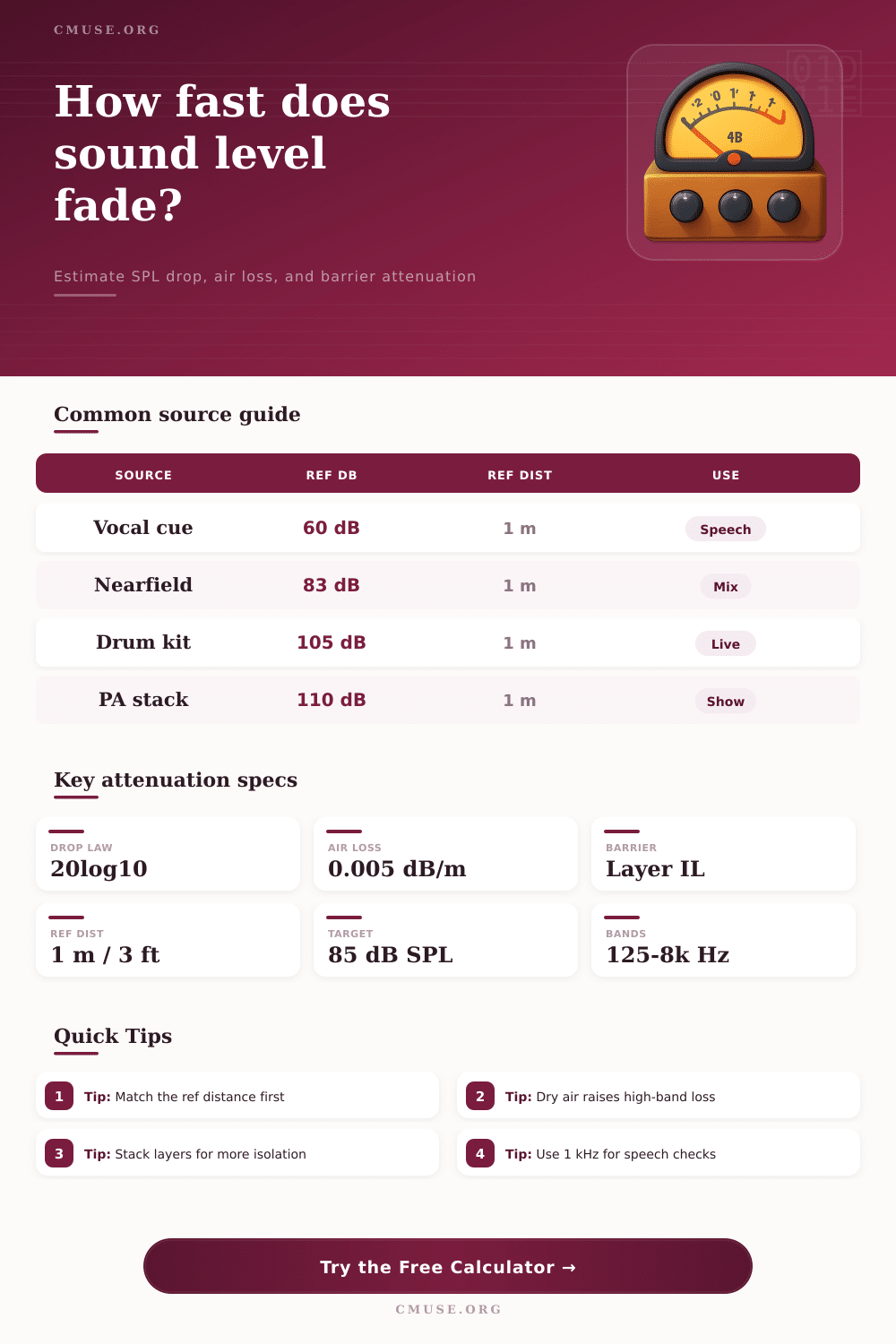
| Source | Typical dB | Ref distance | Context |
|---|---|---|---|
| Whispered cue | 35-40 dB | 1 m | Quiet booth |
| Speech at mic | 60-70 dB | 1 m | Host or talkback |
| Vocal belt | 80-90 dB | 1 m | Lead vocal |
| Drum rimshot | 110-115 dB | 1 m | Live kit |
| Distance step | Drop | Rule | Use |
|---|---|---|---|
| 2x farther | 6 dB | Half the level | Quick estimate |
| 4x farther | 12 dB | Quarter the level | Stage spacing |
| 8x farther | 18 dB | 1/8 the level | Room checks |
| 16x farther | 24 dB | 1/16 the level | Far throw |
| Band | 10 m loss | 30 m loss | Note |
|---|---|---|---|
| 125 Hz | 0.0 dB | 0.0 dB | Air is mild |
| 500 Hz | 0.03 dB | 0.09 dB | Voice body |
| 2 kHz | 0.10 dB | 0.30 dB | Speech edge |
| 8 kHz | 0.40 dB | 1.20 dB | Dry-room fade |
| Barrier | 12 mm | 25 mm | 50 mm |
|---|---|---|---|
| Heavy curtain | 4 dB | 6 dB | 8 dB |
| Plywood gobo | 9 dB | 11 dB | 14 dB |
| Glass partition | 15 dB | 18 dB | 22 dB |
| Drywall pair | 22 dB | 28 dB | 34 dB |
Sound attenuation occur when sound travels from a sound source to a listener. You must understands sound attenuation and how it change with distance, air properties, and the presence of physical barrier. The first rule of sound attenuation is an inverse square law, which states that sound pressure halve if the distance from the sound source double.
Thus, if the distance from the sound source is doubled, the sound pressure levels will drop by 6 dB. If the distance is doubled again, so that the distance is four times original distance, the sound pressure level will drop by 12 dB. This continues, as the sound pressure level will drop by 6 dB each time the distance are doubled.
How Sound Gets Weaker with Distance, Air and Barriers
This significant drop in sound energy with distance is due to the inverse square law. Distance is one of major factor in sound attenuation. However, distance is not the only factor that contribute to sound attenuation.
Air properties contributes to sound attenuation, as air absorbs the energy from the sound waves. Air absorbs the high frequency in sound waves much more quickly than the low frequencies. Thus, high frequencies fade more quickly than the low frequencies.
The temperature and humidity of the air can impact how much the air absorb the high frequencies from sound waves. Warmer and moist air can carry high frequencies better than dry air and cold air. Sound attenuation due to air properties must therefore be considered when calculating the sound attenuation of a system, especially if the sound are traveling through dry air over long distance.
Finally, physical barriers plays a significant role in sound attenuation. Any physical barrier to sound, such as drywall, plywood, or acoustic gobos will provide insertion loss to the sound wave. The amount of insertion loss that a physical barrier will provide to sound waves depend on the thickness of that physical barrier and the frequency of the sound.
The thicker the physical barrier, the more insertion loss will be provide to the sound waves. Using multiple physical barriers can increase the insertion loss of a system. Placing two layers of physical barriers around a sound source will provide more sound attenuation than a single layer of physical barriers.
The angle of the sound can also impact sound attenuation; sound will attenuate before it even hit the physical barrier when it is coming from an off-axis angle. When calculating sound attenuation, it is also essential to consider the relationship between the source sound pressure level and the ambient noise floor. The ambient noise floor represent the level of background noise in a room.
The ambient noise floor will determine how much room you have for capturing clean sound. You must calculate the noise margin to ensure that the sound you want to capture are louder than the ambient noise floor. For example, if you are recording vocals in a vocal booth whose ambient noise floor is 50 dB due to an HVAC system in the room, the vocal performance has to be significantly louder than 50 dB.
The frequency of the sound also change the rules for sound attenuation. You have to monitor the different frequency in the sound because they behave differently in a given environment. For instance, 1 kHz is important for speech but 4 kHz is critical for guitar sounds to be properly recorded, and 125 Hz is the frequency that will impact kick drum.
As a rule of thumb, both air and barriers absorb high frequencies more readily than low frequencies. Therefore, you will have to adjust the distance that the sound travel from the source or the barriers that absorb the sound based on the frequencies you want to control. Another common mistake that people makes is that they do not use a consistent reference distance.
For example, if the sound pressure level specifications for a sound source indicate the level at a distance of 1 meter, it is not appropriate to assume that the sound level at 3 feet will be the same. You have to ensure that all sound attenuation calculation use the same reference distance for accuracy. The total attenuation of sound in the environment is the result of the inverse square law, air absorption, and the barrier insertion loss.
By calculating the total sound attenuation, you can determine the distance that you need to place the sound source to reach the desired sound level. Finally, rooms are not ideal environment for sound attenuation since rooms contain reflections that can impact the sound. The reflections can create comb filtering in the sound that alter the sound that the listener perceives.
Other consideration in sound attenuation are the directivity of the sound source; sound sources can beam their sound forward in a specific direction or they can emanate their sound equally in all direction. Although sound reflections and sound directivity complicate sound attenuation, it is helpful to understand the basic of sound distance, air, and barriers for properly controlling sound in any environment.