dB Distance Calculator
Estimate SPL drop, target reach, and exposure time from source level, distance, room shape, and off-axis aim.
🔊Preset Distance Scenes
🔧Distance Model Setup
📊Reference Spec Grid
📑Distance Law Table
| Step | Ratio | Loss | Use |
|---|---|---|---|
| 1x | 1.0x | 0 dB | Reference |
| 2x | 2.0x | 6 dB | First move |
| 4x | 4.0x | 12 dB | Club throw |
| 8x | 8.0x | 18 dB | Long throw |
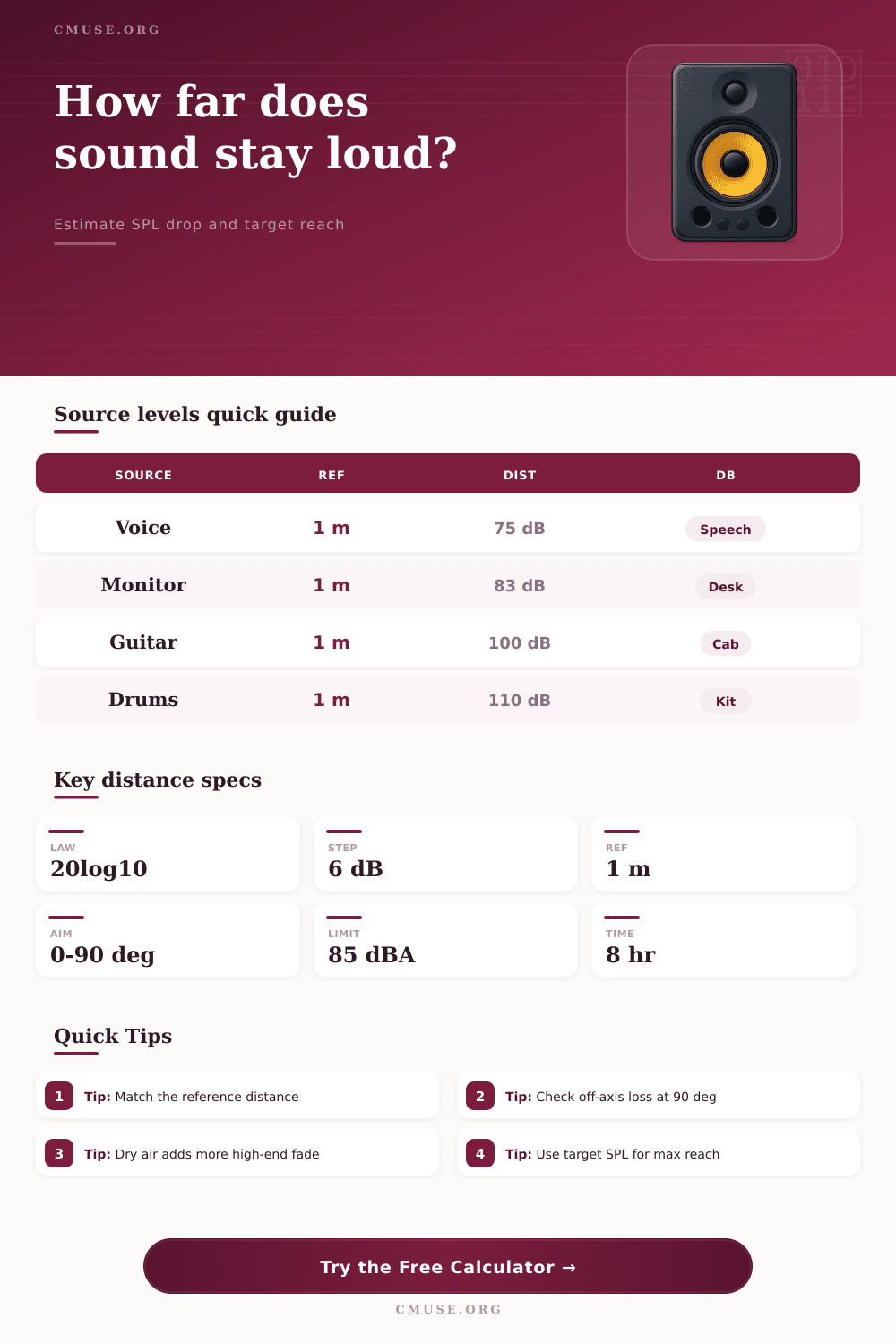
📈Common Source References
| Source | Ref dist | Typical SPL | Context |
|---|---|---|---|
| Speech | 1 m | 60 to 70 dB | Talkback |
| Nearfield monitor | 1 m | 80 to 85 dB | Mix desk |
| Guitar cab | 1 m | 95 to 105 dB | Amp test |
| Drum kit | 1 m | 105 to 115 dB | Live room |
📚Exposure Time Guide
| Level | Limit | Exchange | Note |
|---|---|---|---|
| 85 dBA | 8 h | 3 dB | NIOSH base |
| 88 dBA | 4 h | 3 dB | Half time |
| 91 dBA | 2 h | 3 dB | Fast rise |
| 100 dBA | 15 min | 3 dB | Short stay |
🔬Band Air-Loss Guide
| Band | 10 m | 30 m | Note |
|---|---|---|---|
| 125 Hz | 0.0 dB | 0.0 dB | Bass stays |
| 500 Hz | 0.02 dB | 0.06 dB | Voice body |
| 2 kHz | 0.10 dB | 0.30 dB | Presence |
| 8 kHz | 0.45 dB | 1.35 dB | Top fade |
Sound pressure level follow the inverse square law, which dictate how sound intensity change as the distance between the listener and the sound source changes. If an individual move twice as far from the source of the sound, the sound pressure level will drop six decibels. This drop in sound pressure level are due to the fact that sound spread out in a spherical pattern from a source, meaning that as the distance from the source increases, the sound have to travel over a larger area.
Furthermore, because the drop in sound pressure level is logarithmic, small change in distance can lead to significant changes in sound pressure level. For instance, moving from one meter to two meter from a sound source will result in a six decibel drop in sound pressure level, but moving from two meters to four meters will result in a twelve decibel drop. The environment in which the individual is listen to sound will alter the sound pressure level that the listener perceives.
How Distance, Angle and Rooms Change Sound Level
In a room with concrete walls, for instance, the sound will reflect off to those walls and increase the sound pressure level of the sound, especially of the mid and low range frequency. In a treated sound booth, there are no reflection of the sound, so the sound pressure level will remain the same. In an outdoor environment, however, there are no reflections of the sound that will increase the sound pressure level of the sound.
Additionally, the frequency of the sound will affect the distance that the sound travels in the air; high frequencies travel less effective than low frequencies over distance. Finally, the humidity level of the air will also affect how the high frequencies travels in the air. The sound pressure level of a sound source can be mathematically predict instead of relying upon trial and error method to find the sound pressure level.
Each sound source will have a reference sound pressure level. In addition to that sound pressure level, a distance to the listener, the angle of the sound source, the type of environment in which the sound is to be played, and the humidity level of that environment can be entered into the equation. As a result, the equation can predict the sound pressure level at the listener’s ears, as well as the total attenuation of the sound.
The sound pressure level prediction tool can help to ensure that the individual is aware of the length of time that they can listen to that sound without damaging their hearing; higher sound pressure levels have shorter allowable exposure time according to the rules set by NIOSH. In addition to considering the sound pressure level of sound sources, the angle from which the sound is emitted can be consider when positioning audio equipment. Sound pressure level is higher when the sound is directed at the listener rather than away from the listener.
The off-axis angle of the sound increase the distance that the sound must travel from the source to the listeners ears, and is most pronounced for frequencies above two kilohertz. Thus, for sound equipment like a guitar cabinet, the cabinet will emit more sound pressure at the listener if it isnt turn sideways. In addition to considering the sound sources, the reference distance from which people measure sound pressure levels must also be considered.
Sound is often measured at a distance of one meter from the sound source. However, the technical specifications of many sound equipment is provided at a distance of half a meter. If these distances are not equal, the calculated sound pressure level will not accurate reflect the sound that will be emitted from that equipment.
Therefore, the sound pressure level calculations will be accurate if the measurement distance is the same as the sound specification distance. Additionally, the ambient noise level in the listening area can impact the sound pressure level of the music that is played; high ambient noise level will result in a lower sound pressure level of the music that the listener hears. A variety of different tool can be used to test the sound coverage of a specific area.
Pink noise can be used to measure the average sound pressure level in an environment. Furthermore, music can be used to test the sound coverage. Finally, walking around the area with a sound pressure level meter can help to even sound coverage throughout that area.
By understanding the inverse square law and how distance, angle, and environment can impact sound pressure level, individuals can effective control and manage sound coverage in any given area.