dB Level Calculator
Estimate listener SPL, room lift, and safe headroom from source level, distance, room shape, and absorption.
🎧 Preset Listening Scenarios
🔧 Measurement Setup
📊 Live Spec Grid
📈 Source Reference Table
| Source | Reference | Typical SPL | Use |
|---|---|---|---|
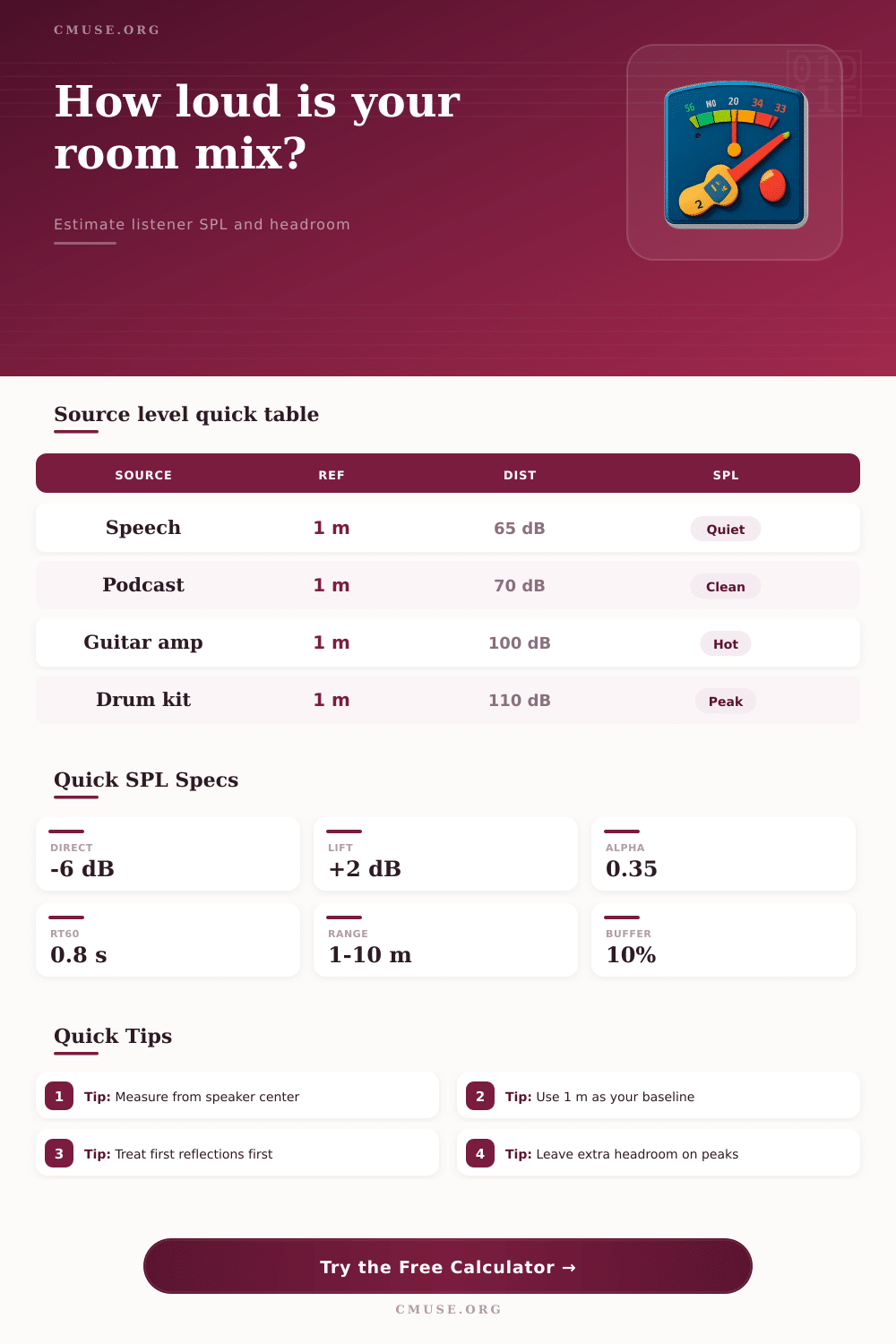
| Speech | 1 m | 60-65 dB | Quiet check |
| Podcast mic | 1 m | 68-75 dB | Clean capture |
| Guitar combo | 1 m | 95-105 dB | Amp test |
| Drum kit | 1 m | 105-115 dB | Peak hit |
📉 Distance Loss Quick Map
| Distance | Loss | Ratio | Note |
|---|---|---|---|
| 1 m | 0 dB | 1.0x | Reference point |
| 2 m | -6 dB | 0.5x | Free-field step |
| 4 m | -12 dB | 0.25x | Quarter level |
| 8 m | -18 dB | 0.125x | Long throw |
🔬 Room Finish Absorption
| Finish | 125 Hz | 1 kHz | 2 kHz |
|---|---|---|---|
| Bare drywall | 0.03 | 0.05 | 0.07 |
| Carpeted room | 0.08 | 0.25 | 0.35 |
| Acoustic panels | 0.25 | 0.75 | 0.82 |
| Treated booth | 0.30 | 0.78 | 0.84 |
📚 SPL Band Guide
| Band | Normal Range | Scene | Comment |
|---|---|---|---|
| 125 Hz | 70-90 dB | Kick body | Room pressure |
| 500 Hz | 65-85 dB | Speech core | Mid clarity |
| 2 kHz | 75-95 dB | Presence | Ear focus |
| 4 kHz | 80-100 dB | Attack | Peak sense |
Sound pressure levels, or SPL, is the measurement of the volume of sound that a person hear within a room. SPL isnt just a measurement of sound within a meter. Rather, it is the physical impact that sound have within a room and upon a listener.
If a person does not manage sound pressure level correctly, they will make incorrect decisions regarding sound playback within a room due to the reflections of sound within that room. Sound pressure level begin at the sound source. Whether it is a guitar amp or vocal microphone, sound will emanate from these points of origin.
Sound Pressure Level in a Room
One often takes the SPL measurement at a specific distance from the sound source, most often one meter from the source. This baseline sound pressure levels is the baseline because it does not take into account any distance from the source or the reflections of sound within the room. If an individual moves away from a sound source within open air, the sound pressure level will drop 6 dB for every doubling of the distance from the source.
This is referred to as an inverse square law, which states that if an individual doubles the distance from a sound source, the intensity of that sound will halve. Within a room, however, sound pressure level may increase due to a phenomenon known as room lift. Room lift occurs when sound waves reflect off of the walls and other surfaces within a room.
This reflected sound can increase the sound pressure level by 2 to 10 dB from the sound that was reflected. The shape of a room will have an impact upon sound pressure level within a room. Rectangular room allow for sound to reflect off of the walls in a predictable manner within the sound studio.
Rectangular rooms are common within sound studios. Additionally, circular rooms will create the least amount of standing waves within a control room. For these reasons, circular control rooms is useful for monitoring sound because all listening positions will experience the same sound quality.
In terms of size of the room, the floor area of a room and the height of the ceiling will determine the total volume of that room. The total volume of the room will determine its reverberation time. Reverberation time, or RT60, is the amount of time it takes for a sound to decay 60 dB within a room.
For mixing applications, reverberation time should be under 0.5 seconds. For those who would like a live room vibe to their mix, however, a longer reverberation time may be desired. The use of materials within the room with high absorption coefficient, or alphas, can manipulate the reverberation time.
The absorption coefficient of a material is how much sound energy the material will absorb. High alpha materials, like treated acoustic panels, will absorb more sound energy than low alpha materials, like drywall. Distance from a sound source will impact SPL within a room.
For instance, if an individual is 2 meters away from a microphone that reads 70 dB at 1 meter, the sound pressure level will be 64 dB at 2 meters. However, if someone measures SPL at 4 meters, the room lift will increase the sound pressure level to compensate for the drop in sound level due to distance. Using two identical sound sources, such as a stereo pair of speakers, will add 3 dB to the SPL of the sound.
Headroom must be managed for sound pressure level measurements. Transients in sound may spike the sound pressure level by 10 to 20 dB above the normal reading for that sound source. SPL should be targeted at 85 dB to allow for headroom to account for these transient spikes in SPL.
Using headroom prevents clipping of amplifiers and ear fatigue. For extended periods of focus upon one task, 75 to 85 dB is the range of safe sound pressure level. For vocal track, however, SPL may be adjusted to lower levels.
The frequency of a sound will impact how a person experiences SPL within the room. Low frequencies, such as 125 Hz, will create a physical pressure upon individuals within a room at certain SPL measurements. SPL at 125 Hz will feel different within the body than SPL at another frequency at the same measurement.
High frequencies, such as 4 kHz, can be piercing to the ears at high SPL measurements. SPL at high frequencies must be managed accordingly within a mix. For monitoring of speech, SPL should be maintained at 75 to 85 dB within the midrange frequencies, such as 500 Hz.
Finally, sound pressure level can be managed through planning. Using presets for certain configuration of sound and SPL will allow engineers to quickly test different scenarios within a project. Engineers can note SPL measurements, such as absorption coefficients and reverberation time, to provide an understanding of how the room will respond to sound.
By understanding SPL within a room, engineers will have an understanding of how to control the reflections from the room. Furthermore, understanding SPL will allow engineers to maintain headroom within their projects. Finally, understanding SPL will ensure that the listening position within the mixing studio is accurate.