dB Addition Calculator
Combine serial gain, independent sources, and coherent audio levels with exact decibel math and practical headroom tracking.
🔊 Preset Mixes
🔧 Addition Controls
Gain chain mode adds dB values directly across each audio stage.
📊 Spec Grid
📖 Summation Reference
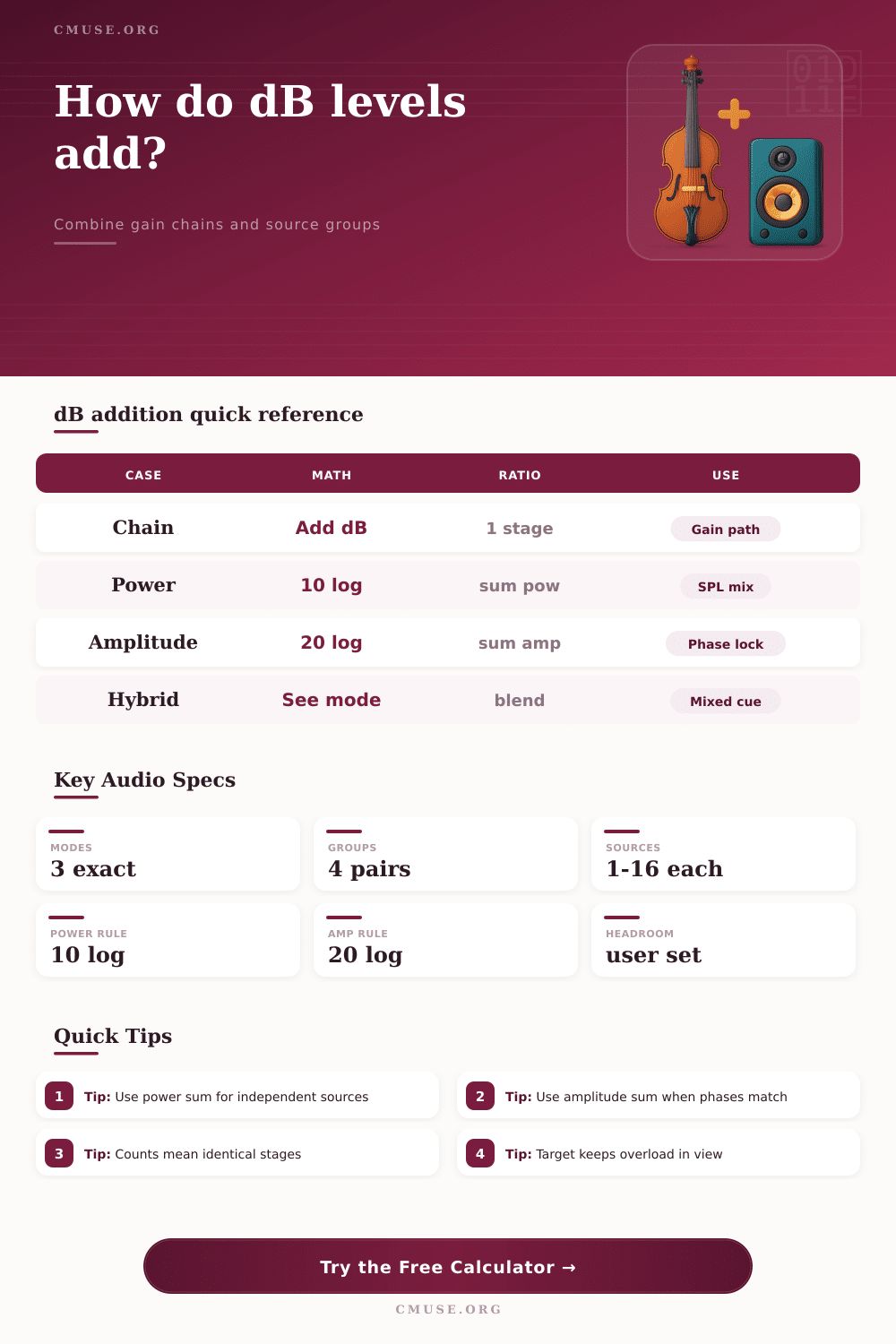
| Mode | Exact formula | Best use | Caution |
|---|---|---|---|
| Gain chain | Sum dB | Serial stages | Counts are repeats |
| Power sum | 10 log10 | Independent SPL | Phases ignored |
| Amplitude sum | 20 log10 | Correlated wave | Phases must match |
| Equal refs | Same base | One scale | Mix scales carefully |
| Target check | Target - total | Headroom view | Negative means over |
| Round step | User set | Display trim | Math stays exact |
📊 Equal Source Boosts
| Identical sources | Power gain | Amplitude gain | Notes |
|---|---|---|---|
| 1 source | 0.00 dB | 0.00 dB | Single path |
| 2 sources | 3.01 dB | 6.02 dB | Doubling |
| 3 sources | 4.77 dB | 9.54 dB | Triad sum |
| 4 sources | 6.02 dB | 12.04 dB | Quad stack |
| 8 sources | 9.03 dB | 18.06 dB | Array cluster |
| 16 sources | 12.04 dB | 24.08 dB | Large rig |
🎧 Audio Path Examples
| Path | Typical dB | Math type | What it means |
|---|---|---|---|
| Mic preamp | +30 to +60 | Chain | Gain into line |
| Channel strip | -3 to +6 | Chain | EQ and trim |
| Mix bus | -6 to +3 | Power | Parallel build |
| Output amp | +0 to +20 | Chain | Final drive |
| Sub cluster | +3 to +9 | Power | Multiple cabinets |
| Delay fill | -9 to -3 | Amplitude | Matched arrival |
📋 Ratio Cheat Sheet
| dB | Power x | Amplitude x | Common cue |
|---|---|---|---|
| -12 | 0.06x | 0.25x | Quiet trim |
| -6 | 0.25x | 0.50x | Half voltage |
| 0 | 1.00x | 1.00x | Unity |
| +3 | 2.00x | 1.41x | Power double |
| +6 | 4.00x | 2.00x | Voltage double |
| +12 | 15.85x | 4.00x | Big lift |
Decibels is used to measure ratio, not absolute values. When adding decibels, it is important to first determine if those decibels are being added in a serial gain chain or if those decibels are being added from an independent sources. The way that decibels adds is dependent upon whether the signal is to be serial or independent.
Serial gain chains are signal that pass through various stages in sequence. For instance, a signal can pass through a microphone preamp, a channel strip, and a bus compressor in that order. In these scenario, the decibel value can simply be added together; this is due to the logarithmic measurement of decibels.
How decibels add in a chain or from separate sources
For instance, if a microphone preamp provide 40 dB of gain, and a channel fader provides 3 dB of gain, the total gain will be 43 dB (40 dB + 3 dB). These values can be added together because the signal passes through each gain stage in sequence. In contrast, independent sources of signal behave differently than signals that pass through a serial gain chain.
For instance, two microphones placed next to a drum kit are independent source. In these scenarios, the decibel value cannot be simply added together. Each gain value must be converted into a linear measurement of power, those power values can be added together, and the total power can be converted back into decibels.
For instance, two independent source of identical sound at 0 dB will output to 3 dB total, not 6 dB. This is due to the fact that if the power of a signal is doubled, the logarithmic power will increase by 3 dB. However, there is one more type of decibel addition that occur with coherent waves.
Coherent waves are waves that are in perfect phase with one another, such as signal that are perfectly time-aligned with one another. For these types of signal, the addition of the two signals will result in a different mathematical calculation; if the voltage of a signal is doubled, the power will increase by 6 dB. However, if the waves are not in perfect phase with one another, they are not coherent, and signals may cancel each other out.
Phase cancellation happen when the waves do not align, thus reducing the total volume of the signal. Many people make mistake with calculating decibel addition because they treat all the sound source as if they are coherent. The chorus microphones or the synthesizers might sound good together when played back in isolation, but they can end up being incoherent in there sound.
Because the power summing method is more conservative with its measurement of sound level, sound engineers use power summing for live sound mixing rig to avoid the mistake caused by sound phase issue. People also often forget to consider which source contribute the most to the sound mix. For example, one preamp might be much louder than four channels with half the volume.
In this instance, the engineer must track the average volume of each sound track to ensure the total sound level does not reach the limits for that recording device. Using safety margin for the decibel levels can prevent audio clipping of digital audio device. Digital audio device have a ceiling of 0 dBFS.
By subtracting a guard margin of decibels, such as 3 dB, engineers have headroom within which to work with sound level without clipping the signal. Headroom within digital audio device allows engineers to stay within safe limit for sound level and to avoid digital clipping of audio signal. Additionally, sound engineers use reference scale of decibels, such as dBu or dBSPL, to ensure that all sound level are correctly compared with one another.
The human ear and hearing perceives change in decibel differently from digital audio device. A change of 3 dB in sound level is noticeable to the human ear, but a change of 10 dB is perceived as a doubling of loudness. These difference in sound level perception allow engineers to set sound mix level according to how the human ear will perceive them.
However, the environment in which the sound is played back can also affect how humans hear sound level in decibels. For example, in a theater, it is more important that the sound is evenly distributed throughout the room than having a high decibel level. Using too many speaker in close proximity to one another can create comb filtering in the sound field, which will interfere with sound clarity.
Understanding how decibel addition work allows engineers to successfully perform many sound mixing task. For example, sound engineers use decibel addition to determine if the vocal chain will clip the master bus or if the subwoofer array will exceed the safe limit of sound level. If sound engineers understand these mode of addition and respect the number of individual source of sound within a mixing device, they can gain better control over their sound mixing task.