dB to SPL Calculator
Estimate loudness from speaker sensitivity, amplifier power, distance, and room effects with quick presets and clear SPL math.
🔊 Real Listening Presets
🔧 SPL Inputs
💻 Formula Specs
📊 Sensitivity Benchmarks
| Source type | Sensitivity | Typical power | Use case |
|---|---|---|---|
| Desktop nearfield pair | 84 to 87 dB | 25 to 75 W | Short desk run |
| Bookshelf stereo | 86 to 90 dB | 50 to 120 W | Living room |
| Stage monitor wedge | 95 to 100 dB | 200 to 600 W | Rehearsal foldback |
| PA top cabinet | 97 to 103 dB | 300 to 1200 W | Front of house |
📢 Distance Loss Chart
| Distance | Free-field loss | Relative SPL | Note |
|---|---|---|---|
| 1 m | 0 dB | Baseline | Reference point |
| 2 m | 6 dB | -6 dB | Double distance |
| 4 m | 12 dB | -12 dB | Another double |
| 8 m | 18 dB | -18 dB | Far throw |
📋 SPL Reference Scenes
| Scene | Average SPL | Peak SPL | Headroom |
|---|---|---|---|
| Quiet room | 35 to 45 dB | 50 dB | Very high |
| Conversation | 60 to 65 dB | 75 dB | High |
| Rehearsal room | 90 to 100 dB | 110 dB | Moderate |
| Club floor | 95 to 105 dB | 115 dB | Limited |
🔬 Power Planning Examples
| Sensitivity | Distance | Target SPL | Needed W |
|---|---|---|---|
| 86 dB | 1 m | 96 dB | 10 W |
| 89 dB | 3 m | 95 dB | 40 W |
| 95 dB | 4 m | 100 dB | 32 W |
| 98 dB | 6 m | 103 dB | 32 W |
Sound pressure levels (SPL) is a measurement of how loud a sound is at a specific position in a space and is measured in decibels (dB). While many people looks at the wattage a speaker can produce when purchasing speakers, that is not the same than sound pressure level. Wattage measure the power that an amplifier provide to a speaker, while sound pressure level measures how loud the sound that the speaker plays is.
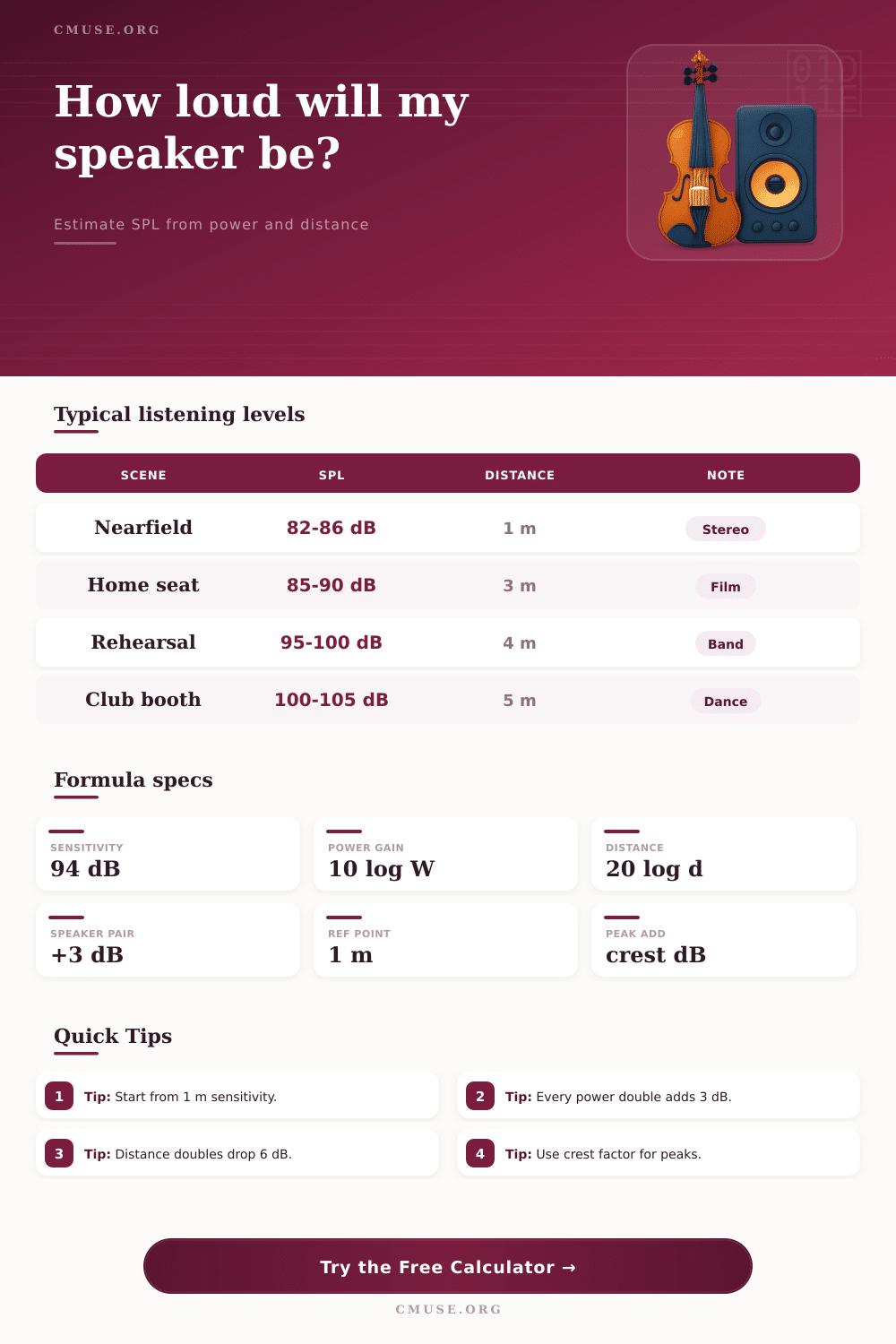
In order to understand the loudness of the speaker that will be used in a specific environment, it is necessary to understand SPL. One of the components of sound pressure level is the sensitivity of the speaker. The sensitivity of a speaker is the decibel level that one watt of power produces at a distance of one meter from the speaker.
Sound Pressure Level and How It Affects Loudness
A speaker with high sensitivity will produce loud sound with less electrical power. For example, a professional PA system may have a sensitivity of 98 dB, while a desktop speaker may have a sensitivity of 85 dB. Those who desires to understand the SPL of that speaker should know the sensitivity of a speaker.
A speaker with high sensitivity will reach high SPL measurement more easily than a speaker with low sensitivity. Another component of sound pressure level is the effect that distance have on SPL. SPL diminishes at greater distances from the speaker.
The inverse square law can be used to explain how SPL decrease with distance. The inverse square law states that if an object is moved twice as far from the source of the SPL measurements, the SPL will drop by 6 dB. For instance, if an object is moved from one meter to two meters away from a speaker, the SPL will drop by 6 dB.
Additionally, if SPL measurements are taken within a room, sound reflecting off of room boundaries will increase the SPL of the sound. If the sound is reflecting off of walls, for instance, the SPL will increase by approximately 3 dB when placed near a corner of the room. Other objects in the room, however, will absorb some of the SPL of the sound; absorption of sound will result in a drop in the SPL of the sound in the room.
Other factors that will affect sound pressure level are the power of the speaker and the number of speakers that are used. If the electrical power that is provided to a speaker increase, its SPL will increase, as well. The increase in SPL, however, will be 3 dB if the electrical power is doubled.
If twice as many speakers are used in a space as there are at the placement of the listener, the SPL will increase by 3 dB because there is more sound output from the speakers. Another factor to consider is the crest factor of the speakers. The crest factor is the difference between the average SPL and the peak SPL of music.
Music has a high crest factor so the peak SPL of music is much more higher than its average SPL. There are also mathematical tools that can be used to calculate the wattage of speakers that are required to achieve a certain SPL in an environment. By inputting factors like the sensitivity of the speakers, the distance that the SPL will be measured, and the amount of power that will be provided to the speakers, it is possible to calculate the SPL that will be created in a space.
Additionally, by inputting the SPL that is targeted for a specific area, it is possible to calculate the wattage of the speakers that are required to achieve that SPL. Using this mathematical calculation will help to prevent the purchase of speakers and amplifiers that dont have enough power to effectively fill the area with sound. Another variable that may affect SPL in a specific space is the environment in which the speakers will be used.
For instance, outdoor environment will not have the same SPL measurements as indoor environments because there will be no walls to reflect the sound; there will be no sound gain in outdoor environments. Indoor environments, however, will have sound reflected off of walls and floors, which will increase the SPL of the sound that the speakers play. These variables should be accounted for when determining how sound will behave in the environment.
Other objects in the area that may reflect SPL, like thick curtain or other individuals in the area will absorb some of the high frequencies of the sound, reducing its SPL. Finally, sound pressure level measurements can be used to plan the use of speakers in an area. For example, pink noise can be played to measure SPL at various point in a space.
Additionally, music can be played to measure the SPL created by the peaks of the music. By taking advantage of the properties of sound pressure levels, it is possible to plan the amount of power that will be provided to each speaker and the placement of the speakers so that SPL creates the desired loudness without damaging the speakers or causing fatigue in the listeners. By understanding sound pressure level and how it relates to the properties of sound, it is possible to transform the specifications of speakers into loudness that will fill an area as desired.