Key Modulation Calculator
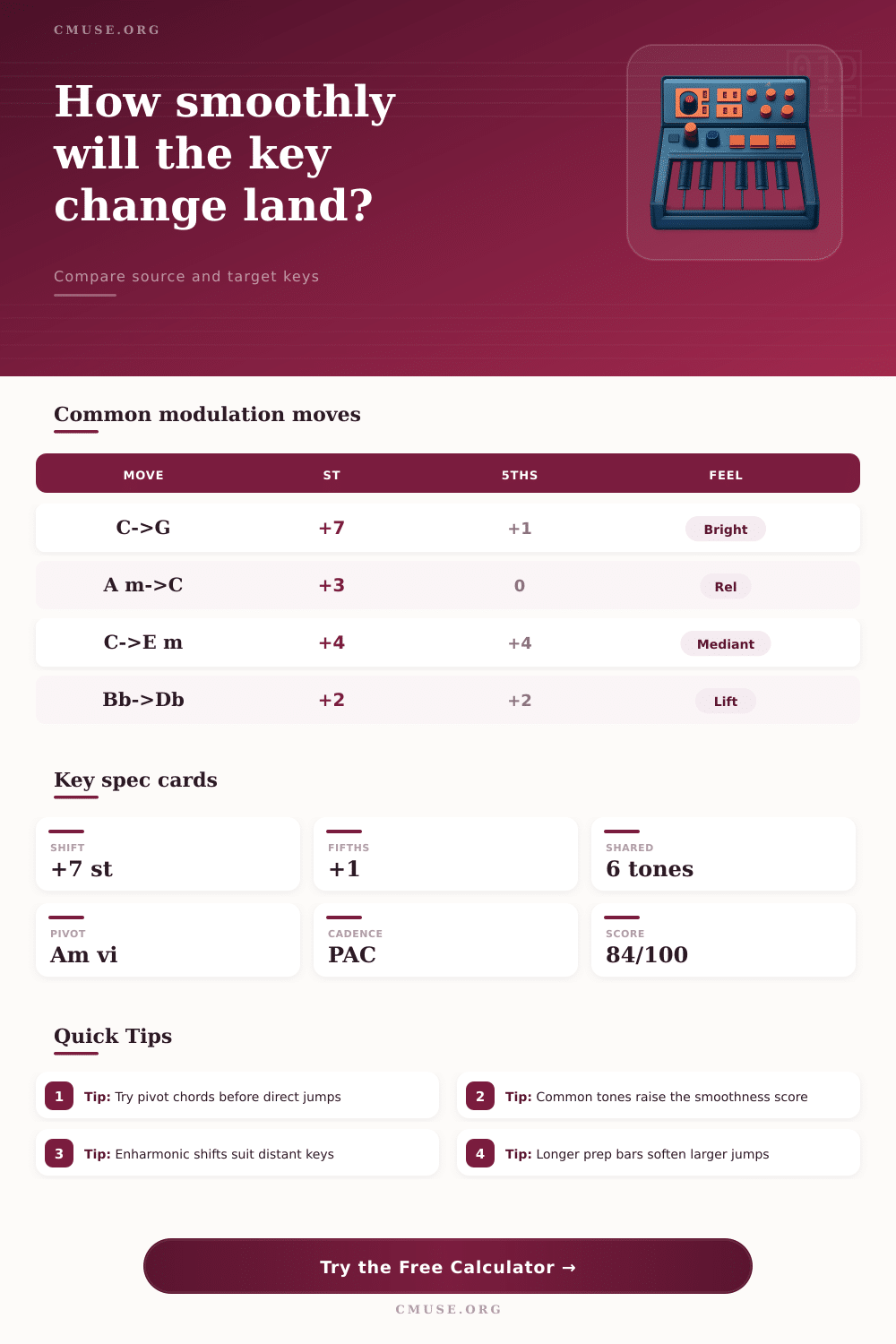
Compare tonic distance, shared tones, cadence choice, and pivot chords to judge how cleanly a song can move between keys.
🎵 Modulation Presets
📊 Key Modulation Inputs
📈 Modulation Spec Grid
📖 Reference Tables
| Link | Semitones | 5ths | Best when |
|---|---|---|---|
| Relative | +3 / +9 | 0 | Shared sig |
| Parallel | 0 | 0 | Same tonic |
| Dominant | +7 | +1 | Bright lift |
| Subdominant | +5 | -1 | Soft turn |
| Family | Source role | Target role | Example |
|---|---|---|---|
| Predominant | ii / IV | iv / ii | Dm to G |
| Dominant | V / vii | V / I | G to C |
| Relative | vi / i | i / VI | Am to C |
| Borrowed | bVI / iv | bIII / bVII | F to Bb |
| Cadence | Arrival | Energy | Use |
|---|---|---|---|
| Authentic | V-I | Firm | Clear landing |
| Plagal | IV-I | Warm | Gentle release |
| Half | V stop | Open | Suspended end |
| Deceptive | V-vi | Surprise | Flip the ear |
| Source | Target | Delta | Shared |
|---|---|---|---|
| C major | G major | +1 | 6 |
| A minor | C major | 0 | 7 |
| D major | Bb major | -5 | 4 |
| Eb major | C minor | +0 | 6 |
💡 Practical Notes
Key modulation are the process of change the key of a piece of music. Key modulation are used to provide a sense of freshness to the song or to create a sense of emotional change within the song. Key modulation can be used within a bridge to move a song from verse to a chorus.
However, using the wrong type of key modulation can lead to a jarringly musical experience for the listener. Key modulation is a structural element that allow the composer to move from one tonal center to another tonal center within the song. The smoothness of a musical key modulation depend on the distance between the old and new keys and the amount of overlapping notes between the two keys.
How to Change Key Smoothly in a Song
If the new key share many musical note with the old key, the key modulation will be smooth. For instance, modulating from C major to G major shares six out of seven musical notes of the scale. However, modulating from C major to Db major will be more difficult due to the smaller number of shared musical notes between the two keys.
There are several methods to make key modulation more easier to follow for the listener. One method is to use pivot chords. Pivot chords are chords that act as different chords in two different keys.
Including pivot chords allow the song to modulate to a different key without jumping from one key to another. Another technique is to use cadences to conclude a key modulation. Using a V-I cadence indicate a strong ending to a key modulation.
In contrast, using a IV-I cadence indicate a gentler way to end a key modulation. Furthermore, the composer can use preparation bars to give the listener time to adjust to the pivot chord that will be use within a key modulation. Many songwriters use their intuition to determine the best type of key modulation.
However, intuition is less reliable under high pressure or when mixing different musical genre. Many songwriters make mistake with key modulation. For instance, they may not properly consider the impact of harmonic rhythm or make too many changes to keys within a musical measure.
Making too many changes to the key within a musical measure can make it difficult for the listener to follow the songs key modulation. Additionally, the tempo and vocal range for a song should be consider when making a key modulation. Songs with a faster tempo can accommodate a boldly key modulation more than songs with a slow tempo.
Additionally, key modulations that move the song up a fourth makes it easier for singers to reach high note. In contrast, key modulations that move the song down a third can reduce vocal fatigue. The key modulation planning tool calculates the intersections of scales between two keys.
The tool indicate how many notes share similarities between the two keys and gives a smoothness score to the key modulation that allow the songwriter to identify if the key modulation is potentially risky. The songwriter can use the tool to determine the smoothest pivot chord for the songs key modulation. Furthermore, using the reference tables allow a songwriter to find relationships between keys.
For instance, dominant chords are used for key modulations that lift a song up in pitch. Borrowed chords are use for surprise key modulations. Finally, using a digital audio workstation to test the key modulation and singing the songs melody after the key modulation will allow the songwriter to ensure that the key modulation sound good to there ear.