Circle of Fifths Calculator
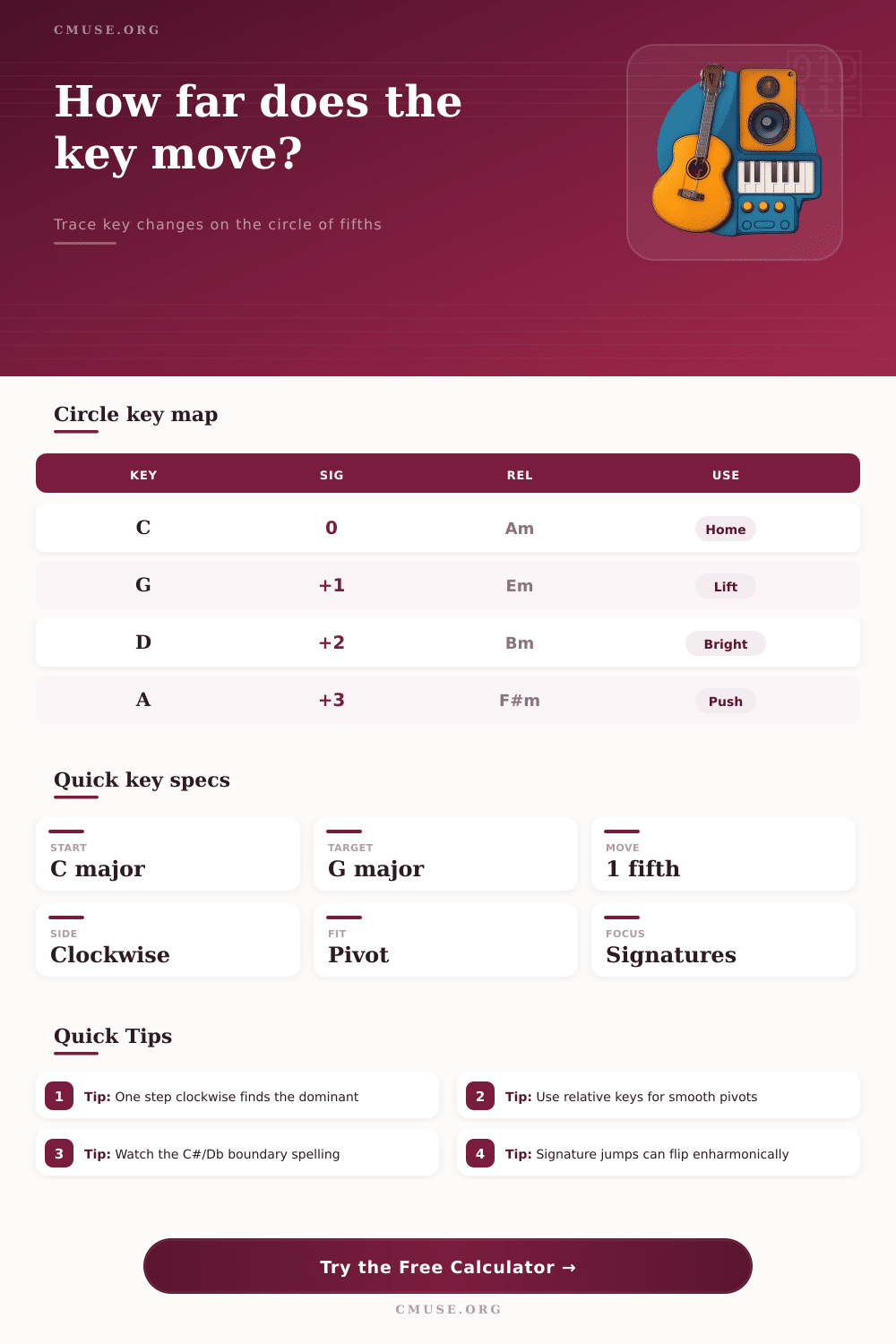
Trace key changes, compare relative partners, and test how far a modulation travels around the circle.
🎶 Preset Key Moves
📊 Circle Inputs
Choose the starting key, the target key, and the route style. The calculator compares your direct fifth move against the target relationship and scores the fit.
📋 Key Spec Grid
📖 Reference Tables
| Major key | Signature | Relative minor | Dominant | Subdominant |
|---|
| Minor key | Signature | Relative major | Dominant | Subdominant |
|---|
| Boundary | Alias | Spelling note | Best use |
|---|
| Route | When to use | Key cue | Landing feel |
|---|
The circle of fifths are a tool that help to map out the changes in musical key. The circle of fifths help a person to understand how the different musical keys relates to one another. The circle of fifths maps out the musical keys according to there key signatures.
The circle of fifths allow a person to navigate between the different keys within a song. The circle of fifths can be used to move from one key to another key within a song; however, a person must choose a direction for the movement between the keys. The circle of fifths has sharp added to the keys if a person move in a clockwise direction around the circle of fifths.
How the Circle of Fifths Helps Change Keys
This movement towards the keys with more sharp creates a brighter sound in the music. Clockwise movement move a person towards the dominant key within the song. The dominant key create a sense of tension within the song.
If a person move in a counterclockwise direction on the circle of fifths, flat are added to the musical keys. Additionally, the movement in this direction take a person towards the subdominant key. Keys in this category often sound warm to the listeners.
A person can move around the circle of fifths to reach the twelve step of musical keys. However, a person should of stay within three or four steps on the circle of fifths to ensure that the transition between keys within a song are smooth for the listener. A relative key is a key that has the same key signature as another musical key.
These two key do not require any sharp or flat to be added to the musical score to represent the key signatures of those keys. For example, the key of C major and the key of A minor has the same key signature. They can be used together to allow for a song to change from a major mode to a minor mode and vice versa.
A songwriter may use relative key to change the mood of the song, but the transition between the two keys will be seamless for the listener. Enharmonic keys has the same sound as each other but they is written differently within the musical score. For example, C# major and Db major are enharmonic keys to each other.
Each of these keys has the same note, but they are spelled differently. Additionally, if a person move across the F# to Gb line on the circle of fifths, the number of sharp changes to the number of flat for those keys. Therefore, a person must be careful when writing music for these keys.
For songwriters who wish to change keys in their song, there are some preset path that they can follow to ensure that they avoid guesswork when choosing the new key for their song. One of these path is known as the home lift. A home lift take a song from one key to the dominant key to the song.
Songwriters often use the home lift to create a feeling of increasing energy within a song. Another of these path is known as the brass pull. A brass pull take a song from its current key to the subdominant key in the song.
This path is used to thicken the sound of a song. These path can be calculated with a musical calculating tool. This tool will calculate a fit score for each path.
A high fit score indicate that the path of a song from one key to another is logically sound. A songwriter may make some mistake when using the circle of fifths. For instance, a person may ignore the tension create by certain musical jump on the circle of fifths.
A jump of six step on the circle of fifths create the most tension in a song. Such a jump, called a tritone jump, may be too dramatic for certain type of musical compositions. Additionally, the distance between keys matter for songwriters.
A distance of one or two step between keys is consider natural for songwriters and listeners. A distance of five step between keys may create a strain on the listeners ears. Reference table can be found in many songwriting and music theory text.
These table list the relative key, the dominant key, and the subdominant key for each musical key. These table allow a person to quickly reference the different musical keys and their relationship to each other. There are separate table for major keys and their relative key and flat.
Additionally, there are separate table for the minor keys and their relative key and flat. These table can be used to determine the number of sharp and flat in each key. These table can be used to plan the songs key change.
The circle of fifths is a map of the musical keys. The circle of fifths allow a person to decide how to move between the keys. A person can choose the direction of the song on the circle of fifths.
Additionally, a person can choose the path that the song take from one key to another using the preset path on the circle of fifths. The circle of fifths can also be used as a tool to guide a songwriter in the completion of their song.