Solfege Calculator
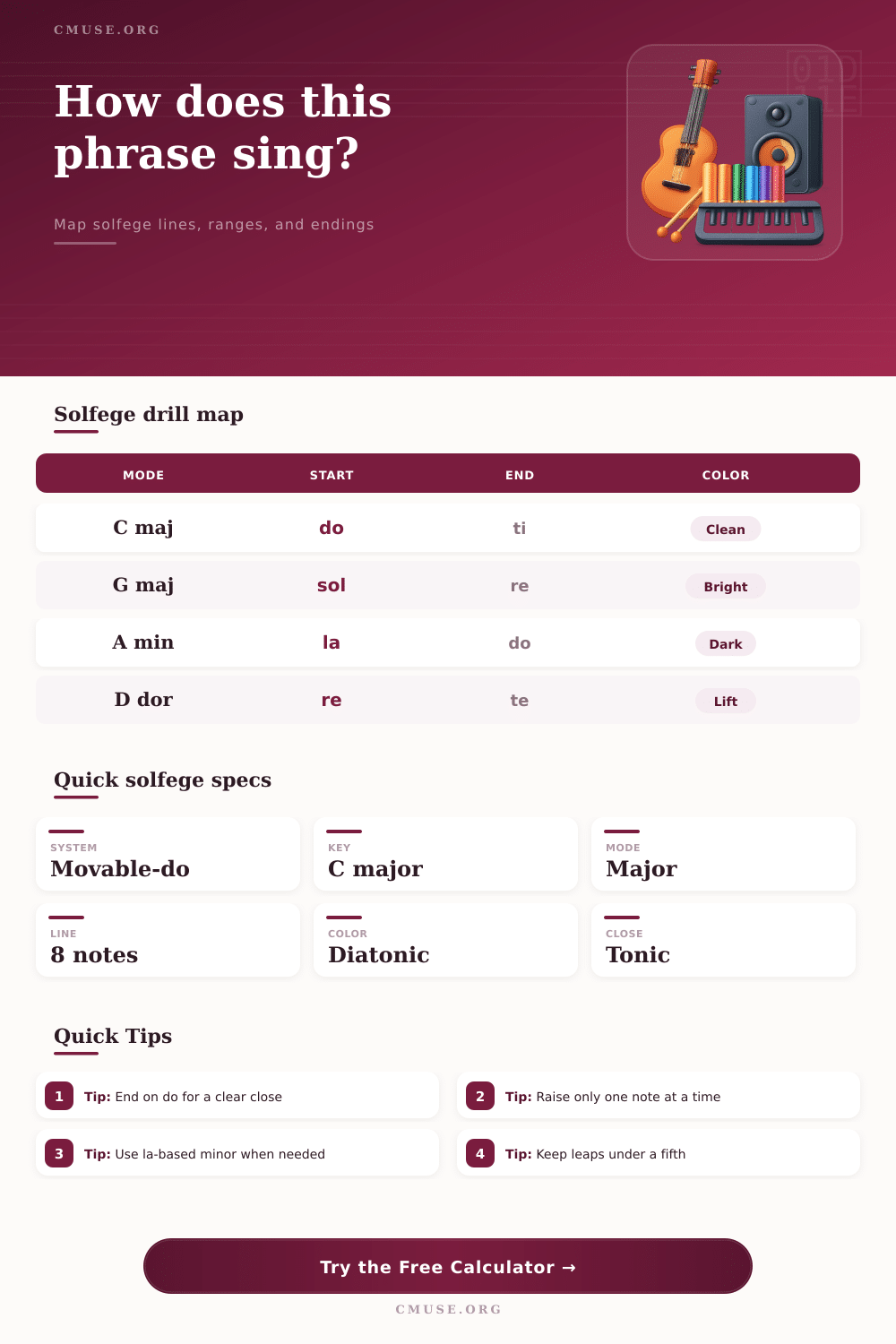
Build movable-do, fixed-do, or numbered drills and see how each phrase lands across the key.
🎵 Preset Singing Lines
📊 Drill Inputs
Movable-do follows the selected mode. Fixed-do shows pitch names beside each syllable, while numbered reading keeps the scale steps visible.
📋 Solfege Spec Grid
📖 Reference Tables
| Mode | 1-3-5 | 7th | Close |
|---|
| Pitch | Sharp-side | Flat-side | Use |
|---|
| Contour | Shape | Best for | Landing |
|---|
| Drill | Cells | System | Use |
|---|
Solfege is the use of syllables to represent musical notes. When people try to sing along to a song, they often have trouble finding the right pitch for there voice. The reason that people may struggle with finding the right pitch in they head for the song that they are trying to sing is that their ear isnt tuned in to the pitch of the musical key in the center of the song.
A solfege calculator can help people to find the proper drill for their voice to allow there ear to tune into the proper pitch for their song. Guido d’Arezzo has used solfege since the 11th century, who used the syllables from a hymn to name each scale step. Musicians often use the notes do, re, mi, and so on to represent each musical note.
Use Solfege to Find the Right Pitch and Train Your Ear
There are various system for solfege that can train a person’s ear in different ways. The movable-do system allows the syllable do to change to the tonic of the note being used, such as do being used for the C note within the key of C major, but being the D note within the key of D major. The fixed-do system, in contrast, hold the do note to the pitch of the middle C note, regardless of the key being used.
The fixed-do system is often used in languages such as French and Italian. The system that use numbers to represent each scale note, such as 1-2-3-5, is often used for focusing on the interval work between each musical note, as the system ignores the vowels in the solfege system. A person can use the solfege system to shape the musical phrase that they form by determining on which musical degree the musical phrase will start and on which degree it will end.
For instance, musical phrases that begin on the fifth degree of the musical scale, or the dominant note, and end on the tonic will allow the singer to learn more about the relationship between these two notes. The singer can also shape the contour of a phrase; stepwise melodies are often used for creating connections between each neighboring musical note. Arches and waves can also be incorporated into a musical phrase to provide some lift to the melody.
Chromatic touches can be used to introduce some color to the melody. Melodies that end on the do note tend to create a feeling of stability in the listener, as the physics of the octave create stability in the root note of a musical scale. Many drills often fail for singers because they do not pay attention to their vocal register.
If people sing all of their musical drills in the same octave range with their voice, they may bore their ears and strain their vocal cord. If people lift their drills by an octave, however, they can easily expand their vocal span. Furthermore, lifting a musical phrase by an octave allow singers to practice singing both high and low notes within their vocal range.
The contour of the musical phrase should match with the vocal sweet spot of the singer. Tenors can use leaps to gain more brightness in their singing, for example. Pedal notes, in contrast, singers can use in the alto range to better remain in tune with other singers in their musical phrase.
Chromatic notes should not be used excessively when learning musical phrases; diatonic notes should be learned first, and chromatic notes second. Furthermore, only raise a musical note if it is necessary for the life of the musical phrase; use of the “ti” note within the major scale, for instance, is one such example where the note should be raised. Fixed-do solfege systems can be useful in different situations than other solfege systems.
For instance, the system that holds do to the pitch of the middle C note, or the fixed-do system, is useful in scenarios that require transposition of musical scale; the pitches will remain absolute within this system, and the system is of special use in keys like Bb major, which is often used for brass instruments. Choir singers often use movable-do solfege systems in warmups, for example, as this system will allow all singer to lock into the same tonic for their musical phrase, regardless of the key of that musical phrase. Numbered solfege systems are of use for those who wish to improve their skill in sight-singing, as these systems focus upon the scale steps in a musical phrase, rather than the vowels.
Each of the solfege systems may be of use to a singer according to their goal for improving their singing abilities. Additionally, the mode in which the music is sung will have an influence upon the singer’s solfege system choices. For instance, the Dorian mode has a flat seventh scale degree, while the modes that are harmonic minor have a raised seventh note for that scale.
Each of these musical setups will provide a quantitative measure of the singer of that musical phrase. High scores on a musical resolution system indicate smoothness in the singer’s voice leading; their musical phrases have few leaps between musical notes, and their voices tend to have a strong pull towards the tonic note. Incorporating musical phrases that include wide span of pitches will challenge a singer’s vocal range.
Using altered musical notes may provide interest in the singer in their musical phrase, but it may also result in a more lowered score on musical resolution charts. Reference tables provide additional information on each of these concept. For instance, the “ti” in a major scale can resolve to the “do” note in that musical scale; the “di” scale note in the fixed-do system represents a tense second scale note.
Furthermore, reference tables can remind the singer that arches are used in musical phrases to provide lift to certain notes in the phrase, and that pedal notes are used to lock the vocalist to the musical center of that musical phrase. When training with the solfege system, a singer should always train their ear to the note “do” first. Musicians should hum the tonic of the musical phrase in their head, and then sing the musical line.
Humming the tonic allows the singer’s ear to lock into the correct pitch in there head. Groups of singers often make the mistake of rushing to the musical contour of their phrase without first establishing a consensus regarding the mode of the musical phrase; this mistake can lead to the singing of unclear musical minor scale. Singers practicing on their own can focus upon mastering the musical waves in their musical phrases.
Additionally, musical phrases should be limited to 12 musical notes in length; singers cannot sustain musical phrases of greater length. For example, if a musician is learning a musical phrase in a minor key, it can start on the “la” note of that scale to create a darker musical mood, but lifting the musical phrase to the “do” note can create a sense of release from those musical tensions. It could of been more effective if they practiced more.