Inversion Calculator
Spell chord inversions, slash symbols, bass notes, and voicings for triads and seventh chords.
🎵 Quick Presets
📊 Calculator Inputs
📈 Chord Family Spec Grid
📑 Formula Reference Tables
| Family | Degrees | Intervals | Inversions |
|---|---|---|---|
| Major triad | 1-3-5 | 0,4,7 | 2 |
| Minor triad | 1-b3-5 | 0,3,7 | 2 |
| Diminished triad | 1-b3-b5 | 0,3,6 | 2 |
| Augmented triad | 1-3-#5 | 0,4,8 | 2 |
| Dominant seventh | 1-3-5-b7 | 0,4,7,10 | 3 |
| Major seventh | 1-3-5-7 | 0,4,7,11 | 3 |
| Minor seventh | 1-b3-5-b7 | 0,3,7,10 | 3 |
| Half-diminished 7 | 1-b3-b5-b7 | 0,3,6,10 | 3 |
| Diminished seventh | 1-b3-b5-bb7 | 0,3,6,9 | 3 |
| Position | Triad Bass | Seventh Bass | Slash Form |
|---|---|---|---|
| Root position | Root | Root | No slash |
| First inversion | Third | Third | Root/3rd |
| Second inversion | Fifth | Fifth | Root/5th |
| Third inversion | N/A | Seventh | Root/7th |
| Style | Move | Span | Texture |
|---|---|---|---|
| Closed | None | Tight | Compact stack |
| Open | Lift inner notes | Wider | Airy spacing |
| Drop-2 | Lower 2nd highest | Wider | Common jazz shell |
| Drop-3 | Lower 3rd highest | Widest | Broad voicing |
| Example | Bass | Notes | Use |
|---|---|---|---|
| C/E | E | C-E-G | Tonic lift |
| G/B | B | G-B-D | Leading bass |
| Dm/F | F | D-F-A | Subdominant color |
| G7/F | F | G-B-D-F | Third inversion |
| Cmaj7/E | E | C-E-G-B | Lush first inv |
| Fmaj7/C | C | F-A-C-E | Soft second inv |
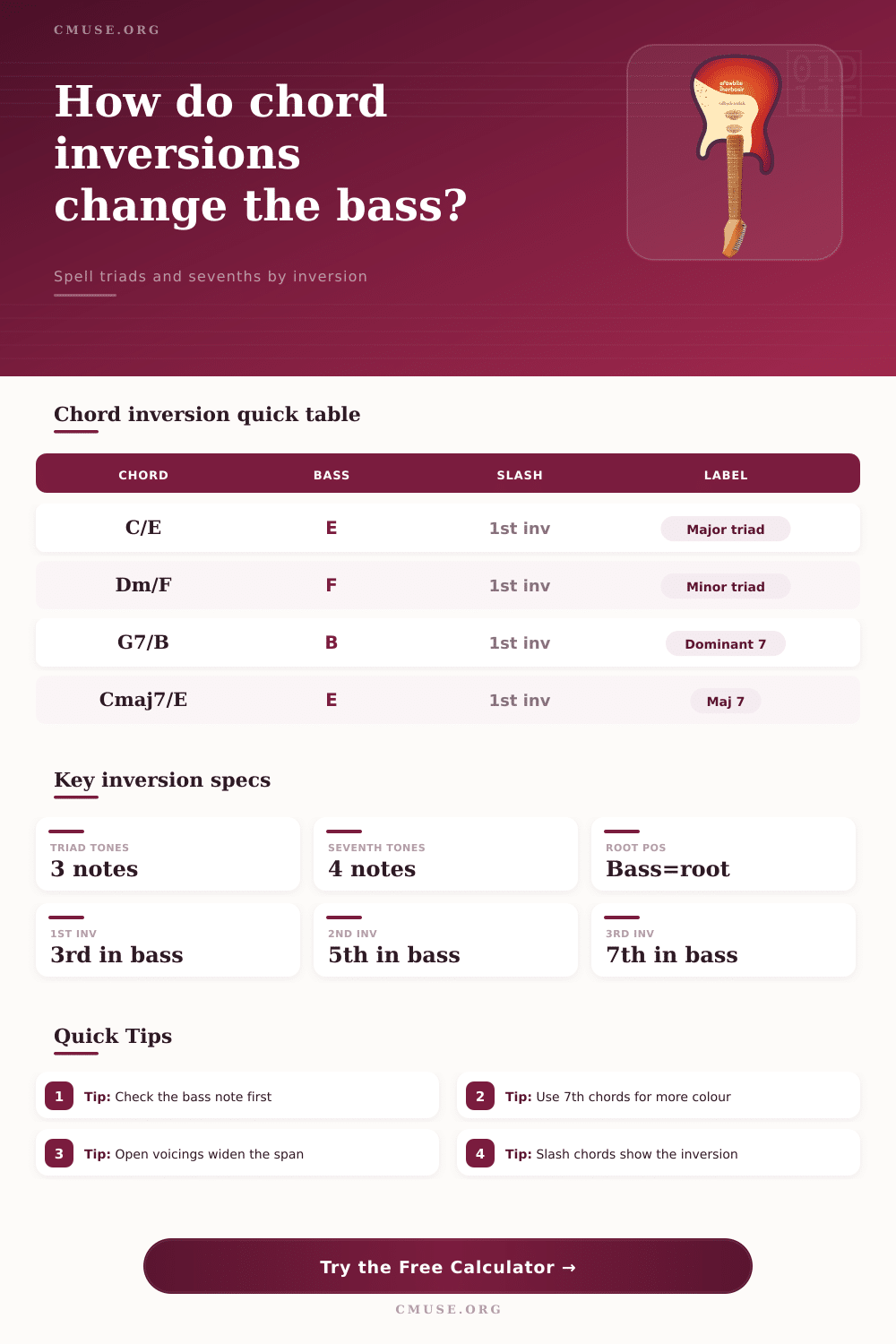
Chord inversions is used to change the lowest note of a chord to a different note within the chord besides the root note of that chord. Chord inversions change the bass note of a chord, and changing the bass note create movement in the music created by those chords. Chord inversions allow musicians to create smooth voice leading in there musical compositions because the inversions allow for the notes within a chord to move in small step rather than jumps to other notes.
A standard major chord contain three notes: the root note, the major third note, and the perfect fifth note. If the major third are the lowest note in the chord, it is referred to as a first inversion chord. If the perfect fifth is the lowest note in the chord, it is referred to as a second inversion chord.
What Are Chord Inversions and How They Work
Finally, if the root is the lowest note in the chord, it is referred to as root position chord. Seventh chords contains four notes and, therefore, have up to three inversions. In a third inversion chord, the flat seventh is the lowest note in the chord.
Root position chords tend to feel grounded when played, but chord inversions produce movement within the music that is create. Voicing refer to the arrangement of the notes in a chord. Closed position voicing involve the chord notes being close together, while open position voicing involve spreading the chord notes out.
Drop-two voicing refers to lowering the second highest note of a chord by one octave and is often used in jazz music. Finally, doubling a note in a chord, such as the root or third note of a chord, create the chord with less variation in its chord tones. Slash chords are used as a shorthand notation to represent chord inversions.
A slash chord indicate the chord to be played followed by a slash and the note that should be the lowest note in that chord. For example, a C/E chord indicate that a C major chord is to be played with an E in the bass. The placement of the E in the bass indicate that the chord is in first inversion.
Using slash chords in music allow musicians to communicate with bass players and guitarists. It allows the musicians to understand which note should be the lowest note in the chord. For instance, root position indicate that the root note is used in the chord, first inversion indicate that the third is used in the chord, second inversion indicate that the fifth is used in the chord, and third inversion indicate that the seventh is used in the chord.
Chord inversions are often used to allow for smooth transitions from one chord to the next. For example, playing a G7 chord with B in the bass will lead smoothly into a C chord. Playing a Dm chord with F in the bass will lead smoothly into a G7 chord.
However, care must be taken to ensure that the span of the chord does not become too narrow. A span between the lowest and highest notes of a chord should not be less than twelve to sixteen semitones to ensure that the chord sounds clear and accessible to the listeners. There are different ways to play chords with voicing style that offer a certain musical texture but allow the musicians to play the chord more easily.
For example, closed voicing works best for solo piano musicians. Open voicing works best for big bands so that the horn players can play around the chord. Drop-two voicing is often used for jazz music to allow the chord to have a classic sound without sounding cluttered to the listeners.
However, the musician must have control over the target span of the chord, especially when playing music for an ensemble of instrument. In identifying inversions for chords, the musician must identify the lowest tone of the chord to determine the inversion. For instance, a root position chord will always use the root note of the chord in the bass.
A first inversion chord will always use the third of the chord in the bass; many musicians make mistake here because they do not identify the third note of the chord as the note in the bass for a first inversion chord. Seventh chords only have three inversions in the chord, as there is no such thing as a fourth inversion of a seventh chord. Using the chord inversion formula allow musicians to create musical progression that use the chords to move smoothly from one note of the chord to the next.