Prime Form Music Theory Calculator
Reduce pitch-class sets, compare inversion candidates, and read normal order plus interval vectors in one fast analysis view.
🎵 Real Presets
📝 Calculator Inputs
Enter pitch classes like 0, 3, 7 or note names like C, Eb, G. The calculator collapses duplicates, compares the inversion, and chooses the tightest normal order.
| Candidate | Packed order | Transposed prime | Span | Decision note |
|---|---|---|---|---|
| Original | -- | -- | -- | Waiting for input |
| Inversion | -- | -- | -- | Waiting for input |
📊 Analysis Spec Grid
📖 Reference Tables
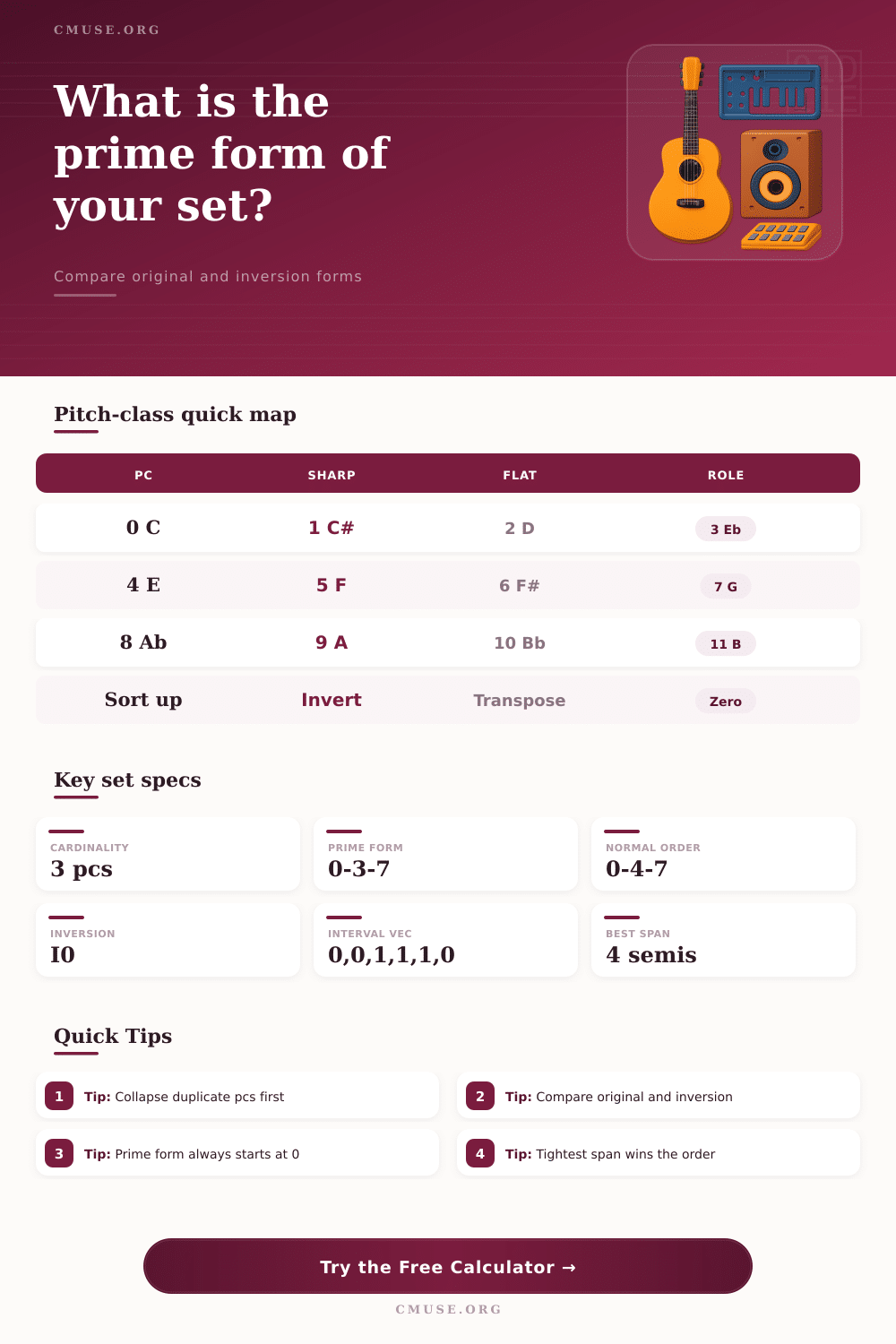
| Pitch class | Sharp name | Flat name | Common role |
|---|---|---|---|
| 0 | C | C | Tonic anchor |
| 1 | C# | Db | Chromatic upper neighbor |
| 2 | D | D | Whole-step rise |
| 3 | D# | Eb | Minor third color |
| 4 | E | E | Major third color |
| 5 | F | F | Perfect fourth |
| 6 | F# | Gb | Tritone core |
| 7 | G | G | Perfect fifth |
| 8 | G# | Ab | Minor sixth color |
| 9 | A | A | Major sixth color |
| 10 | A# | Bb | Minor seventh |
| 11 | B | Cb | Leading tone |
| Tie-break rule | What to compare | Wins when | Example |
|---|---|---|---|
| Smallest span | First and last pcs | Total width is shorter | 0-4-7 beats 0-5-7 |
| Rightmost interval | Compare from the end | Later interval is smaller | 0-1-4 beats 0-2-3 |
| Inversion check | Original vs I0 | More compact prime wins | Pick the tighter zero-form |
| Symmetry note | Prime forms match | Set is TnI-symmetric | 0-3-6 stays mirrored |
| Common set | Example pcs | Prime form | Why it matters |
|---|---|---|---|
| Major or minor triad | 0,3,7 | 0-3-7 | Shared triad class |
| Diminished triad | 0,3,6 | 0-3-6 | Even minor-third stack |
| Whole-tone hexachord | 0,2,4,6,8,10 | 0-2-4-6-8-10 | Symmetric six-note cell |
| Octatonic collection | 0,1,3,4,6,7,9,10 | 0-1-3-4-6-7-9-10 | Alternating half-step pairs |
💡 Quick Tips
Prime form are a method used in atonal music theory to determine the essential shape of a collection of musical notes. In atonal music theory, each note can be represented as a pitch class. The concept of prime form allow a person to reduce any collection of musical notes to it’s most basic form.
Prime form begins at zero, and the notes is ordered such that the collection of notes takes up the smallest span of notes in possible. Because this notation focuses on the interval between the notes in a chord, it help to reveal whether two chords are part of the same set class. To find the prime form of a chord, the first step is to find all of the unique pitch classes in the chord.
Prime Form: How to Find a Chord’s Basic Shape
The register of the notes can be ignored in this step. Following this, the composer must arrange the chord into a normal order. The normal order is the sequence of pitch classes in a chord that has the smallest possible span between its highest and lowest pitch class.
Additionally, in order to compare the normal order of a chord to the original chord, the inversion of the chord must first be found. You can find the inversion by flipping each interval of the chord around a central axis. Once you have found the inversion of the chord, the normal order of the chord can be compared to the inverted normal order.
The chord with the smallest span between its highest and lowest pitch class will become the prime form of the chord. In cases where the span of the chord and its inverted form are the same, tie-breaking rules must be used to determine which will become the prime form. The rule state that the version of the chord with the smaller rightmost interval will be considered the prime form.
In cases where the rightmost intervals are also the same in size, the inversion of the chord will determine the prime form. If a chord is both transpositionally and inversionally symmetric, any form of the chord will have the same prime form. In addition to these rules, any duplicate pitches within a chord dont have an effect on its prime form.
In cases where there are cluster of notes of the same pitch class, those duplicates must first be removed prior to determining the chords prime form. By using the concept of prime form, musicians can determine how many different chords relates to one another. For instance, a major triad and a minor triad may contain completely different notes within their chords, but their prime form are the same.
Because a major and minor chord have the same prime form, they belongs to the same set class. This concept is often used in the music of composers like Igor Stravinsky. For instance, the Petrushka chord contain a specific set of notes, but all of its transformations will have the same prime form as the original chord.
In addition to analyzing chords, the concept of prime form can also be used to analyze twelve-tone rows and jazz scales. Twelve-tone rows can be analyzed with prime form to determine how many different forms of the row can be used in a piece of music. Additionally, jazz scales like blues scales and dominant sevenths contain specific hexachord that can be analyzed with the aid of prime form notation.
Another musical concept that can be used along with the concept of prime form is the interval vector for a chord. An interval vector is a six-digit number that display how many times each interval size appear within the chord. For instance, each digit in the interval vector represent the number of half steps within a chord that are a perfect fifth, a perfect fourth, two perfect fourths, a major third, a diminished fifth, or two major thirds.
By using the concept of prime form, musicians can understand the melodies and harmonies used in the music of different composers. Some composers has a preference for certain set classes of chords in there compositions. For instance, Olivier Messiaen composed music that utilized octatonic collections of notes, which have a specific prime form that contain many seconds and thirds within the chord.
In the use of prime form, care must be taken with enharmonic notes. Enharmonic notes are notes with different names but the same pitch class. For instance, the pitches of G-flat and F-sharp are the same.
Because these two notes has the same pitch class, the same prime form can be used in their representation in musical notation. In this way, the concept of prime form allows for musicians to identify the relationship between sets of musical chords throughout a piece of music.