Drum Kit Calculator
Estimate stage footprint, clearance, stand count, and shell wrap area for realistic drum layouts.
🥁 Real Presets
🧱 Space Inputs
🥁 Drum Build Inputs
📊 Kit Spec Grid
| Kit Type | Bass | Span | Stands |
|---|---|---|---|
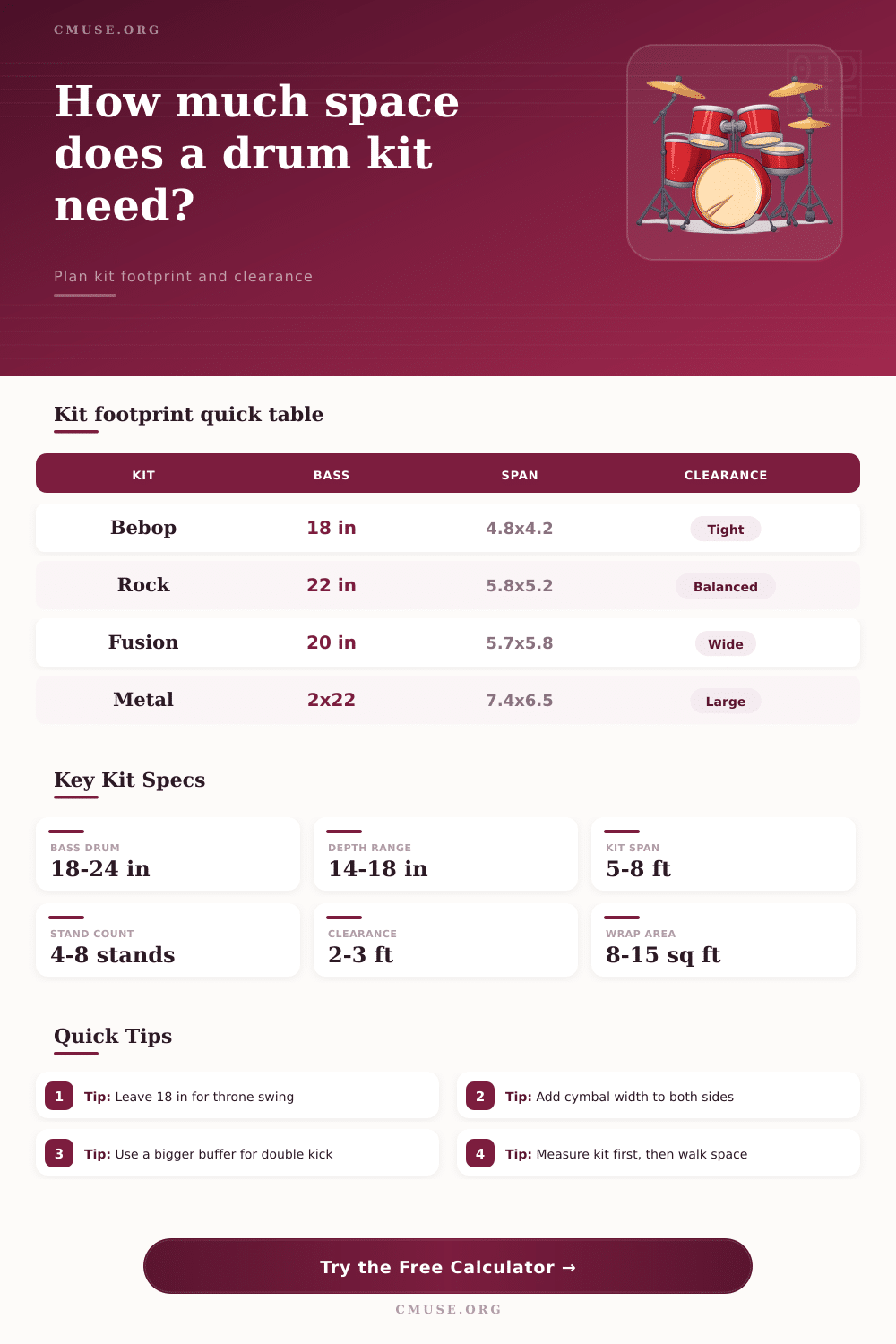
| Bebop Trio | 18×14 | 4.7 x 4.3 | 4 |
| Classic Rock | 22×16 | 5.8 x 5.2 | 6 |
| Fusion Five | 20×18 | 5.7 x 5.7 | 6 |
| Metal Rig | 2x22 | 7.3 x 6.4 | 8 |
| Shell | Dia | Depth | Wrap |
|---|---|---|---|
| Bass | 18-24 in | 14-18 in | Largest |
| Rack Tom | 10-12 in | 8-9 in | Light shell |
| Floor Tom | 14-16 in | 14-16 in | Deeper shell |
| Snare | 14 in | 5-7 in | Fixed shell |
| Setting | Width | Depth | Note |
|---|---|---|---|
| Club | 6 ft | 5 ft | Tight |
| Rehearsal | 8 ft | 6 ft | Comfortable |
| Worship | 9 ft | 7 ft | Wide kit |
| Arena | 12 ft | 8 ft | Big backline |
| Kit | Toms | Cymbals | Stands |
|---|---|---|---|
| 4-piece | 1-2 | 3-4 | 4-5 |
| 5-piece | 2-3 | 4-5 | 5-6 |
| 6-piece | 3-4 | 5-6 | 6-7 |
| Double kick | 4-5 | 6-8 | 7-8 |
A drum kit take up a specific amount of floor space. The amount of floor space that a drum kit take up is referred to as it’s footprint. The footprint of a kit are important to consider because it will determine the amount of movement that the drummer can have in their kit and the amount of movement that the other musician have in the band.
If the footprint of the kit is too large, it may interfere with other musicians. If the footprint of the kit is too small for the drummer, they may not have enough space to play the kit effective. The size of a kits footprint begin with the size of its bass drum.
How to measure the space a drum kit needs
The diameter of a bass drum will determine the width of the kit, and the depth of the bass kit will determine its depth. Following the placement of the bass drum, the drummer will add their toms and cymbal. Each tom will add to the width of the kit footprint, and the addition of each cymbal stand will also add to the width of the kit footprint.
Kits with many toms and many cymbals will have a larger footprint then kits with few toms and few cymbals. Other hardware component for the kit will also add to the footprint of the kit. Any addition of stand component for the toms, cymbals, and pedal boards will add to the footprint.
Any use of double-kick kick pedals will take up more width in the kit than kits with single-kick kick pedals. Additionally, the stands for the cymbals may splay outward from the kit; this splaying outward of the stands add to the area that the kit takes up on the floor. You must account for the space that the stands take up in the calculation of the footprint.
Additionally, the drummer must account for the space that the throne take up. Thrones must be allowed room to swivel. If a throne does not have enough space to swivel proper, it may hit the snare and other part of the kit.
The type of music that you play will also impact the footprint of the kit. Jazz kits for bebop trios are relatively small at around 4.8 feet in width and 4.2 feet in depth. In contrast, metal kits can be much larger in footprint, as metal kits often have many cymbals and double-kick kick pedals.
The drummer may want to consider their reach and pedal extension to determine the proper size for their kit footprint. Many people makes the mistake of estimating the footprint of their kit by sight. This estimation is inaccurate because a drummer may not account for the width of the cymbals or the swing of the throne.
To avoid such mistake, estimation by measurement is the best strategy. Use tape to mark the footprint of the kit on the floor prior to setting up the kit. The environment in which the kit is to be played will also have an impact on the size of the kit.
Kits in small club will have smaller footprints so that the kit does not interfere with other musicians. Kits in large music arenas can take up more floor space. The shape of the environment should also be considered; clubs in rectangular shape may require different footprints than clubs in circular shape.
Finally, a drummer should always include a buffer in the calculation of the footprint of their kit. Adding a buffer to the measurement ensure that the drummer has enough space in their kit. For instance, adding a ten percent buffer will provide the drummer with enough breathing room in their kit.
Having breathing room will prevent the drummer from feeling too crowded in their kit and will prevent the kit from interfering with other musicians in the band.