🎧 Acoustic Panel Calculator
Calculate material volume, panel count, and coverage for any acoustic treatment project
lbs / yd³
lbs / yd³
lbs / yd³
lbs / yd³
lbs / yd³
lbs / yd³
lbs / yd³
lbs / yd³
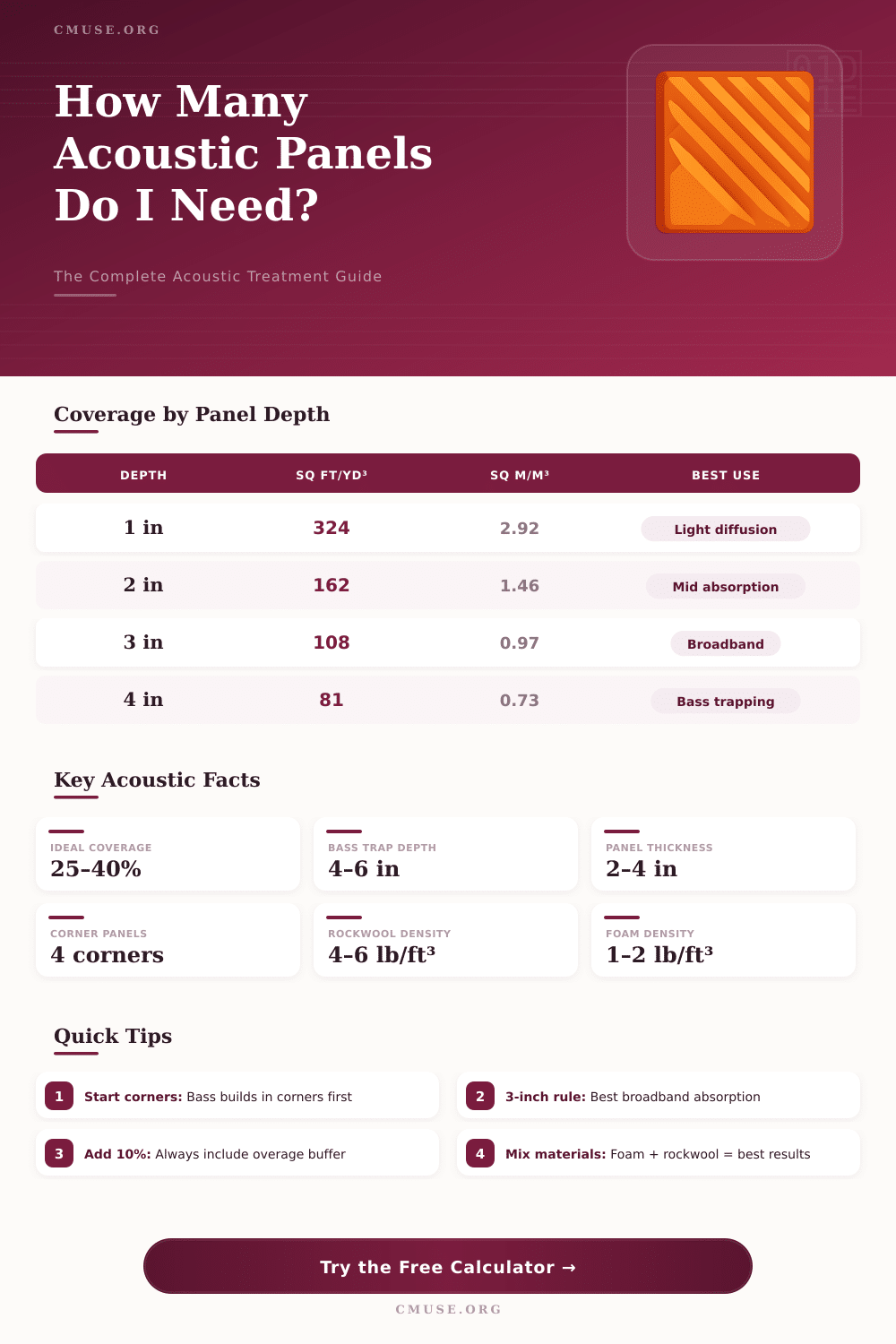
| Panel Depth | Metric Depth | Sq Ft per Yd³ | Sq M per M³ | Best Application |
|---|---|---|---|---|
| 1 inch | 25 mm | 324 sq ft | 29.2 m² | High-frequency diffusion |
| 2 inches | 50 mm | 162 sq ft | 14.6 m² | Mid-range absorption |
| 3 inches | 75 mm | 108 sq ft | 9.7 m² | Broadband absorption |
| 4 inches | 100 mm | 81 sq ft | 7.3 m² | Bass & low-mid control |
| 6 inches | 150 mm | 54 sq ft | 4.9 m² | Bass trap / corner fill |
| Bag Size | Volume per Bag | Bags per Yd³ | Coverage @ 3 in |
|---|---|---|---|
| 2 cu ft bag | 0.074 yd³ | 13.5 bags | 8 sq ft / bag |
| 3 cu ft bag | 0.111 yd³ | 9 bags | 12 sq ft / bag |
| 1.5 cu ft bag | 0.056 yd³ | 18 bags | 6 sq ft / bag |
| Bulk (1 yd³) | 27 cu ft | 1 unit | 108 sq ft |
| Project | Wall Area | Cu Yds @ 3 in | 2 Cu Ft Bags |
|---|---|---|---|
| Vocal Booth 4x6 | 24 sq ft | 0.22 yd³ | 3 bags |
| Practice Room 8x8 | 64 sq ft | 0.59 yd³ | 8 bags |
| Home Studio 10x12 | 120 sq ft | 1.11 yd³ | 15 bags |
| Recording Room 12x14 | 168 sq ft | 1.56 yd³ | 21 bags |
| Live Room 16x20 | 320 sq ft | 2.96 yd³ | 40 bags |
| Theater Room 20x24 | 480 sq ft | 4.44 yd³ | 60 bags |
The size of acoustic panels is really important to treat a room. Aim to cover around 20% of the wall surface with panels in 60×120 cm and at least 5 cm thick, that is a good rule. The shape and size of the room seriously affects the impact of the panels
The format 60×120 cm is very practical and modular. You can use it alone or combine it with other panels based on need. Available sizes range from 30×30 cm to 240×120 cm depending on the product.
How to pick the right size and thickness for acoustic panels
Panels in 120×60 cm or 90×90 cm give flexibility to control noise according to desgin and beauty. Custom sizes are also possible, although the final dimensions can differ by 6 mm, so leave enough space around panels in tight places.
Panels of small to medium size, as 600×600 mm or 1200×600 mm, work for many rooms. Place them beside main spots of sound. Too many big panels can make the space feel crowded.
A mix of medium and big, for instance 1200×600 mm and 1200×1200 mm, work well in large rooms. The sizes 1200×600 mm and 600×600 mm are standards for false ceilings, where acoustic panels are most commonly used.
A calculator for acoustic panels helps to estimate the number according to room sizes and wanted coverage. For instance for typical home-made size 60×120 cm it shows 14 panels for minimal 10% covering, 16 for suggested 20% and 21 for ideal 30%. People usually want 15, 30% of whole surface covering.
The right amount depends on room size and shape, surfaces, sounds that you produce and wanted results.
Besides size the thickness also matters. Problems with sound commonly come from reflecting off hard surfaces, and panels in 2.5 to 5 cm thick here will help to improve acoustics. There are thin compressed panels in 1 to 1.3 cm with backing, and thick in 2.5 to 5 cm for more absorbent space.
Deeper panels naturally catch lower frequencies. Back air space doubles the impact. Panels in 5 cm with 2.5 cm of space left form an efficient system.
Use same thickness and same space panels through the whole room for equal absorption.
Avoid foam. Rockwool in 7.5 cm thick works better and does not cost tooalot.