Amplifier RMS Calculator
Estimate RMS voltage, RMS current, and RMS power for speaker loads, amp output stages, and peak headroom.
🔌 Presets
📏 Inputs
📊 Reference Cards
Home stereo
4 to 8 ohm loads, moderate RMS power, clean headroom, and balanced output for everyday listening rooms.
Studio monitor
8 ohm nearfield setups, accurate RMS matching, low noise, and predictable voltage swing.
PA top
8 ohm live-sound loads, higher peak margin, and current delivery that stays stable under stress.
Guitar cab
16 ohm or 8 ohm cabinets, strong RMS voltage, and safe headroom before clipping or speaker damage.
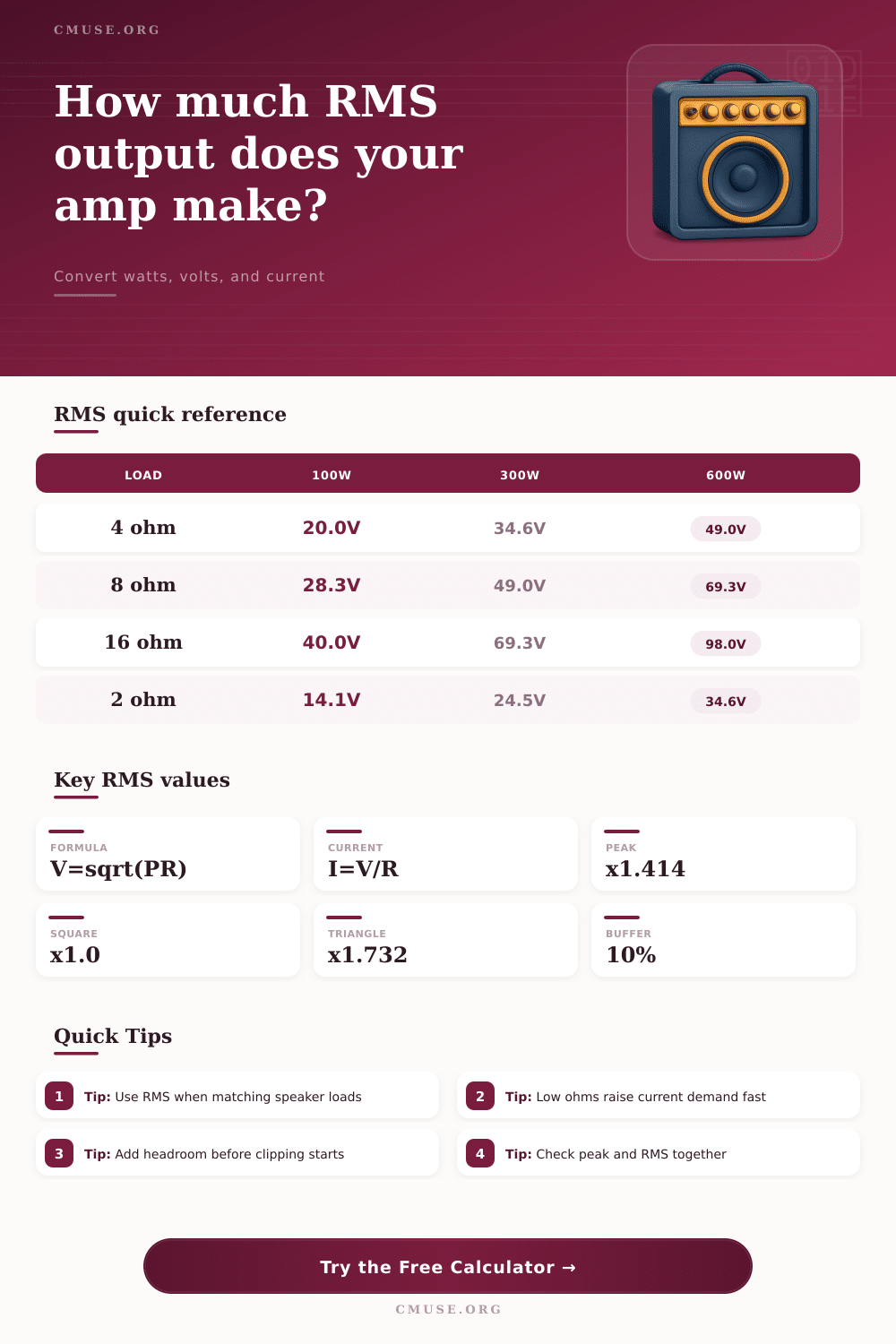
| Load | 100W | 300W | 600W | 1000W |
|---|---|---|---|---|
| 2 ohm | 14.1V | 24.5V | 34.6V | 44.7V |
| 4 ohm | 20.0V | 34.6V | 49.0V | 63.2V |
| 8 ohm | 28.3V | 49.0V | 69.3V | 89.4V |
| 16 ohm | 40.0V | 69.3V | 98.0V | 126.5V |
| Type | Efficiency | Heat | Best Use |
|---|---|---|---|
| Class A | Low | High | Reference audio |
| Class AB | Medium | Medium | Home hi-fi |
| Class D | High | Low | PA and subs |
| Class H | High | Low | Large rigs |
RMS power commonly seems less impressive at first look, at least compared with peak values. RMS stands for Root Mean Square and shows continuous power, so when you talk about RMS watts, you talk about how much stable power a speaker or subwoofer handles or how much an amplifier actually delivers. Here the thing: RMS figures are almost always less big than peak watt numbers, but that is what makes them honest.
They describe what a device truly gives in real situations.
What RMS Power Means and Why It Matters
To measure power in a way that truly matters, RMS is the only important value for amplifiers and speakers. If an amplifier has 90W RMS at 8 ohms, that means that it delivers that much continuous power into an 8-ohm load over long time, without passing distortion limits. That is a real measure of its real skill.
RMS gets counted by averaging the power over time and considering the amplitude of the wave. This matters because it shows how much power an amplifier or speaker handles day after day without overheating or sounding bad. Otherwise said, it best measures clean, useable power.
Peak power is an entirely different thing; usually a bigger number, that impresses, until you understand that it includes distortion. When an amplifier promises 200W peak, that means that it reaches that level only for moments or a speaker survives a sudden spike of 200W. Speakers with flashy peak watts seem stronger on paper, but they do not give better sound. RMS tells you about the reel force.
For long-term stability and steady sound RMS is the main number. Peak and program values deal only about short bursts. On the spec sheet of an amplifier you want to see RMS power rating per channel at a given impedance.
To properly match an amplifier with a speaker the RMS of the speaker must meet or pass the output power of the amplifier, including peak values. For a 100W RMS speaker, an amplifier of 100 to 120W RMS works, which fills the room and keeps the sound strong even at high volumes. Lower power works fine if you do not push the amplifier too hard.
Not every device gives what the box promises… Some truly deliver more honest watts for your money. Right settings of gain levels make even lower powertotally workable.
When an amplifier advertises 1400W peak, that number comes from testing at one specific frequency, usually around 1 kHz. That 1400W peak matches around 400W RMS, give or take. There is a rough 2-to-1 ratio between peak and RMS power.
The math for a sine wave multiplies the peak voltage value by 0.707 to get RMS.