Amplifier Wattage Calculator
Estimate recommended watts per channel, voltage, current, and SPL from speaker sensitivity, impedance, room size, and listening distance.
🎧 Presets
📏 Inputs
📊 Speaker Profiles
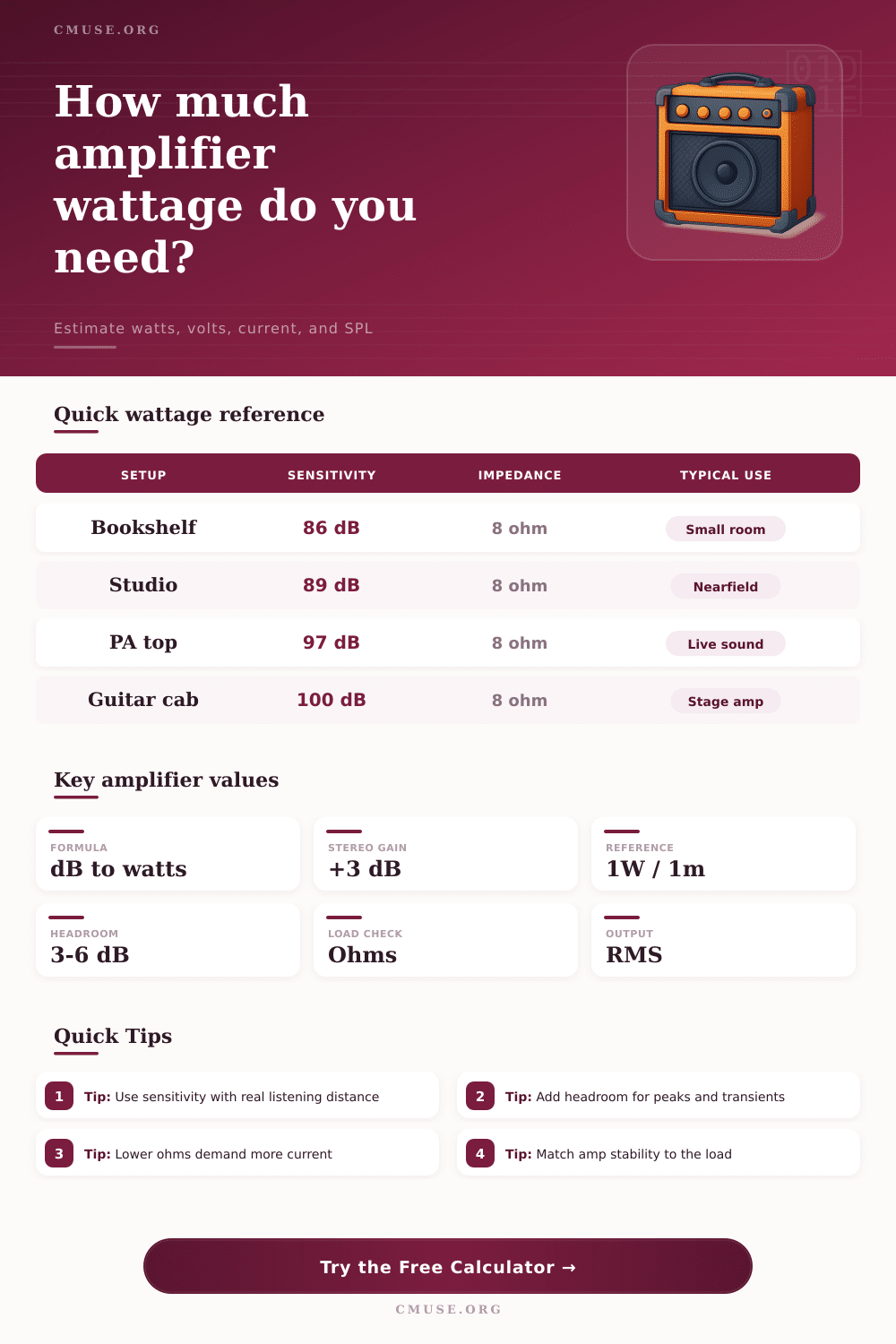
Bookshelf hi-fi
86 dB sensitivity, 8 ohm, 40 to 80 W amp range, ideal for compact rooms and nearfield listening.
Studio monitor
89 dB sensitivity, 8 ohm, 60 to 120 W amp range, tuned for accurate playback at short distance.
Ceiling speaker
88 dB sensitivity, 8 ohm, 20 to 40 W amp range, suited to distributed background audio.
PA top
97 dB sensitivity, 8 ohm, 250 to 600 W amp range, built for live reinforcement and coverage.
DJ portable
95 dB sensitivity, 4 ohm, 150 to 400 W amp range, good for dance playback and punchy bass.
Horn-loaded speaker
104 dB sensitivity, 8 ohm, 25 to 75 W amp range, very efficient for long throw sound.
Subwoofer
93 dB sensitivity, 4 ohm, 300 to 800 W amp range, focused on low frequency output.
Guitar cabinet
100 dB sensitivity, 8 ohm, 50 to 150 W amp range, common for clean headroom and stage use.
| Load | 100W | 250W | 500W |
|---|---|---|---|
| 4 ohm | 20.0V / 5.0A | 31.6V / 7.9A | 44.7V / 11.2A |
| 6 ohm | 24.5V / 4.1A | 38.7V / 6.5A | 54.8V / 9.1A |
| 8 ohm | 28.3V / 3.5A | 44.7V / 5.6A | 63.2V / 7.9A |
| 16 ohm | 40.0V / 2.5A | 63.2V / 4.0A | 89.4V / 5.6A |
| Project | Room Size | Auto Distance | Typical Watts / ch |
|---|---|---|---|
| Bedroom stereo | 12 x 10 ft | 4.5 ft | 10 to 30 W |
| Studio nearfield | 10 x 8 ft | 3.5 ft | 15 to 40 W |
| Living room | 18 x 14 ft | 6.0 ft | 25 to 75 W |
| Small PA | 30 x 20 ft | 10.0 ft | 150 to 400 W |
| Amplifier Class | Efficiency | Heat | Best Fit |
|---|---|---|---|
| Class A | Low | High | Reference setups |
| Class AB | Medium | Medium | Home audio |
| Class D | High | Low | PA and subwoofers |
| Class H | High | Low | Large live rigs |
Amplifier wattage is one of those things that seems easy but gets confusing fast Amplifier with low wattage has around 5 to 10 watts, but it can go up to 100 or even 200 watts. To find how many watts you need, the main thing is think how you will use it.
The link between power output and sound volume is logarithmic, not linear. Amplifier with 100 watts per channel does not sound twice as loud as one with 50 watts per channel using same speakers. To double the sound level in dB, you must multiply the wattage.
How Amplifier Watts Affect Sound and Speakers
Like this 10-watt amplifier sounds twice as loud than 1-watt, but only half as loud than 100-watt.
RMS power shows the continuous power that amplifier can give or speaker can take without damage or distortion. RMS well points to everyday performance. Peak pwoer is the maximum that amplifier reaches during very short moment, for instance during strong bass hit or drum kick.
During normal levels usually stay under 1 watt, peaks can be much higher for moments.
Match gear is hard because makers differently rate their devices. For speakers you must believe the maximum safe power that the maker says. Amplifier makers rate according to what it can put out.
There are no standards for rating speaker wattage. It often is only hint about the maximum amplifier skill, no promise about steady power at all frequencies.
If the amplifier power falls inside the limits that the speaker-maker sets, and it is of good quality, the exact watts do not matter a lot. Quality beats amount. Speakers rated for 100 RMS watts will work with good amplifier of 20 watts or more.
The sound volume of speaker depends on its sensitivity or efficiency measured in dB, not of power or ohm ratings. Speaker with 98 dB/1W/1m produce 98 dB sound in 1 meter with 1 watt. That is high efficiency.
For louder sound you need however much more power.
Guitar amplifier gives different tones at different volumes. This counts especially for tube amplifiers that reach wanted gainy tone called breakup. Low power amplifiers break up and twist at lower volumes, while high can give more sound without distortion.
50-watt amplifier is sweet spot for many musicians, with good balance of power and flexibility. Amplifiers are not 100 percent efficient, so rated watts don’t perfectly matchreal world.