High Pass Crossover Calculator
Estimate tweeter and midrange high-pass parts with first- and second-order crossover math.
🔌 Calculator Inputs
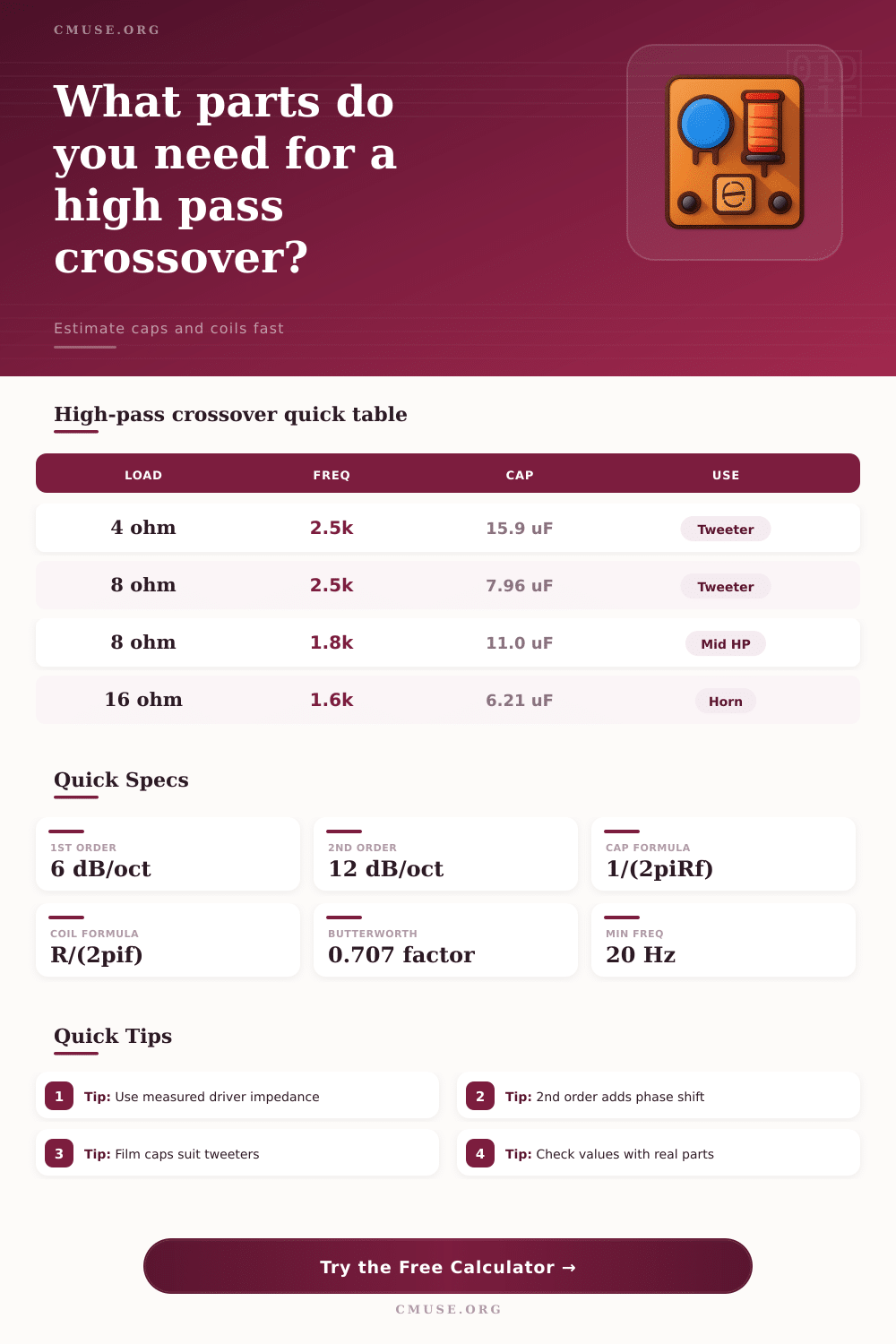
📊 Reference Table
| Load | Freq | Cap | Use |
|---|---|---|---|
| 4 ohm | 2.5 kHz | 15.9 uF | Tweeter |
| 8 ohm | 2.5 kHz | 7.96 uF | Tweeter |
| 8 ohm | 1.8 kHz | 11.0 uF | Mid HP |
| 16 ohm | 1.6 kHz | 6.21 uF | Horn |
🔧 Filter Specs
Crossover frequency is the spot where audio signal divides in upper and bottom parts that sends to various speakers or subwoofers according to what best answers for each. Imagine audio crossovers as special filters: they decide which sounds go to that speaker in your system. In multi-driver speaker configuration, the crossover scatter the frequencies so that each driver receive only what it is done for.
Here is the key cause: the tweeter care about the high sounds, those clear, sharp tones. The low frequencies go to woofer. You do not want to send heavy bass to the tweeter or bright sounds to the woofer, right?
What is crossover frequency?
Here the filter network intervene. It divides the sound and tells the system which speakers correspond for those parts of the audio view. Basically, the crossover frequency decides everything thta.
Three types of crossovers exist. High-pass filters do what they call: they allow only the high frequencies to tweeters, protecting them against distortion and break. When you produce, high-pass crossover abort the low sounds, while low-pass block the high.
The same crossover frequency marks in -3 dB, where the power of the speaker declines to half. Down, the power continuously diminishes when you go of that spot.
The most advocated… Also of THX, are 80 Hz. Modern AV receivers allow to set the crossover point for every channel manually.
Good start for satellite speakers are 80 Hz, but you will have to correct according to your real installation. Genuinely, subwoofers can reach until 20 Hz, but room acoustics and position matter much more practically. General rule: lay the crossover at least 10 Hz above the bottom limit of your speakers.
If front speakers are a bit big, 80 Hz operate well, because they self can go until around 40 Hz. For little speakers answer more 120 Hz. More than 150 Hz do not value, because you lose direction, the subwoofer show and the illusion disappears.
Above 120 Hz the bass sounds mushy.
Surround speakers recline between 80 and 100 Hz. For the subwoofer, 60 until 80 Hz preserve good quality and protect the speakers. Around 80, 85 Hz help to keep stereo image nice; more highly you start to bother it.
12 dB each octave high-pass filter in 40 Hz dilute 20 Hz-tone in -12 dB regarding original. At the crossover point self, both drivers play the same frequencies (usually in different volumesand phases).