Compressor Ratio Calculator
Estimate gain reduction, output level, and makeup gain using threshold, ratio, and input peak values.
🔊 Compression Presets
💻 Compressor Inputs
📊 Ratio Behavior Grid
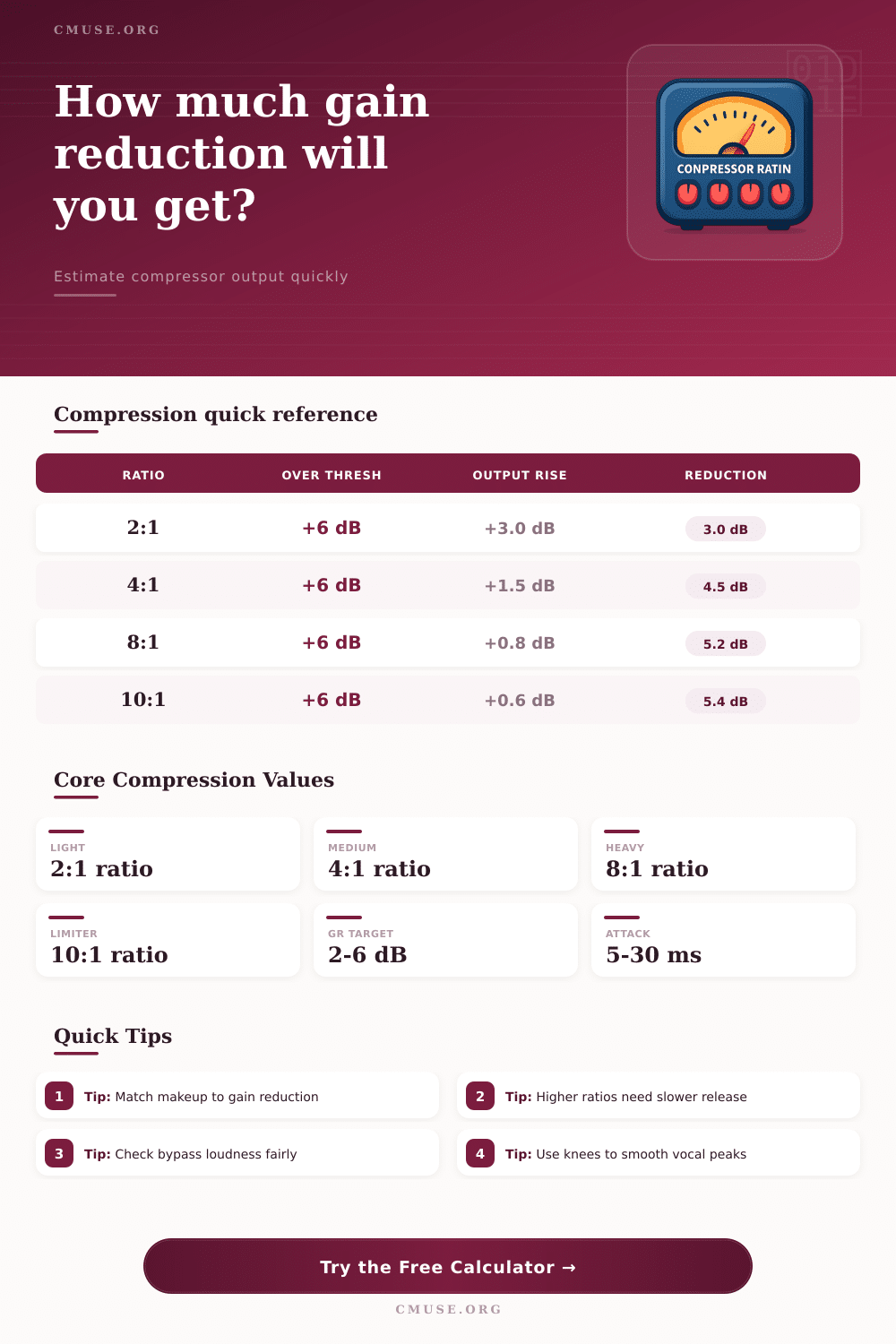
| Input Over | 2:1 | 4:1 | 8:1 |
|---|---|---|---|
| +2 dB | +1.0 dB | +0.5 dB | +0.25 dB |
| +4 dB | +2.0 dB | +1.0 dB | +0.50 dB |
| +6 dB | +3.0 dB | +1.5 dB | +0.75 dB |
| +10 dB | +5.0 dB | +2.5 dB | +1.25 dB |
| Use Case | Threshold | Ratio | Target GR |
|---|---|---|---|
| Lead Vocal | -18 dBFS | 3:1 | 3-6 dB |
| Bass Track | -24 dBFS | 4:1 | 4-8 dB |
| Drum Bus | -12 dBFS | 6:1 | 2-5 dB |
| Master Bus | -14 dBFS | 2:1 | 1-3 dB |
Compressor ratio shows how much reduction the compressor applies when the signal passes the threshold. The threshold sets the level at which the compression truly starts. Then it decides how the signal drops after passing that spot.
Ratio 4:1 means that for every 4 dB that the signal passes the threshold, only 1 dB comes out. At 2:1 the compressor softens the signal by 1 dB for every 2 dB above the threshold. With 10:1 for every 10 dB going in above the threshold the compressor allows only 1 dB out.
How Compressor Ratios Work
Dividing the input level by the first number of the ratio you find how much signal actually comes out.
Compression means that at a certain volume level you start to squash the sound according to the set ratio. This shrinks the diffrence between soft and loud parts. It reduces the dynamics.
Ratio 1:1 is the lowest. Because of flaws in parts and changes in resistors because of heat, it can reach 1.3 to 1.7:1. Passing a signal through a compressor at 1:1 can catch analog traits of the circuit.
For bus compression you commonly choose a lower ratio. Many bus ratios go even below 2:1, for instance 1.5, although some engineers like even 4:1. A lower ratio forces the compressor to act more often four the same reduction, because the threshold sits lower.
Ratio 4:1 gives a natural, well rounded compression. Gentle compression under 2:1 gives a bit of tubey smoothness and holds back peaks. Only to tame seriously rough dynamics or for an ultra-compressed sound you push up to 8:1.
Knee affects how the compressor transitions into the ratio. Normally at 10:1 you have 1:1 before the threshold and 10:1 after it. With knee the ratio grows gradually over some decibels instead of jumping, so the threshold spot stays smooth without a corner.
For classical music a ratio of 1.1:1 with a threshold around -30 dBFS works well. That reduces the whole dynamic range, but keeps a bit of dynamic feeling. Compression for classical recordings should overcome recording limits to match a live listening experience, without changing the character of the instrument.
Make-up gain is added to the output forthe compression, which can make the whole thing seem louder.