Amplifier Output Voltage Calculator
Calculate RMS voltage, peak voltage, and current for stereo or bridged speaker loads.
🔌 Presets
📏 Inputs
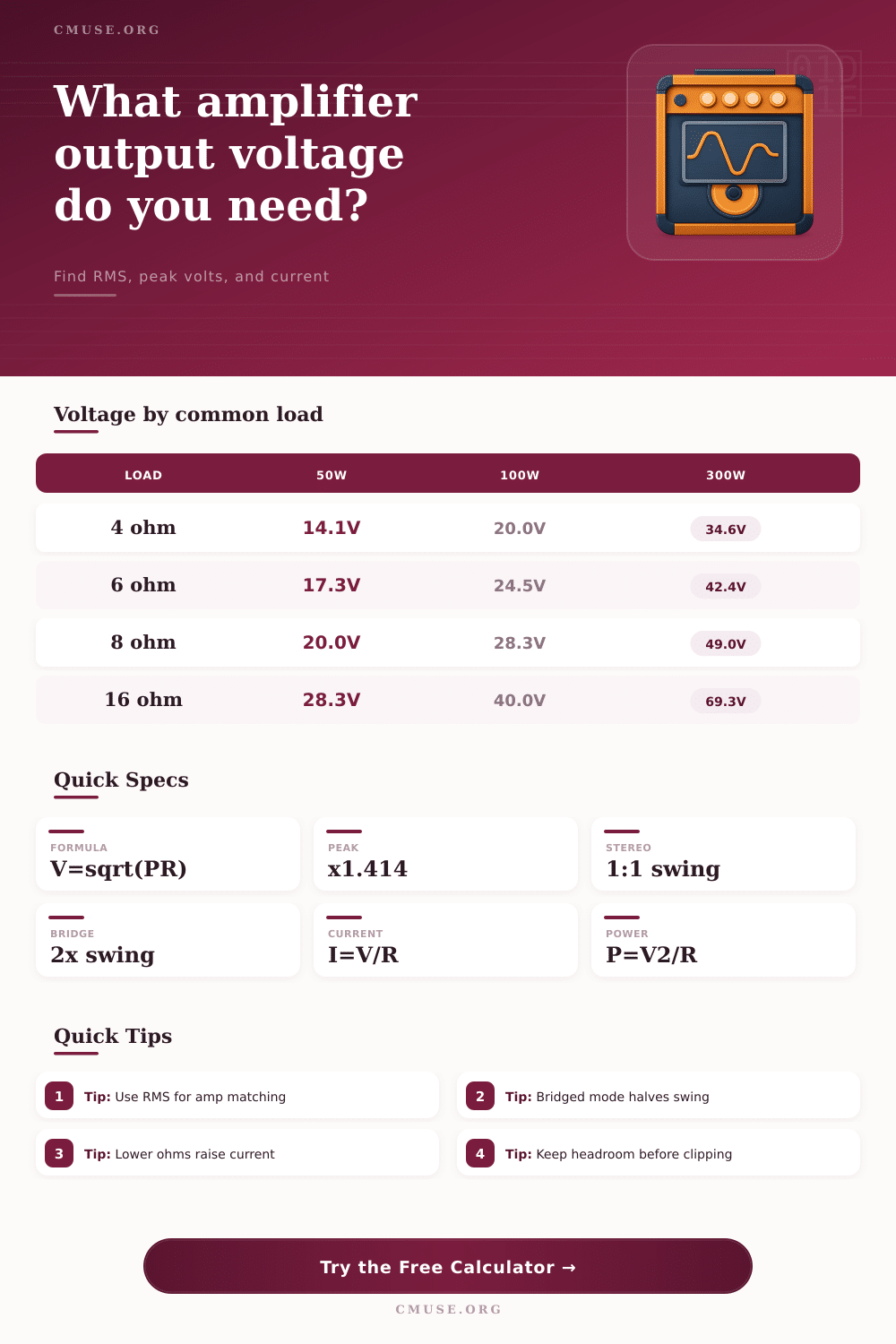
📊 Reference Table
| Load | 50W | 100W | 300W |
|---|---|---|---|
| 4 ohm | 14.1V | 20.0V | 34.6V |
| 6 ohm | 17.3V | 24.5V | 42.4V |
| 8 ohm | 20.0V | 28.3V | 49.0V |
| 16 ohm | 28.3V | 40.0V | 69.3V |
📋 Amp Spec Grid
💡 Tips
Amplifier output voltage matters a lot if you want to understand how amps work. In simple form it is a circuit that gives bigger voltage than the input. At big voltages you commonly use them to expand the output.
20 dB of gain match exactly to ten times the input voltage. So theoretically, if the input is 1.0 V, the output reaches 10.0 V. Recall that this differs from power in watts… Because current comes into the game.
How Amplifier Output Voltage Works
Every 6 dB of gain doubles the voltage. An amplifier with 30 dB gain so raises it by 32 times.
With 100 W output power and 8 ohm load the voltage shows 28.3 V. It depends on the power and the impedance of the speakers. The formula P = V² / R counts here. For an AC sine wave the paek reaches around 1.414 times the RMS value, so almost 28 V. Those peaks go in positive and negative directions, so peak-to-peak it is around 56 V.
The output voltage sits between the rail values. Normal swing does not reach the rails fully, commonly only some volts below. Builders try too reduce that gap, because it hurts the thermal efficiency.
Less input voltage causes less output swing, which ultimately reduces the power.
Currently most audio power amplifiers have voltage gain of around 25 dB. The maximum input voltage depends on their internal DC supply. Inside voltage and current limits the amplifier runs smoothly, as if a simple voltage source with a bit of output resistance.
But the power supply commonly sags, when more current flows.
When a good quality audio power amplifier stands silently without input signal, at the output terminals you measure almost zero AC and DC volts. Tiny leftover AC voltages of 40 to 80 microvolts appear here.
The -3 dB point of an amplifier is called the half-power point, because it is 3 dB under the maximum (with 0 dB as peak). In the common American 70.7 V standard all power amplifiers give 70.7 V at their rated power. Whether 100 W, 500 W or 10 W, the maximum output voltage stays the same.
The increase of low output voltage with high current is normal; it comes from voltage across one output transistor, when theload requires more current.