DIY Crossover Calculator
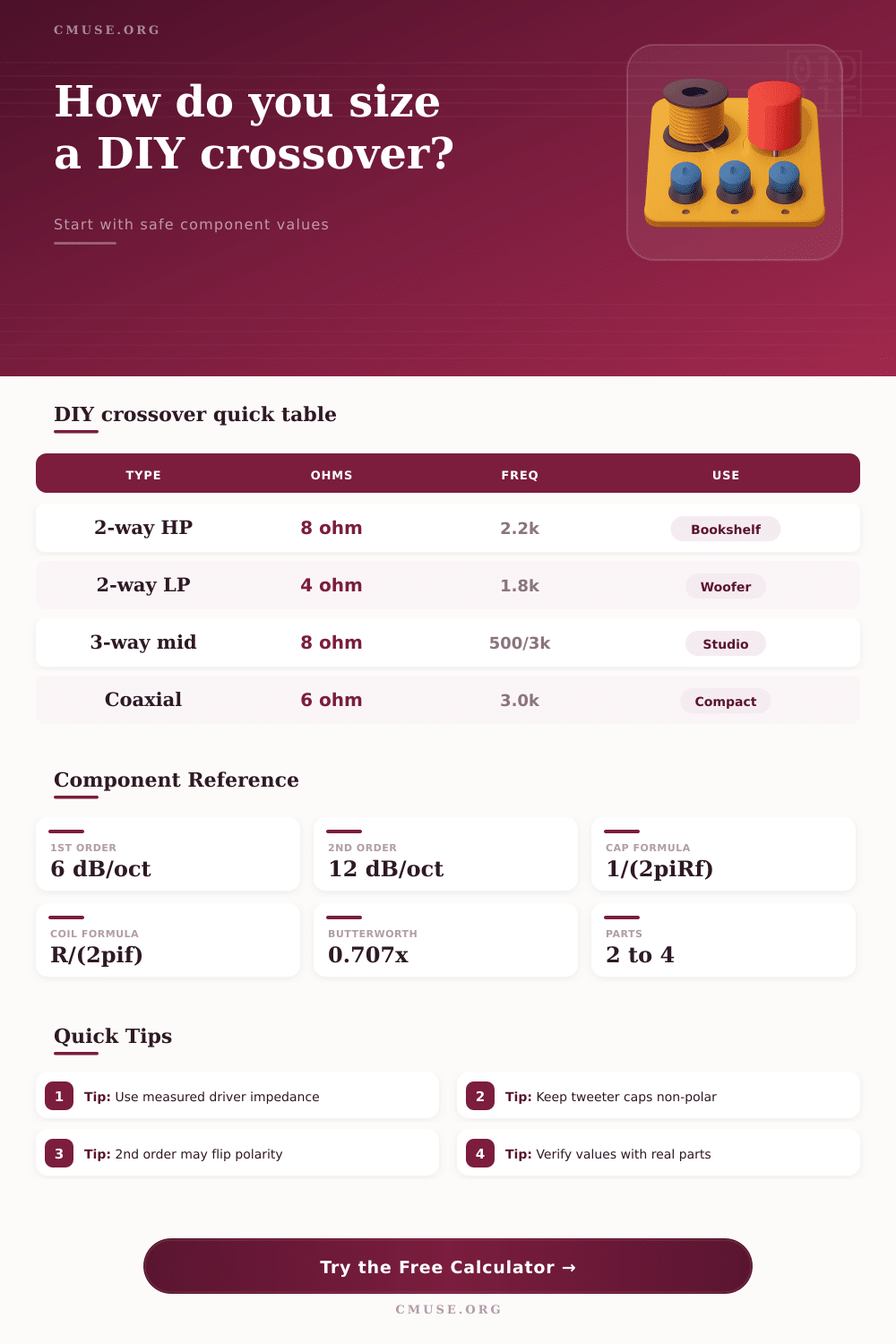
Estimate starting capacitor and inductor values for 2-way and 3-way speaker builds.
🎚 Inputs
📊 Starting Points
| Build | Ohms | Freq | Goal |
|---|---|---|---|
| Bookshelf 2-way | 8 ohm | 2.2k | Smooth mids |
| PA top 2-way | 16 ohm | 1.8k | High output |
| 3-way mid | 8 ohm | 500/3k | Wide bandpass |
| Horn tweeter | 6 ohm | 4.0k | Bright top end |
🔧 Component Spec
In crossover design, every participant experiences different medical modes in various time periods The order of treatments is randomly assigned to the subjects, and they receive all during the testing. Such arrangement works for bioequivalence and clinical trials in several scientific areas.
You predetermine the sequences, and later randomly share the units between them. The most used are the 2-sequence, 2-period, 2-treatment model with AB and BA. It is occasionally called 2×2 crossover design.
What is a crossover design?
For instance, one group gets the drug A in the first stage, later B in the final.
Crossover study is a research method where the same folks do all interventions one after the other. Between the phases you lay a washout period to stop leftover impacts. Like this you can check if the therapies differ.
The subjects act as their own control. You apply it especially for bioavailability and bioequivalence exploration. It strongly simplifies comparison of therapies, because you do not need to care about factors like age, gender or ethnic group.
In crossover design the subjects are randomly put to a sequence of therapies. So, those who follow AB, take the first treatment during a week, later pass to the second. The others go according to BA.
One research used only 15 participants with 6 time-points for each therapy. It compared two treatments, with baseline scores, 6-weekly and 12-weekly control.
There are also incomplete crossover designs, where not all treatments do the subjects. Crossover trial commonly includes standard treatment or placebo among the options. Test and control products you give to participants in different times, which well limits leftover impacts compared to other trial types.
Crossover design it is possible also for educational research. For instance, test scores you can nest according to students, and if the main interest is the utility itself, you include the theme as a predictor. Like this the tool impact values independently of the theme.
The rating happens by means of mixedmodel.