Low Pass Crossover Calculator
Estimate woofer coil and capacitor values for low-pass speaker crossover design.
🔊 Calculator Inputs
📊 Reference Table
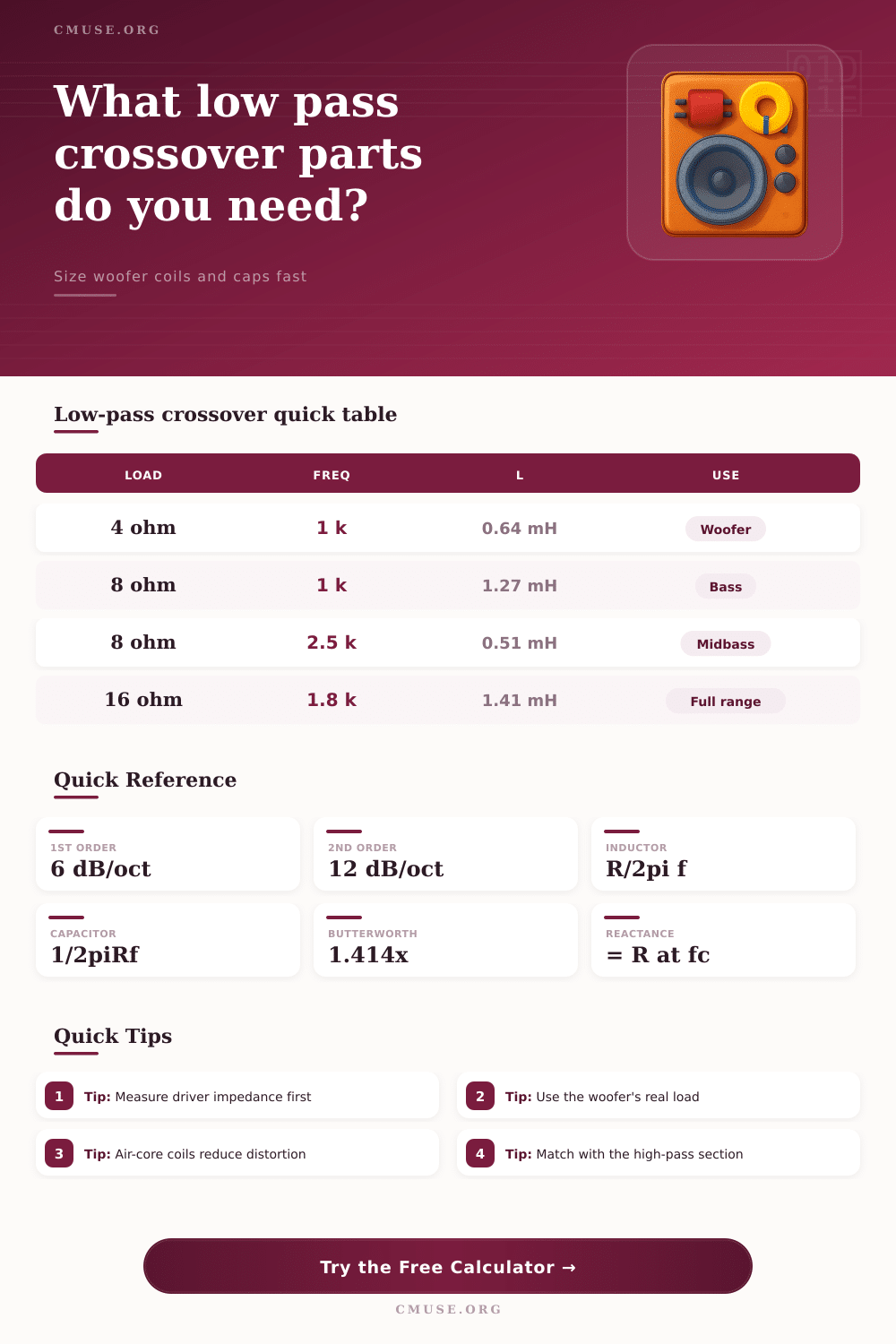
| Load | Freq | L | C |
|---|---|---|---|
| 4 ohm | 1 kHz | 0.64 mH | 39.8 uF |
| 8 ohm | 1 kHz | 1.27 mH | 19.9 uF |
| 8 ohm | 2.5 kHz | 0.51 mH | 7.96 uF |
| 16 ohm | 1.8 kHz | 1.41 mH | 5.52 uF |
🔧 Part Specs
The crossover frequency points the ideal spot where the audio signal turns to the speaker or subwoofer. Consider audio crossovers as special filters, they manage which frequencies go where in your audio system. The crossover frequency is that precise place that tells the system how to divide the sound and which speakers handle which parts of the audio view
Most high-fidelity speaker systems have at least two different drivers. A woofer for the deep sound and tweeter for the high tones. Crashing cymbals bursting through your subwoofer would not please you, and bass sound from your tweeter would be entirely bad.
How to Set the Crossover Frequency for Your Speakers
Because of that between them sits a filter net that wisely turns frequencies to their best place. During construction of a speaker with several drivers, the crossover does that: it splits the signal, so the tweeter receives the high frequencies and the woofer the low.
There are three main kinds of crossovers. High-pass filters allow only the higher frequencies to go to your tweeters, which stops distrotion and damage. Think about it this way: crossovers have outputs that show different signals (high-pass blocks low frequencies), while low-pass blocks high.
At the crossover point the power of the speaker drops in half, measured as -3 dB. Away from that frequency it continuously drops.
The usual crossover frequency for many folks is 80 Hz (it is also the THX standard). Modern AV receivers allow you to set crossover points for every channel separately. Start at 80 Hz for your satellite speakers for a good base, then you adjust according to your actual system.
Really, a subwoofer could theoretically sound down to 20 Hz, but room modes and its position dramatically alter the result in practice. From my experience, setting crossovers at least 10 Hz higher than the lowest rated frequency of your speakers helps everything operate smooth.
If you set it much higher, say 120 to 150 Hz, that causes problems. Above 150 Hz you lose direction, those frequencies move with the subwoofer instead of the speakers. For bigger front speakers 80 Hz commonly is the best, because they reach around 40 Hz.
For smaller front speakers climbing to 120 Hz makes more sense.
Surround speakers best operate between 80 and 100 Hz, while subwoofers usually stay between 60 and 80 Hz. That range gives good sound quality and protects the drivers against damage. If you turn the subwoofer crossover too high, for example above 80 Hz, the bass sounds muddy and loses its force.
It also mixes the stereo image if you go past 80-85 Hz. Room acoustics play a role, so the good frequency answer depends on your space.
A high-pass filter at 40 Hz with 12 dB each octave slope knocks a 20 Hz tone down by around 12 dB compared to the input. Because 20 Hz is one octave under the limit. A gentler slope has fewer side effects, although it still lets a bit of weak signal slipthrough under the limit frequency.