🎼 Roman Numeral Analysis Calculator
Enter a key and chord names to get instant Roman numeral analysis, scale degrees & chord qualities
| Mode | I | ii | iii | IV | V | vi | vii |
|---|---|---|---|---|---|---|---|
| Ionian (Major) | Maj | min | min | Maj | Maj | min | dim |
| Dorian | min | min | Maj | Maj | min | dim | Maj |
| Phrygian | min | Maj | Maj | min | dim | Maj | min |
| Lydian | Maj | Maj | min | dim | Maj | min | min |
| Mixolydian | Maj | min | dim | Maj | min | min | Maj |
| Aeolian (Minor) | min | dim | Maj | min | min | Maj | Maj |
| Locrian | dim | Maj | min | min | Maj | Maj | min |
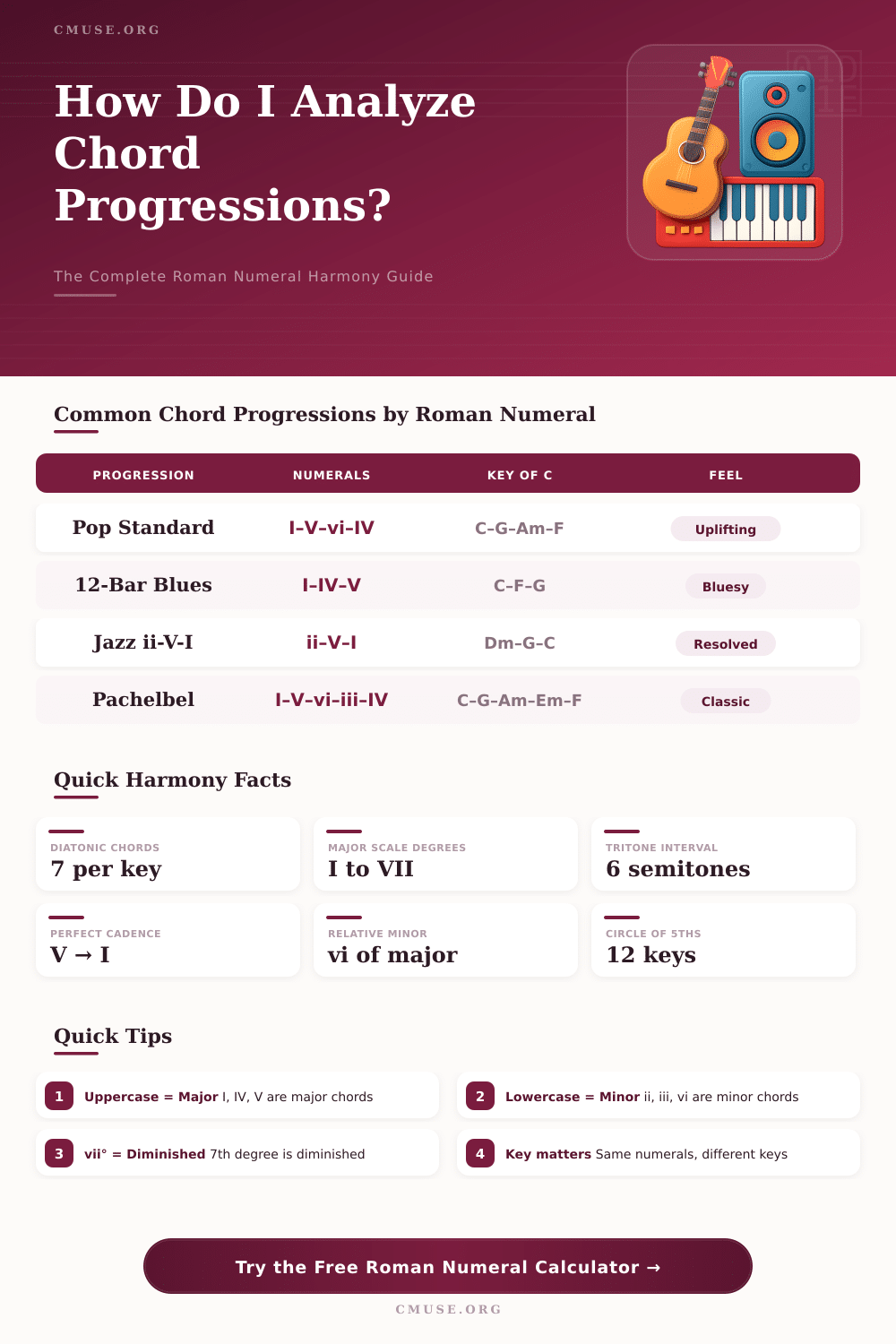
| Progression Name | Roman Numerals | Key of C Example | Genre |
|---|---|---|---|
| Pop Anthem | I – V – vi – IV | C – G – Am – F | Pop / Rock |
| 50s Progression | I – vi – IV – V | C – Am – F – G | Doo-Wop |
| Jazz ii–V–I | ii – V7 – I | Dm – G7 – C | Jazz |
| 12-Bar Blues | I – I – I – I – IV – IV – I – I – V – IV – I – V | C–C–C–C–F–F–C–C–G–F–C–G | Blues |
| Canon (Pachelbel) | I – V – vi – iii – IV – I – IV – V | C–G–Am–Em–F–C–F–G | Classical |
| Andalusian Cadence | i – VII – VI – V | Am–G–F–E | Flamenco / Rock |
| Soul / R&B | I – IV – I – V | C – F – C – G | Soul |
| Minor i–VI–III–VII | i – VI – III – VII | Am–F–C–G | Pop / Rock |
| Key | I (Tonic) | IV (Subdominant) | V (Dominant) | vi (Relative min) |
|---|---|---|---|---|
| C Major | C | F | G | Am |
| G Major | G | C | D | Em |
| D Major | D | G | A | Bm |
| A Major | A | D | E | F#m |
| E Major | E | A | B | C#m |
| F Major | F | Bb | C | Dm |
| Bb Major | Bb | Eb | F | Gm |
| Eb Major | Eb | Ab | Bb | Cm |
Roman numeral analysis is a way to recognize and call chords in musical sequences by means of Roman numerals. They show the grade of the scale in the tonic key. Thanks to this method musicians can understand the ties between chords, which simplifies the study of music.
In music theory, Roman numerals mark the grade of chord and its harmonic role in any tonic key.
How Roman Numerals Show Chords in Music
The key notion is genuinely simple. During musical analysis, each diatonic triad receives Roman numerals. When do is in the bass, it is scale 1st grade, so the figure I. When re is bass, then II.
Like this. Big letters show major chords, little ones as minor chords. The figures simply point the root note of chord regarding the scale.
To learn Roman numerals, you need to think about music independently of particular tone, for maximum clairy. Like this same chord sequence in C major, G major or D major seem identical. The actual tone does not have weight.
Roman numerals help to note chord progressions free of one tonic key.
When things get complex, you need a method to trace everything regarding the root chord. Here Roman numerals settle that. The strongest tie is V-I, for instance G to C in C major.
This teaches you the first steps in Roman numeral analysis. At start of the bit or fragment, always point the tonic key.
Roman numeral analysis helps to explain functions. By means of big and little letters you separate major from minor. Some systems use only big letters for both, and the quality comes from the scale position of the triad.
There are several kinds of Roman letter analysis, even with figured bass in it, called “Figured Roman”. Roman numerals relate to the tonic key, Arabic numerals to the root chord.
The first such analysis emerged in late 18th century in France, where you reduced every chord to its root note. First Arabic numerals served for root chords. In 1778, the German musician Georg Joseph Vogler first applied Roman numerals for some chords.
Except analyze and understand chord progressions, they ease also the transposition. In Roman numeral analysis or labeling, you identify the whole chord together with every inversion. Chords are a set of notes with scale degrees, and Roman numeral analysis explains their mutual relations in a given scale.