Tube Amplifier Bias Calculator
Estimate idle current, dissipation, and cathode resistor values for common output tubes.
🔧 Presets
📏 Inputs
📊 Tube Reference
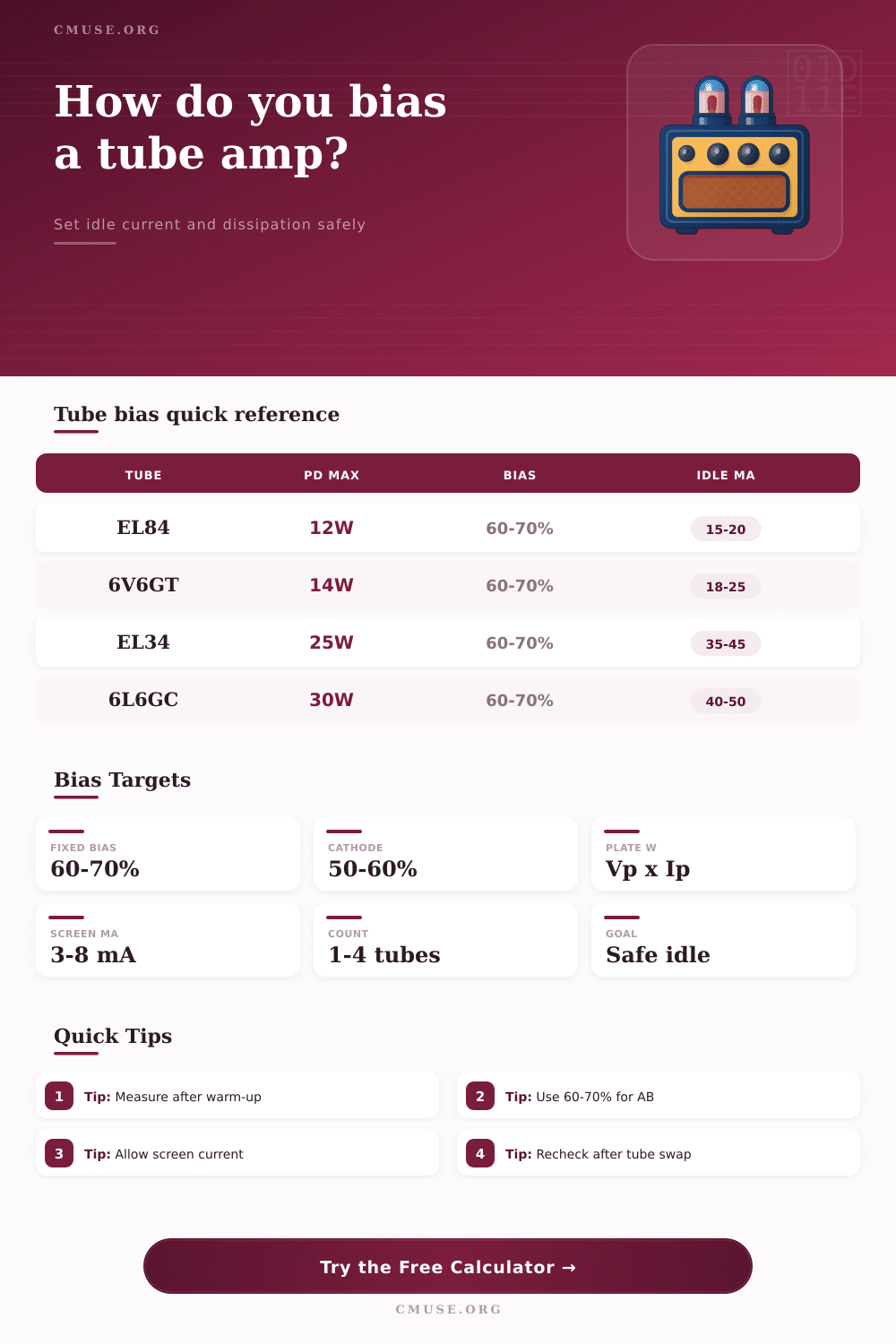
| Tube | Max Pd | Typical Bias | Notes |
|---|---|---|---|
| EL84 | 12W | 60-70% | Small combos |
| 6V6GT | 14W | 60-70% | Low power amps |
| EL34 | 25W | 60-70% | Classic Marshall |
| 6L6GC | 30W | 60-70% | Fender style |
EL84
Max plate dissipation
12WBias window: 60-70%
6V6GT
Max plate dissipation
14WBias window: 60-70%
EL34
Max plate dissipation
25WBias window: 60-70%
6L6GC
Max plate dissipation
30WBias window: 60-70%
Amplifier bias is the application of steady voltage or current to set the operating point of active devices in amplifier, which optimizes its activity. It forms a part of the design for power amplifier. Most amplifiers operate well only in a specific voltage region.
When the input signal go outside it, they stop working correctly or entirely. Biasing keeps the input signal in the right zone
What Is Amplifier Bias and Why It Matters
In electronics, biasing commonly relates to the application of voltage on transistor in amplifier, so that it work in a particular part of its transconductance curve. Transistor requires around 0.7 volts base to emitter voltage to start to lead. The bias point must be set to a specific voltage, so that it faithfully amplifies the alternating signal without distrotion.
To act as amplifier, the transistor must be in its active region, between the cut-off point and the saturation point.
Tubes must be right biased to use them as amplification stages. You bias a tube by setting the DC current, that flows through it when no signal is on the grid regarding the cathode. Setting the bias, you alter the voltage on the control grids of the power tubes, so that they draw the right current.
This is like the setting of idle on a car during tune ups.
The amount of bias differs according to tube, depending on its sensitivity, and it helps to avoid failure. When the grid bias is well set, the tube balances with the circuit and give a pure, strong signal. Right biased amplifier works efficiently and exactly amplifies the sound.
Bias you can set more hot or cold than optimal, which affects the activity of the amplifier. Too cold, and the sound sounds flat and dead. Too hot, and it lost headroom and twist too early.
In tube amplifiers, bias acts on the quiescent current and voltage, which directly works the tone quality and the duration of the valves.
The two main kinds of bias in guitar tube amplifiers are cathode bias and fixed bias. Most valve amplifiers belong to fixed bias. Self-biasing output stage limits the available power.
Cathode bias is occasionally called variable, because the voltage automatically moves up and down to keep it always right. For preamp tubes you need not care about bias, because they fix themselves.
Equal tubes matter also. It is possible not buy tubes with equal resistances. Always choose a matched pair or quad, but the chance to find a current matched pair are small.
Leave the amp to a tech for biasing; that is a wise step.