4th Order Crossover Calculator
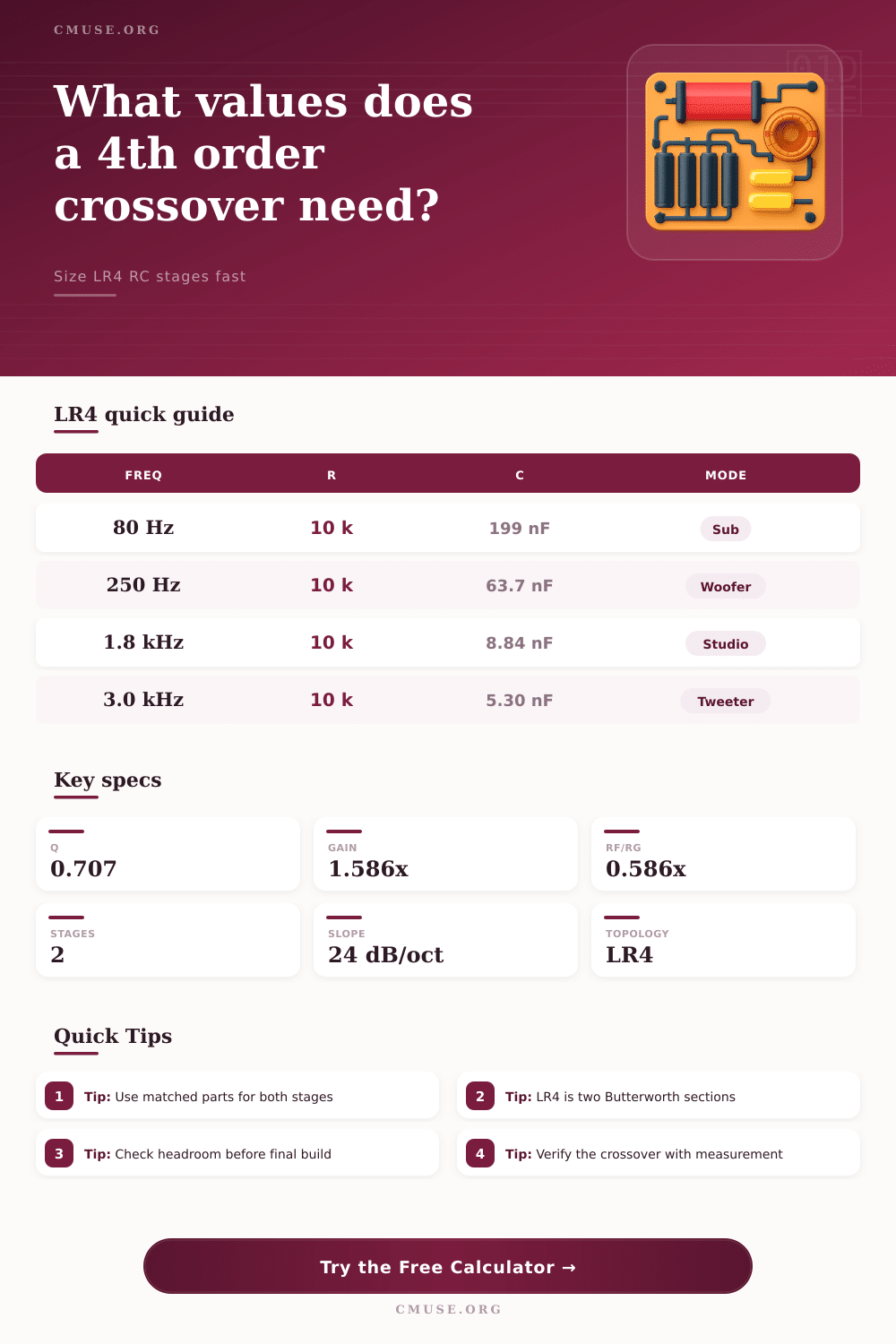
Size LR4 crossover RC stages and check the Butterworth values used in active speaker filters.
🔌 LR4 Inputs
📊 LR4 Reference
| Freq | 10k cap | 10k R | Use |
|---|---|---|---|
| 80 Hz | 199 nF | 10 k | Sub |
| 250 Hz | 63.7 nF | 10 k | Woofer |
| 1.8 kHz | 8.84 nF | 10 k | Studio |
| 3.0 kHz | 5.30 nF | 10 k | Tweeter |
🔧 Spec Grid
🎵 Common Targets
| Build | Split | Type | Note |
|---|---|---|---|
| Sub / Sat | 80 Hz | LR4 | Deep split |
| Woofer | 250 Hz | LR4 | Clean handoff |
| Studio monitor | 1.8 kHz | LR4 | Safe start |
| Tweeter | 2.5 kHz | LR4 | Protect HF |
You will find the term “crossover order” in some different fields. Design of speakers, genetic algorithms, production of music. The meaning changes based on the use but every case deserves attention
In design of speakers, “order” simply shows how many filter elements are before every driver. First order? Only one capacitor or inductor for driver.
What Is Crossover Order?
For second order you need two elements, third order has three, and so on. Just count the parts.
First order crossover causes only small delay of the signal, but here is the catch: it drops the frequency in -6 dB each octave. Fourth order on the other hand is differnet, it reaches -24 dB each octave, which reduces the power to almost 1/256 for every octave. Fourth order became standard in professional systems: it gives best control of the sound, although with strict demands for the setup.
Different orders give very different phase effects. First order has no phase change. Second order reaches 180 degrees, third 270 degrees, and fourth closes the circle in 360 degrees.
Well designed crossover stays phase coherent through the whole area, regardless of the order. Here is the interesting part: for second order Linkwitz-Riley filter between two drivers, one driver must reverse so that it will work. At fourth order Linkwitz-Riley that reverse is not needed.
The resulting order of crossover depends on a mix of electrical and acoustic behavior. Hence occasionally you end with second order answer using only first order element, the own acoustics of the driver deliver that what you need. Mix second and third order filters is not a problem, if you set everything for your drivers.
DSP-based active crossover is the most complex option now available. Some producers add extra filters to there designs, commonly with second bass, that covers the same base but starts much more early than the main one.
In genetic algorithm, order crossover operates otherwise, the notion comes from work of Davis. It takes sorted information of the second parent and sends it to the children. First you choose two parents.
Random bit from the first parent is copied, and the rest is filled by values from the second, carefully avoiding duplicates and respecting the original order for the rest.
Simple applications commonly choose first order. The steeper the slope of the crossover, the more it causes phase distortion and complexproblems.