Butterworth Crossover Calculator
Estimate passive speaker crossover parts for 1st and 2nd order Butterworth networks.
🎧 Crossover Inputs
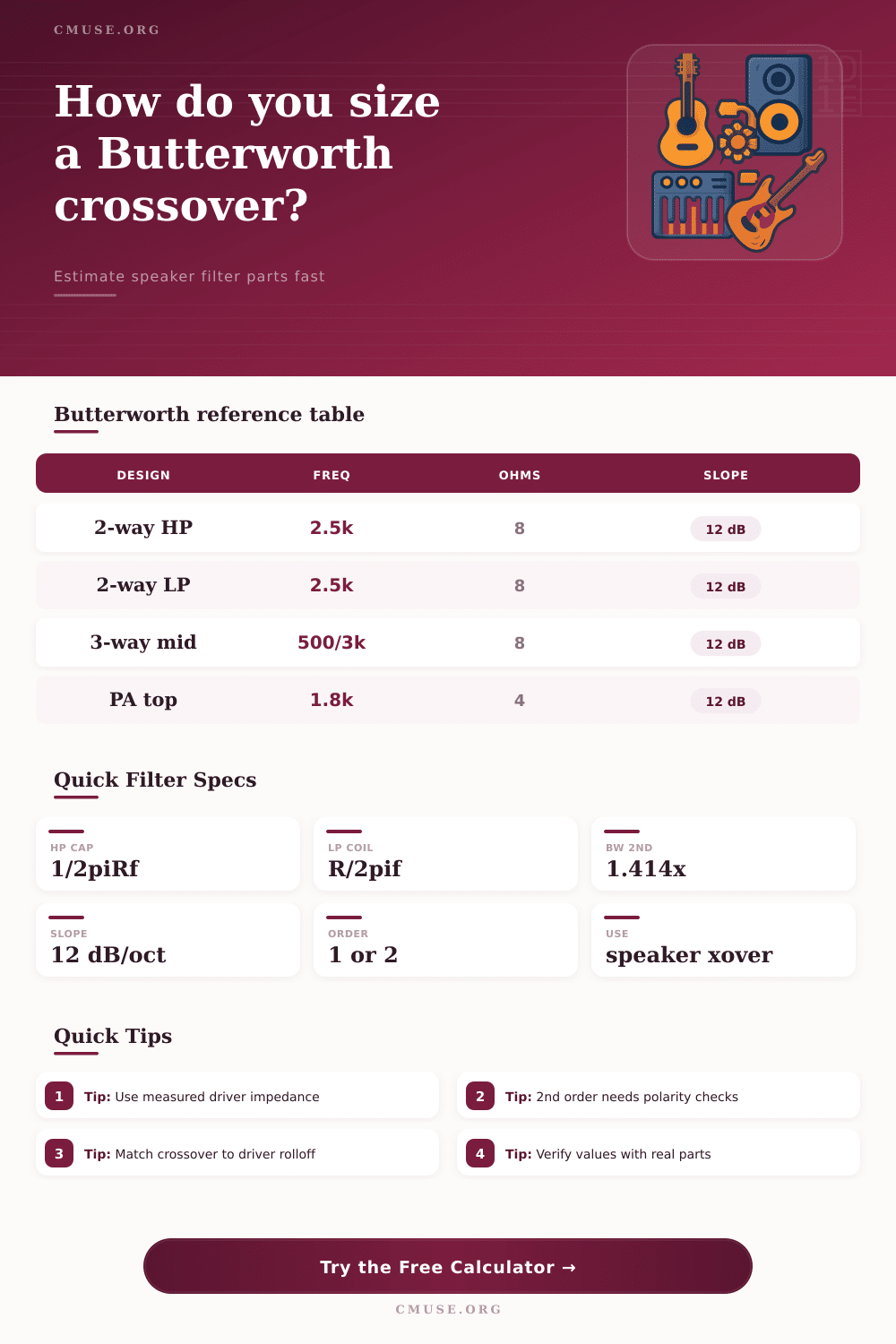
📊 Butterworth Reference
| Mode | Formula | Parts | Use |
|---|---|---|---|
| 1st HP | C = 1/(2piRf) | 1 cap | Tweeter |
| 1st LP | L = R/(2pif) | 1 coil | Woofer |
| 2nd HP | 1.414 factor | 2 parts | Steeper |
| 2nd LP | 1.414 factor | 2 parts | Smoother |
🔧 Component Guide
🎵 Common Crossover Points
| Build | Ohms | Freq | Note |
|---|---|---|---|
| Bookshelf | 8 ohm | 2.5k | 2-way |
| PA top | 4 ohm | 1.8k | Loud |
| Studio | 8 ohm | 2.2k | Clean |
| 3-way mid | 8 ohm | 500/3k | Band-pass |
When you work with audio systems, the crossover frequency is the place where the magic happens, here the coming signal splits up and goes to various speakers or subwoofers according to what they can handle. Crossovers in audio act as filters that decide which frequencies go where. They set the precise limit that tells your system how to share the sound and which driver should take each part of the spectrum
Most quality speakers have at least two different drivers working together, the woofer for the deep sounds and the tweeter for the highs. You would not want kick drums or deep guitar smashes through your tweeters, and sending cymbal blows to the woofer is likewise bad. Because of that you put filter nets in place.
What is Crossover Frequency and How to Set It
If you have several drivers in one box, the crossover does the heavy work sharing the frequencies, so that each goes to its rigth place.
You find three main kinds of crossovers. High-pass filters allow the high frequencies to the tweeters while they block the low, which stops distortion and possible damage. The kind of crossover decides which signal range you leave past…
High-pass blocks the lows, while low-pass keeps away the highs. The real crossover frequency is the spot where the power of the speaker falls to half of its standard level, at -3 dB, and declines more when you move from that ideal.
THX and almost every other person advise to start at 80 Hz, which is a wise starting point for later tuning. Modern AV receivers allow you to set crossovers separate for every channel. For satellite speakers 80 Hz works well, then you adjust according to your setup.
Subwoofers can theoretically reach 20 Hz, but room acoustics and position decide how deep it goes in your room.
Here it becomes a matter of your particular situation. If your front main speakers are big units, 80 Hz works well, they can go down to around 40 Hz. For little speakers you commonly raise it to 120 Hz, which gives a better result.
Above 150 Hz troubles emerge, because those frequencies lose direction when the subwoofer takes them. Note that 120 Hz and 150 Hz are common for compact or slim speakers.
Your room itself matters more than you think. Occasionally 100 Hz gives the most smooth total response. A simple rule says that the crossover be at least 10 Hz above the bottom rating of your speakers.
For instance, a 40 Hz high-pass filter with 12 dB per octave drops a 20 Hz tone by -12 dB. While you set the subwoofer, stay around 80-85 Hz so that the stereo image stays clear. If you raise it a lot, the sound becomes muddied or obscure.