Drum Stave Calculator
Plan drum notation layout, page depth, and chart capacity for printed scores and rehearsal sheets.
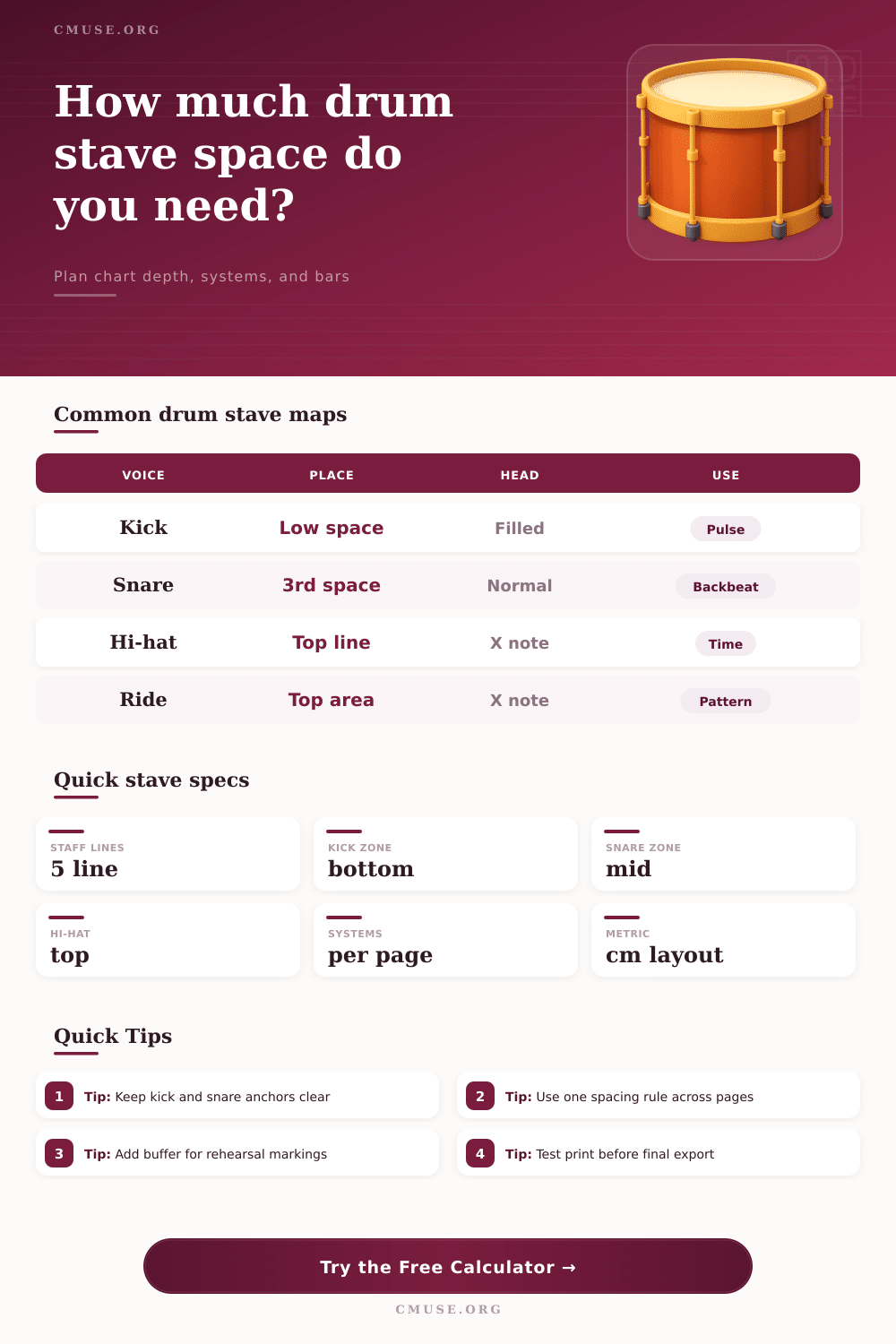
Kick Drum
Bottom space
Foundation voice
Snare Drum
3rd space
Backbeat anchor
Hi-hat
Top line
Time keeper
Ride / Tom
Upper voice
Accent layer
| Chart | Bars / sys | Depth | Use |
|---|---|---|---|
| 4/4 groove | 8 | 3 in | Pop set |
| Jazz chart | 6 | 2 in | Light comping |
| Funk sheet | 7 | 3 in | Busy groove |
| Metal grid | 4 | 4 in | Dense hits |
| Style | Bars | Density | Recommendation |
|---|---|---|---|
| Basic groove | 8 | 1.00 | Starter charts |
| Jazz chart | 6 | 1.20 | More space for comps |
| Funk chart | 7 | 1.10 | Balanced syncopation |
| Metal chart | 4 | 1.30 | Fast dense parts |
| Marching line | 10 | 0.85 | Longer systems |
| Orchestral perc | 5 | 0.80 | Open scoring |
| Project | Page size | Systems | Depth |
|---|---|---|---|
| 4/4 groove | 8.5 x 11 in | 3 to 4 | 3 in |
| 8-bar cue | 11 x 17 in | 4 to 6 | 4 in |
| 16-bar lead sheet | 11 x 17 in | 6 to 8 | 6 in |
| Drumline excerpt | 13 x 19 in | 8 to 10 | 6 in |
Drum staves are made up of strong pieces of wood that form the backbone of drum shells. They don’t bend thin layers together as you would do with plywood, but cut wood into trapezoid shapes and stick them side by side to form a whole round shell. That is an entirely different approach.
Solid wood instead of layered layers, and the difference immediately shows in the sound and look of the drum.
Why Stave Drum Shells Sound Better
Here the secret of the unique resonance in stave drums: glue. In plywood shells the glue between layers dampens vibration. Stave shells entirely escape that problem.
You can make them thick without glue running through the whole structure. Hence they sound much more alive (the wood itself vibrates freely). It is already well known that glue kills resonance in drum making, and the stave method almost entirely escapes that.
Playing stave snares, you immediately notice how much fuller they sound. Take a 12×7 jarrah stave snare, it gives that broad, open tone, that beats most 5.5-inch plywood versions and even rivals some 6.5-inch models on a 14-inch shell. Walnut staves have proved themselves in almost every musical situation.
Whether rock, tight acoustic jazz in a trio or big band, they adapt. The sensitivity is also remarkable, with broad dynamic range that lets you play softly without losing articulation.
Thickness of the shell directly shapes the base pitch and its whole character. Most bearing edges get cut at 45 degrees inwardly, then a bit rounded outside. For a thicker version it is easily done, depends on your order.
Popular woods are maple, mahogany, walnut, wenge and even purpleheart for something exotic.
Building stave shells is genuinely easier then you think, and you don’t need a ton of tools. I saw stave snare projects come together only with a rented miter saw and basic hand tools. Online calculators exist for the precise rip angle and stave count for any diameter that you target.
They give your angles, measures and costs in one go. How broadly you rip each outer stave, that much material goes to reach your target shell diameter.
The stave shell method isn’t new, it has been used for years in some of the best congas and djembes out there. Brady block drums, which are basically stave construction, have solid sonic credentials. Tama made some stave models, and independent builders like Unix created genuinely wonderful sounding drums by means of that technique.
The real advantage is that uniform staves with minimal glue let the shell keep all the natural sonic and vibrational quality of solid wood, while staying strong. Even so, thicker and denser shells sometimes trade away a bit of that natural resonance andsensitivity, that is a tradeoff worth keeping in mind.