Polyrhythm Calculator
Measure note spacing, shared cycles, and alignment points for any rhythm ratio.
🎶 Presets
⏱ Inputs
📊 Reference Table
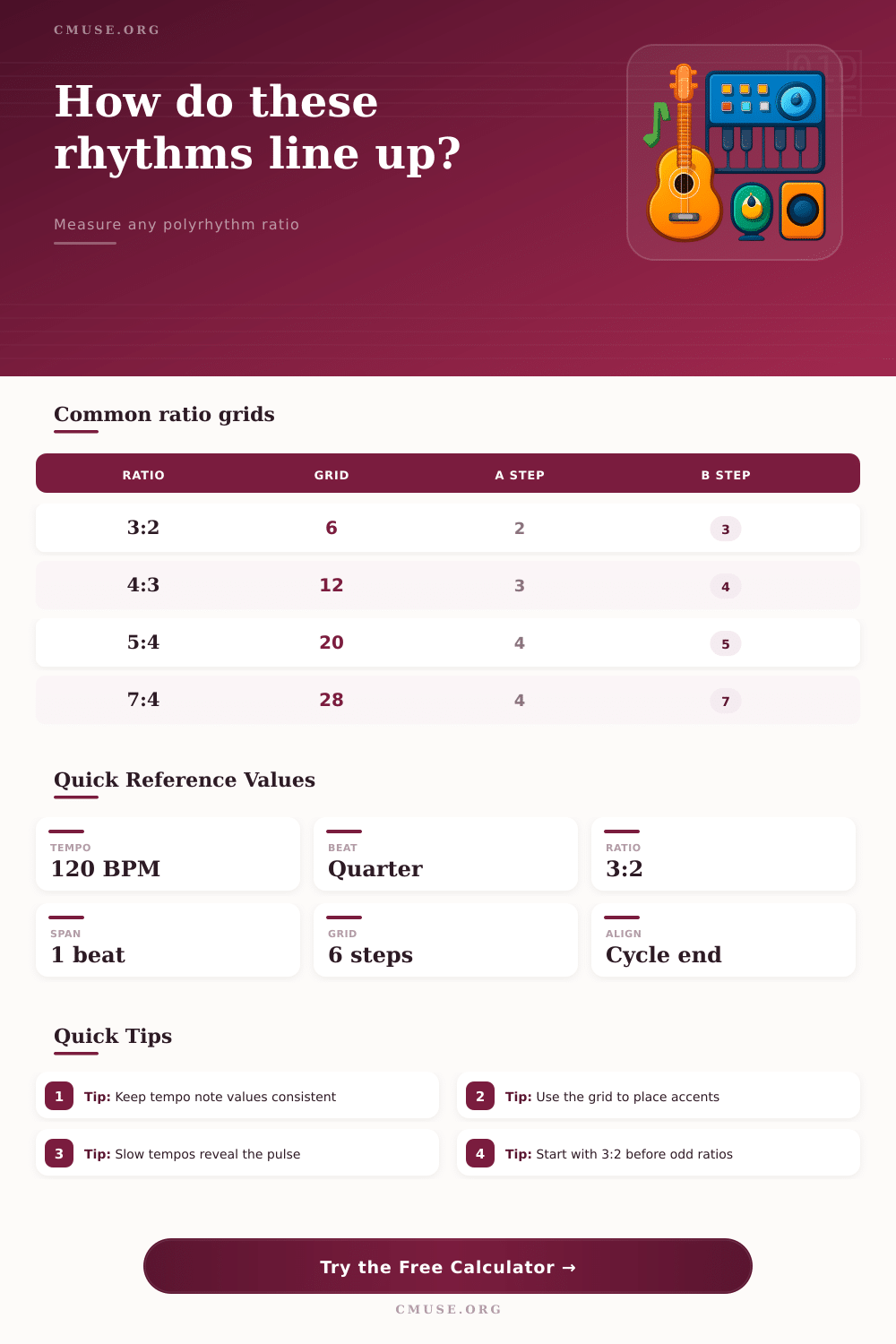
| Ratio | Grid | A step | B step |
|---|---|---|---|
| 3:2 | 6 | 2 | 3 |
| 4:3 | 12 | 3 | 4 |
| 5:4 | 20 | 4 | 5 |
| 7:4 | 28 | 4 | 7 |
🎯 Ratio Grid
Polyrhythm is the simultaneous play of two or more rhythms that do not seem to come from each other or simple versions of the same rhythm. The term comes from Greek words “poly” for “many” and “rhythm” for “measured motion” Rhythmic layers can base a whole musical piece called cross-rhythm or only a short part. Polyrhythms are some of the most misunderstood rhythmic patterns in music theory.
Two or more rhythms that do not fit well on paper sound together. In common 3:2 polyrhythm, two different rhythms seem to work and at the same time fight each other. The “3” is a triplet, where three eighth notes fit in space for only two.
What Is Polyrhythm?
In 4/4 rhythm it sounds as triplet eighths against smooth eigths.
Polyrhythms are in the center of African, Middle Eastern, Cuban and Brazilian traditional music. They are roots in American popular music too. In dance music you commonly use them, keeping rhythms for order.
The soft effect adds nice accents without chaos.
To learn any polyrhythm, count the least common multiple of the numbers. For 2 against 3 it is 6. The three falls come on 1, 3 and 5.
The two falls on 1 and 4. Count slowly from 1 until 6 and play notes according to rhythms. Helpful phrases remember positions.
For 2 against 3 say “nice cuppa tea”. For 3 against 4 “pass the goddamn butter”.
Polyrhythm should not be mixed with polymeter. Led Zeppelin in “Kashmir” show polymeter: drum stays in 4/4, but guitars and orchestra play 6/4 part, that syncs only on one after 12 bars. At polyrhythm different subdivisions fit in same rhythm, never out of sync, always sharing the beat on “1”.
The Christmas melody “Carol of the Bells” shows 2 against 3.
“46 & 2” of Tool has various polyrhythmic phrases. Basic it is a 3-over-4 pattern. 4 against 3 polyrhythm are really common in modern dance pop.
In classical music Chopin, Mozart, Beethoven, Dvořák, Schubert, Tchaikovsky and many others used them. Mastering them is really hard. Simple ones can be learned with time and practice, but 3 and 4 atthe same time stays a real challenge.