Guitar Fret Position Calculator
Map a scale length to exact fret slots, bridge compensation, and spacing for standard, short-scale, or baritone instruments.
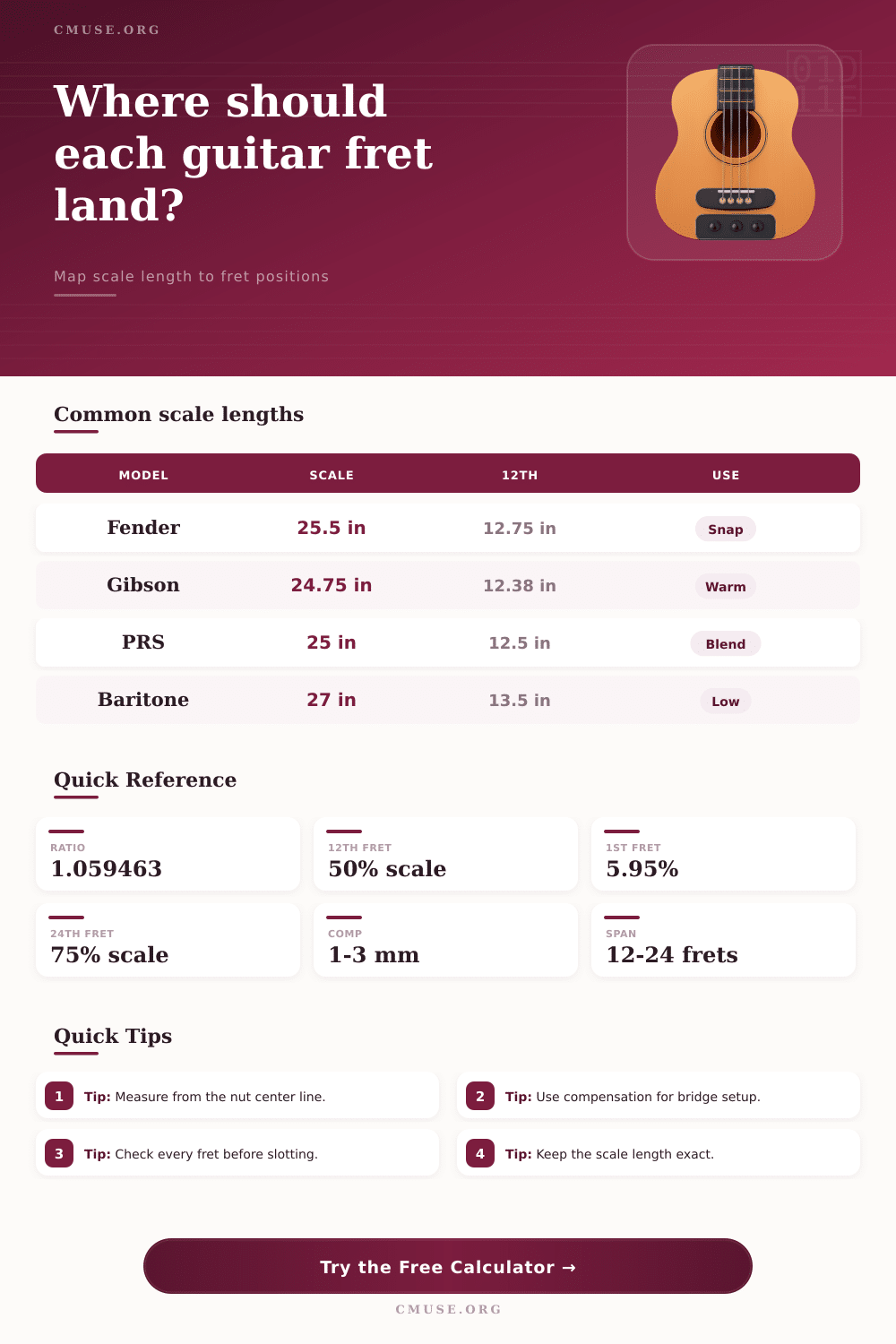
12th Root
1.059463
Equal temperament ratio
12th Fret
50%
Half the speaking length
1st Fret
5.95%
From the nut
24th Fret
75%
Three-quarter scale point
| Instrument | Scale | 12th fret | Use |
|---|---|---|---|
| Fender | 25.5 in | 12.75 in | Bright |
| Gibson | 24.75 in | 12.38 in | Warm |
| PRS | 25 in | 12.5 in | Balanced |
| Baritone | 27 in | 13.5 in | Low |
| Fret | From nut | Remaining | Spacing |
|---|
Guitar fret position is actually more hard than it seems first. The position shows where you lay your index finger on the fretboard, this is your basic spot, the lowest fret that you reach without moving the hand. Usually you play with four fingers on four frets: index, middle, ring and pinky.
So in the fifth position the index finger lands exactly on the fifth fret and the rest spreads from that place
Guitar Fret Positions and Finger Placement
The term “position” has a precise meaning talking about guitars. It deals with the place of your left hand on the fretboard in any moment. Assume you learn the C major scale first at the seventh fret.
That forms a clear image on the wood. If you stay in one position, you have a steady pattan for any scale that you play.
Most guitars have inlays in the 3rd, 5th, 7th, 9th, 12th, 15th, 17th, 19th and 21st frets. Some mark the first fret. Here happens something weird (some guitars), especially Gypsy Jazz models, have a sign in the 10th fret instead of the 9th.
The reason is that they were originally designed by mandolin specs, and mandolins traditionally mark there.
When you build a guitar, the distance between frets matters a lot. Modern guitars use an even-tempered scale with mathematical factor 17.817154, that determines the spacing. A piece of fretwire extends the whole fretboard, which means to play in any key.
The scale length also is important; it measures from the nut to the bridge saddle. Guitars with same scale length have same fret spacing. The goal is to share the vibrating string length so the octave is divided equally.
For instance, in the 12th fret the vibrating length is half of the open one.
As you lay fingers on the fretboard, that really affects. Fingers must lie only behind the fret itself, as close to the metal wire as possible. Especially on low frets, if you press too far and hard, the note sounds too high.
Good pressure keeps the thumb center behind the neck. The knuckles stay almost parallel to the strings, with curving fingers, so that the fingertip presses. The thumb usually points upward, almost direct to the neck.
Stretching it flat along the neck causes unnecessary tension.
For builders the tolerance is around plus or minus 0.2 mm for fret position. Interestingly, the first fret can drift by 1 mm and nobody will mind. Some luthiers reach plus or minus 0.1 mm using a glass.
Online calculators are needed, they help to do precise spacing for any scale length. Forbuilders the tolerance is around plus or minus 0.2 mm for fret position.