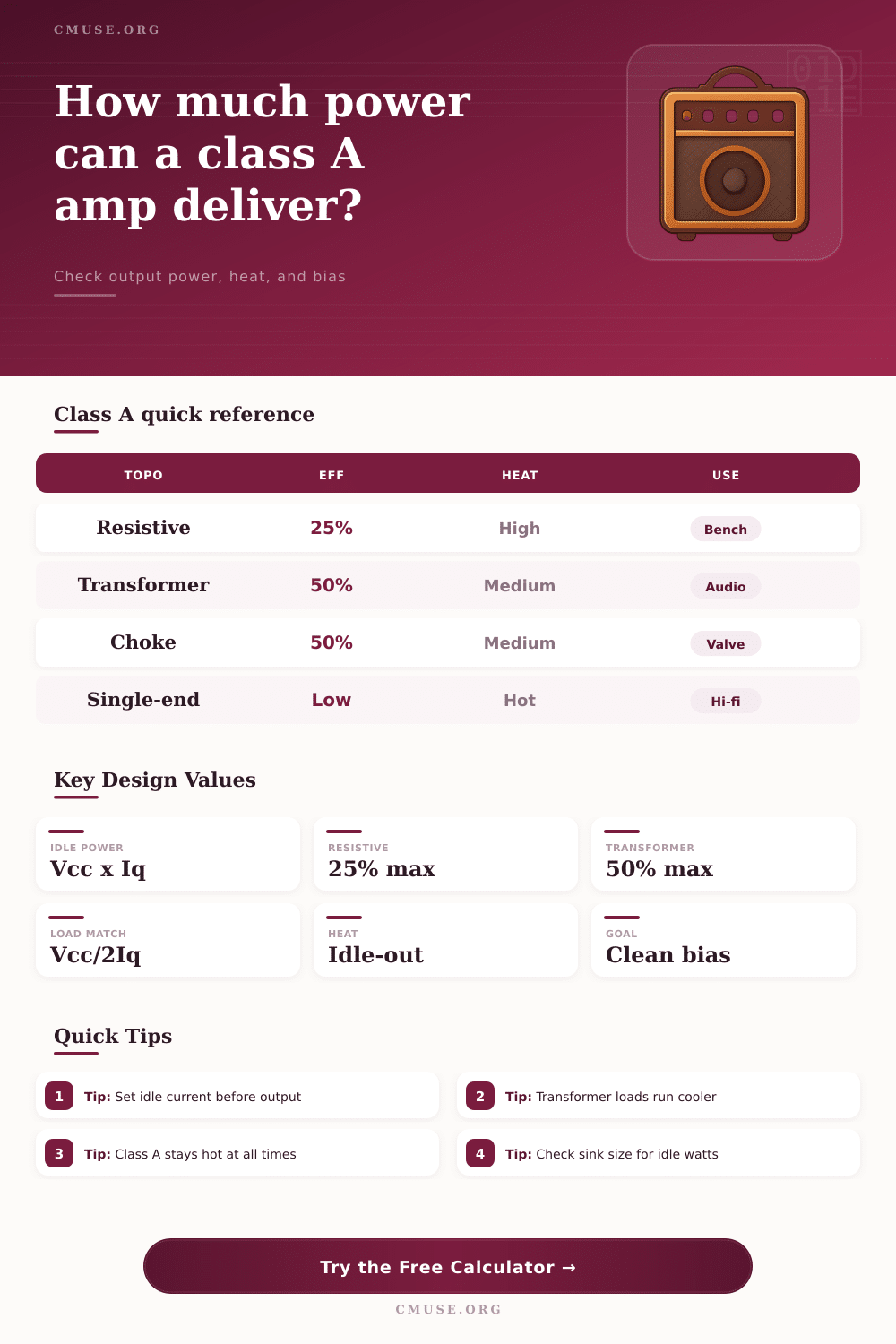
Class A Amplifier Calculator
Estimate output power, idle dissipation, efficiency, and load matching for class A audio stages.
| Topology | Eff max | Heat | Best use |
|---|---|---|---|
| Resistive load | 25% | Very high | Simple bench tests |
| Transformer | 50% | Lower | Audio output stage |
| Choke-loaded | 50% | Lower | Tube designs |
| Single-ended | Low | Always hot | Pure class A |
Resistive Load
Max efficiency
25%Heat stays high
Transformer
Max efficiency
50%Best audio use
Quiescent Power
Formula
Vcc x IqIdle heat budget
Ideal Load
Match target
Vcc/2IqResistive bias line
| Scenario | Supply | Load | Idle Current |
|---|---|---|---|
| Headphone amp | 12V | 32 ohms | 0.15A |
| Desktop audio | 18V | 8 ohms | 0.75A |
| Small speaker | 24V | 8 ohms | 1.0A |
| Transformer stage | 36V | 4 ohms | 1.5A |
At its core, amplifier is electronic device that takes signal and grows its force. It is useful because it strengthens the voltage, current or power, without changing the main parts. The frequency, waveform and phase, that stay unaffected.
Think about it as two-port circuit that draws energy from the supply and uses it for strengthening the signal, giving much more strong output
How Amplifiers Work
Amplifiers work with all kinds of signals; audio, video or whatever you add to them. In audio systems they are the main workhorsses, that give stronger and clearer sound, so that you genuinely enjoy the listening. Here is the spot: many audio devices today generate signals with enough voltage for little speakers.
The real restriction is the electricity. Your phone or computer simply can not produce enough energy to move speaker in good sound without help. Like this amplifier intervenes.
Every speaker that values its price requires that: take the weak analog signal of your CD player or computer and convert it into something with real force.
Amplifiers come in various kinds for different tastes. There are whole models, preamplifiers, power amplifiers and multichannel systems for surround sound. All can give heavy sound.
Power amplifiers genuinely show their force in raw power output. For serious audio fans nothing surpasses well done power amplifier in its own box with own supply. They commonly have balanced inputs and outputs.
Value note: they usually give less distortion and pureer sound than AV receivers.
In Class AB push-pull system each element bears a bit more than half of the burden, one takes the positive part of the signal, while the other takes the negative half. That construction operates effectively. Amps of that class do generate heat, but that is normal part of their work and do not cause problems.
Whether you use vacuum tubes or transistors, the basic principles are the same across all. For receive amplified voltage nourishment you require three different types: positive, negative and sole.
The preamplifier stands in the start of bass amp system. It takes the weak signal directly from your bass. Low electricity, low voltage, and strengthens it to middle level.
It does that to keep the noise low, while the signal travels. Value mention: electrical amps are not ideal for acoustic guitars. Many acoustic amps sound well quite a lot with good pickup and a bit of configuration.
Electrical guitar through acoustic amp commonly sound slim and dead without right preamp. For amplified acoustic playing the Fishman Loudbox line projects between good choices.
Invest in dedicated amplifier beyond that what AV receivers can have sense in sure cases. When you sit more than ten feet from your speakers, strengthen the sound or use less efficient speakers, then separate amps genuinely prove their benefit.