70V Amplifier Calculator
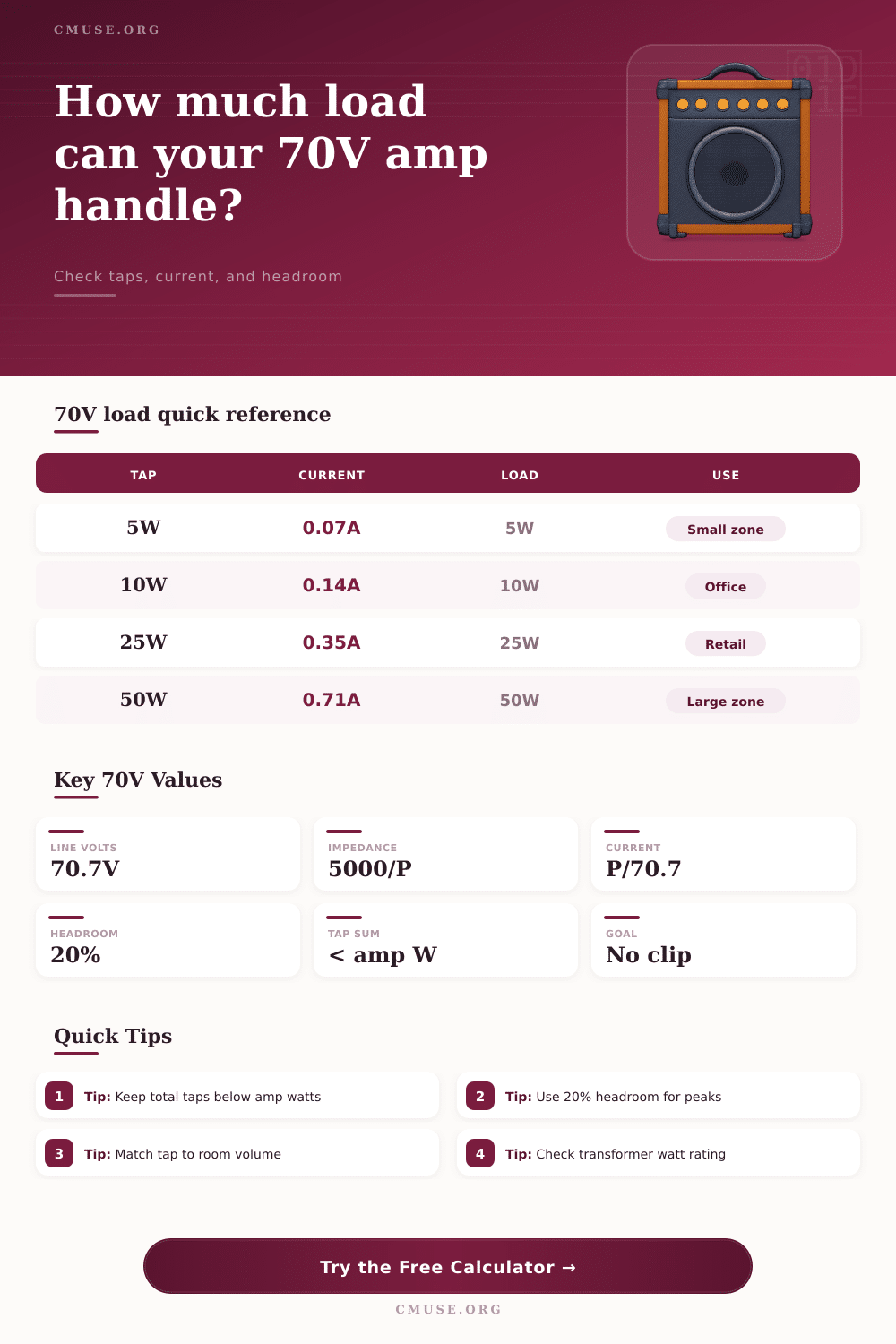
Size 70V line loads, estimate current draw, and check tap totals before you commit a zone to one amplifier.
| Tap | Current | Load | Rule of Thumb |
|---|---|---|---|
| 1 W | 0.01 A | 1 W | Paging |
| 5 W | 0.07 A | 5 W | Small room |
| 10 W | 0.14 A | 10 W | Office |
| 25 W | 0.35 A | 25 W | Retail |
5 W Tap
0.071 A
Quiet background audio
10 W Tap
0.141 A
Speech and paging
25 W Tap
0.354 A
Louder program audio
50 W Tap
0.707 A
High output zone
| Zone | Typical Tap | Speaker Count | Total Load |
|---|---|---|---|
| Small office | 5 W | 6 | 30 W |
| Retail floor | 10 W | 10 | 100 W |
| Restaurant | 7.5 W | 12 | 90 W |
| School hall | 25 W | 8 | 200 W |
At its core, a voltage amplifier is really simple: it is a circuit that gives more voltage than the input. It shines when you work with a fixed voltage source because it boosts the voltage. You need them when you must send power through long cables and you need higher voltage to make it work well
An amplifier, technically talking, is a two-port electronic circuit. It takes energy from the supply and expands the amplitude of any signal that arrives at the input terminals, and sends a much stronger signal on the other end. How much force it adds to the signal, you measure by its gain, the ratio between output and input, whether talking about voltage, current or power.
Basics of Voltage Amplifiers
About voltage gain we talk when we divide the output voltage by the input. It shows how the amplifier strengthens your incoming signal. The amplification is measured in decibels, and here is the good part: every 6dB doubles the voltage.
If your amplifier has 30dB gain, it will raise your voltage by a factor of 32.
Operational amplifiers for voltage come in two kinds; inverting and non-inverting configurations. The nice thing is that in any case you control the gain only by choosing the right ratio of resistors. Even so, most op amps max out around 35 volts.
They act weird when the output sits at zero or at maximum, so designing a 0-30V amplifier is more hard than you think.
But here is the thing: amplifying voltage itself is quite easy. Even a simple passive transformer can do that. What actually requires active electronics is amplifying power.
Higher voltage does not always give more power; raise the voltage, and the current drops, plus some power gets lost along the way. Amplifiers and transformers operate on entirely different principles.
A good voltage amplifier has high input impedance at the input side and low output impedance at the output side. Like this the source does not get bogged down and the load receives maximum voltage. To build such systems, you need three separate voltage supplies, positive, negative and ground to tie everything together.
Variable-gain amplifiers or voltage-controlled amplifiers allow you to change the gain by using a control voltage. You find them in audio-compressors, synthesizers and AM-circuits. In audio work gain almost always means a voltage boost.
But in low impedance applications, for instance when an amplifier drives a speaker, the gain is mostly an increase in current.
Class-B amplifier works without the permanent DC bias of Class-A. The transistor turns on only when the input signal passes the base-emitter threshold, which is around 0.7 V for silicon transistors. Give it zero input, and you receive zero output.
Because only half of the input signal passes to the output, this system is much more efficient than Class-A.