Amplifier Voltage Gain Calculator
Calculate linear voltage gain, gain in dB, power ratio, and output power for audio amplifier stages.
🔊 Presets
📏 Inputs
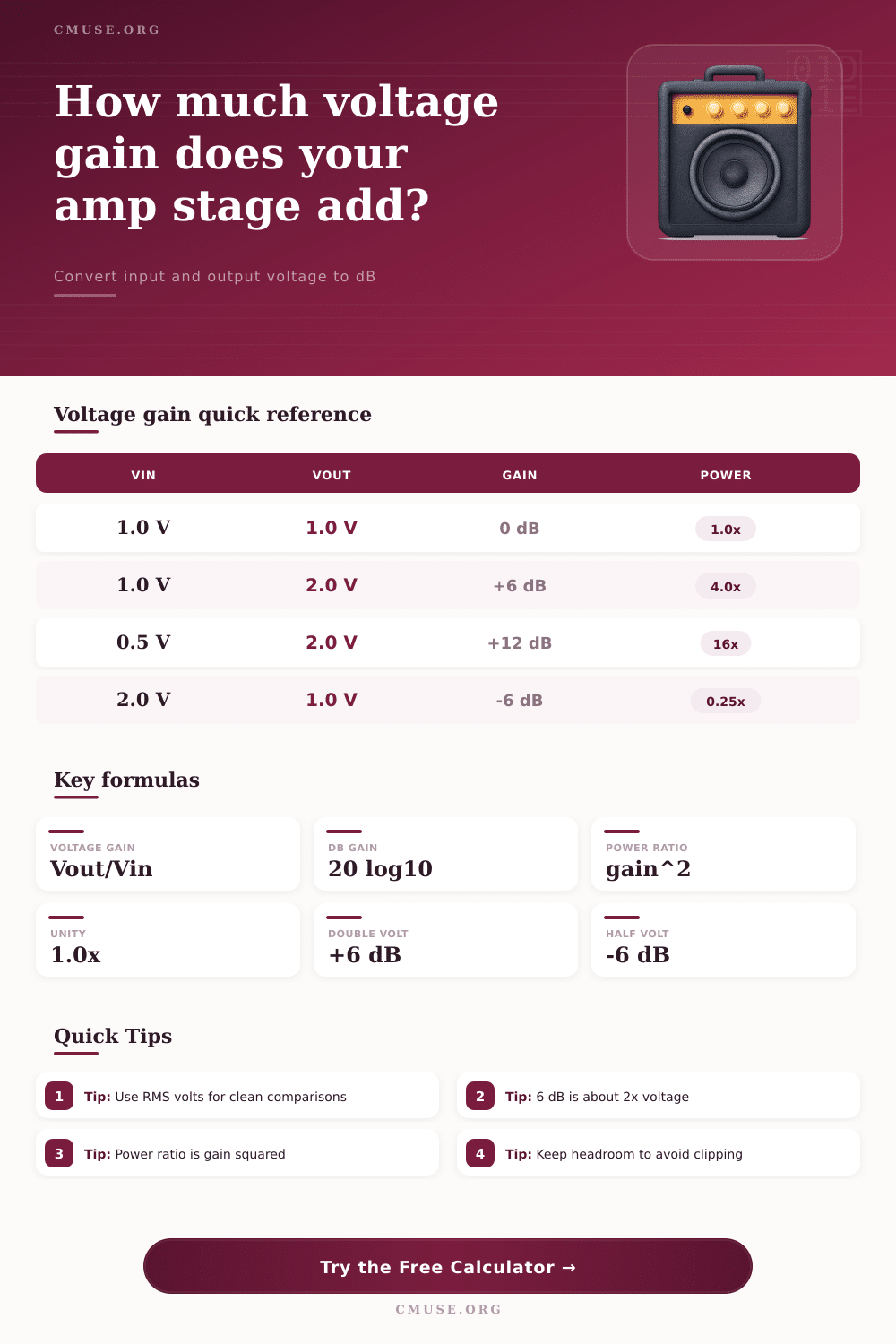
📊 Quick Reference
| Vin | Vout | Gain | Power |
|---|---|---|---|
| 1.0 V | 1.0 V | 0 dB | 1.0x |
| 1.0 V | 2.0 V | +6 dB | 4.0x |
| 0.5 V | 2.0 V | +12 dB | 16x |
| 2.0 V | 1.0 V | -6 dB | 0.25x |
📋 Gain Spec Grid
💡 Tips
Amplifier voltage gain is the ratio between the output and input voltage. It shows how the amplifier increases the signal voltage. For instance, if the gain is two then the output doubles the input.
Gain simply measures the level of amplification.
What is amplifier gain?
Mathematically you symbolize it by means of the capital letter “A_V”. If an amplifier receives an AC signal of 2 V RMS and gives 30 V RMS, then its AC voltage gain matches 30/2, so 15. Simple way to imagine that: 10 V out for 1 V in, which gives a gain of 10.
In audio and general amplifiers, especially operational, “gain” normally means voltage gain. In radio frequency amplifiers it usually means power gain. The use depends on the kind of circuit that is discussed.
The amplified level of the input signal you express by means of decibels. Every 6 dB corresponds to a doubling of the voltage. An amplifier with 30 dB gain turns 2 V into 64 V, so a factor of 32.
If output of 3.5 V comes from 35 mV input, gain is 40 dB, which menas 100 times expansion.
An amplifier can reach voltage gain of 100, current gain of 10 and so power gain of 1,000. Everything you can put in decibels. Power gain is calculated as 10 times the logarithm of the output to input power.
Voltage gain uses a similar formula.
By means of a voltage amplifier you can expand an audio signal, that was too weak to here, until it sounds clear. It chiefly amplifies voltage of guitars or microphones, so that the signal is ready for further processing and later projection by means of speakers. Besides that, gain helps to get a good signal-to-noise ratio.
Most amplifiers use feedback to set the gain. A change in that loop alters the gain. When gain changes, the bandwidth automatically adjusts.
A normal amplifier does not alter its gain according to the input signal strength, except in case of overload by means of big input voltage.
A single preamp stage gives enough voltage to the power amplifier, because the preamp gain multiplies by means of that of the power stage. In practice, extra load reduces the gain below the maximum, because the current needs to rise todeliver more current to the load.