Amplifier Efficiency Calculator
Estimate output power, input power, heat loss, and efficiency for common amplifier classes and speaker loads.
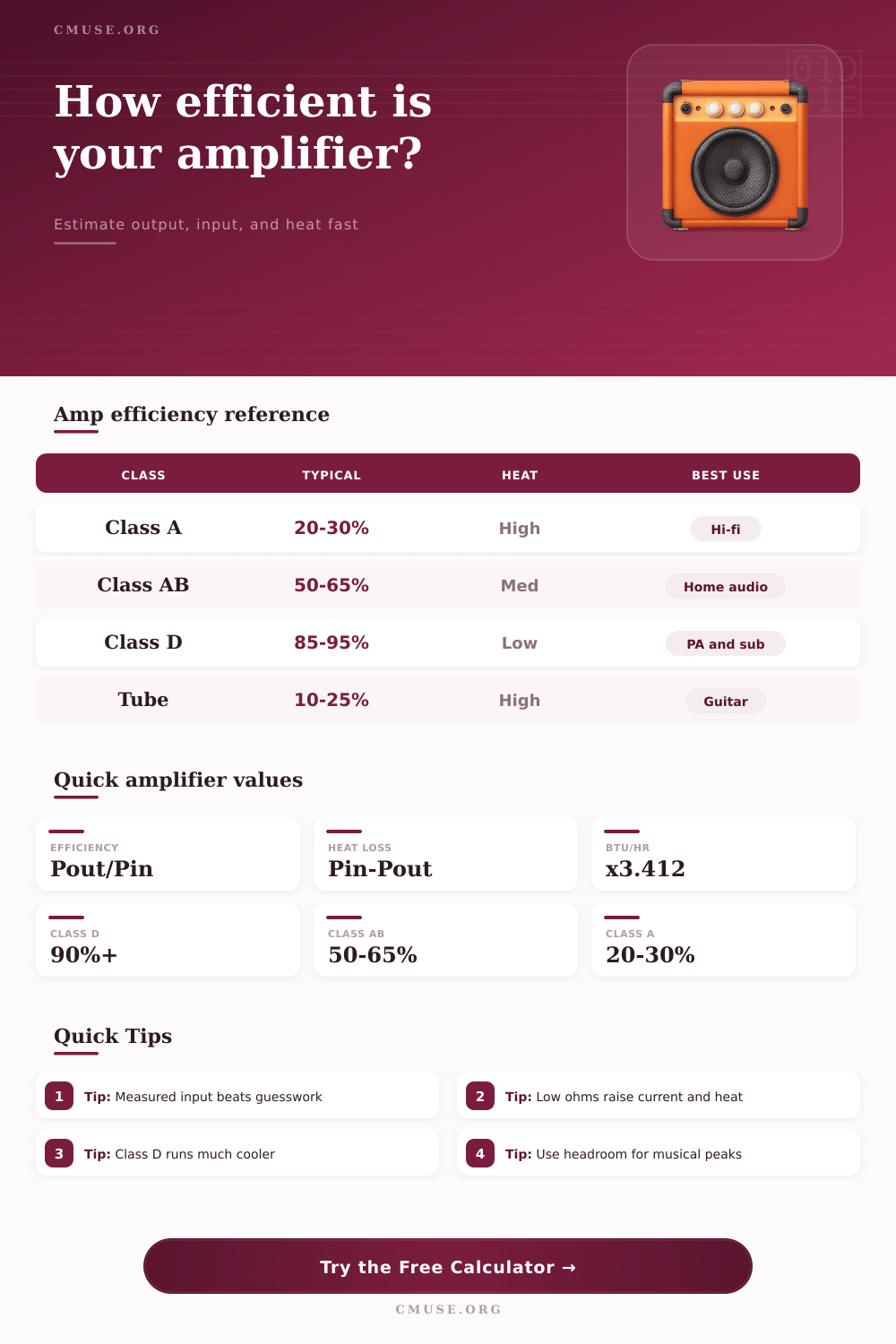
| Class | Typical | Heat | Best Fit |
|---|---|---|---|
| Class A | 20-30% | High | Reference audio |
| Class AB | 50-65% | Medium | Home audio |
| Class D | 85-95% | Low | PA and subs |
| Tube | 10-25% | High | Guitar amps |
| Setup | Output | Class | Heat Notes |
|---|---|---|---|
| Studio monitor amp | 2 x 75 W | AB | Moderate airflow |
| PA top amp | 2 x 300 W | D | Compact rack cooling |
| Subwoofer amp | 1 x 800 W | D | Low idle draw |
| Guitar combo | 1 x 30 W | Tube | Runs hot by design |
Class A
20-30%
lowest efficiency
Class AB
50-65%
balanced design
Class D
85-95%
highest efficiency
Tube
10-25%
warm but hot
Amplifier efficiency shows how much power actually arrives to the speakers compared with how much enters. It is the ratio between the electrical energy that moves the speakers and the whole power given to the amplifier. The efficiency of the amplifier depends only on its own build, not on the time of use.
Simply said it depends on how much power drains from the power supply and how much actually goes to the load.
Amplifier efficiency and main classes
An amplifier with a rated power of 100 watts always delivers its declared output level. The efficiency relates to the losses of input power that happen during the production of that rated power. To estimate the output power you use the formula P = V² / R, where V is the output voltage and R the resistance.
The most commonly used classes of amplifiers are A, B, AB and D. Class A is very inefficient, because it wastes a lot of power as heat, even when it does not work. It always consumes almost as much power as if it produces full power, although maybe nothing comes out. Theoretically it reaches a maximum of 25 percent with a resistive load, while with an inductive load like a converter it can go up to 50 percent.
In practice it commonly stays at about 40 percent. Class A has a theoretical efficiency limt of only 50 percent, so it must spend much power and dump it as heat.
Class AB well improves the efficiency, similarly to Class A. In typical push-pull AB amplifiers each element takes a bit more than half of the work. Like this it works more efficiently. Most AB amplifiers reach around 65 percent of efficiency.
Typical AB amplifiers have 60 percent efficiency, with 40 percent of power lost in the heatsink.
Class D reaches much higher efficiency by means of entirely new working principles. They are high-efficiency, small and stay relatively cool. The main advantage of Class D is the mighty efficiency, that sometimes reaches 95 percent.
The MOSFETs waste power only during the switching, not in a steady state. So the amplification happens extremely well, because the signal passes most of its thyme either in full state or off.
Between traditional RF classes Class C is the most efficient. The efficiency grows when the conduction angle declines, and can reach 100 percent if it gets close to zero. The output device wastes the least power in cutoff or saturation state.
In a higher amplifier class the efficiency grows, but the linearity declines. A less linear amplifier gives more power efficiency, but twists the signal. Modern solid state amplifiers have bigger power, the speakers got smaller, but theefficiency declined.
They go together.