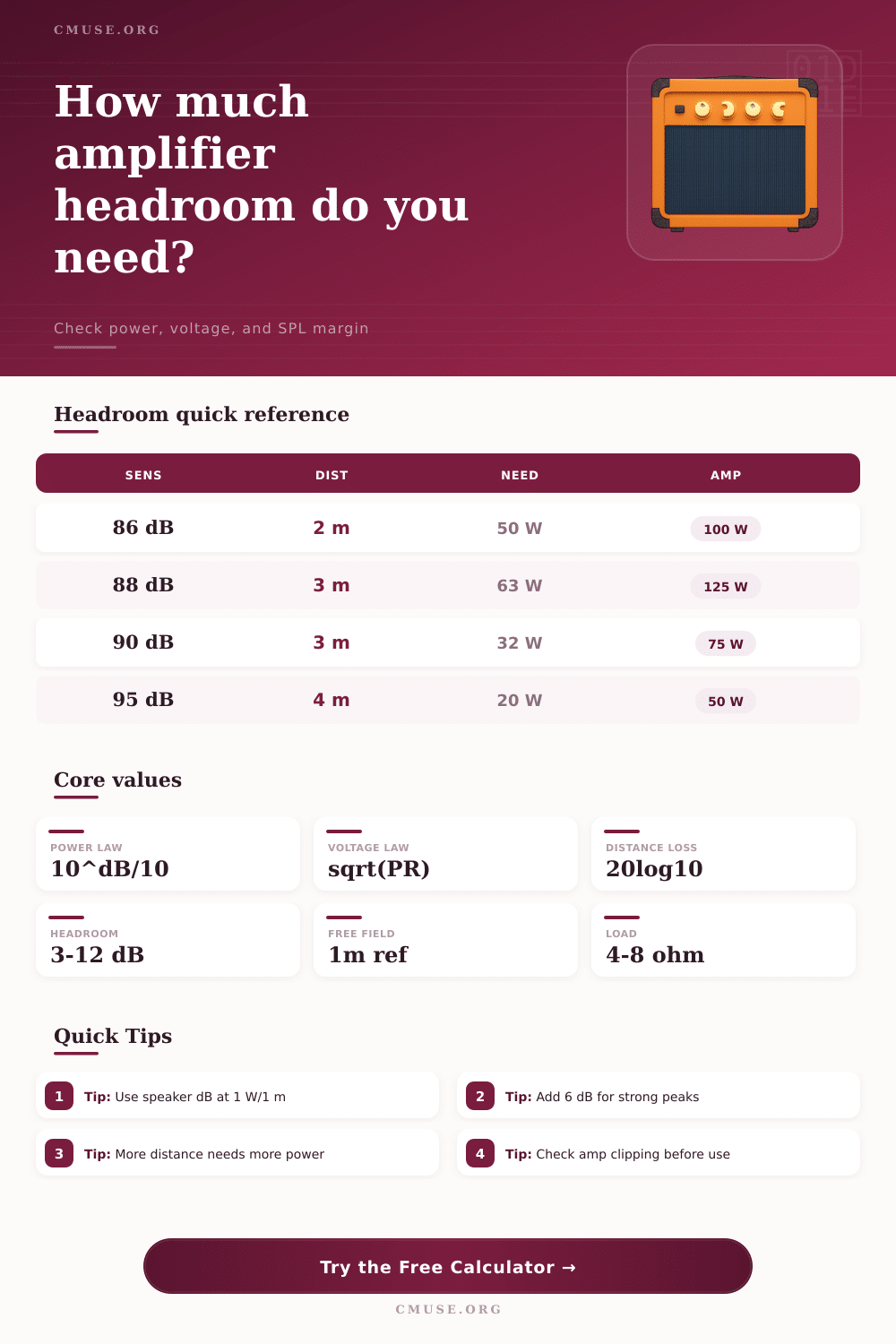
Amplifier Headroom Calculator
Compare required power, peak demand, and available margin from speaker sensitivity, distance, and amp output.
| Speaker type | Sensitivity | Typical amp | Headroom note |
|---|---|---|---|
| Bookshelf | 84-88 dB | 50-150 W | Needs margin |
| Studio monitor | 87-90 dB | 30-100 W | Close range |
| Floorstander | 89-92 dB | 75-200 W | Room dependent |
| PA speaker | 95-100 dB | 200-1000 W | Peak reserve |
| Distance | Loss | Multiplier | Note |
|---|---|---|---|
| 1 m | 0 dB | 1.0x | Reference |
| 2 m | 6 dB | 4.0x | About four times power |
| 3 m | 9.5 dB | 8.9x | Approx free field |
| 4 m | 12 dB | 16x | Much more reserve |
Bookshelf
86 dB / 8 ohm
Moderate amp, short distance
Studio
88 dB / 6 ohm
Nearfield monitors
PA
98 dB / 4 ohm
Loud peaks, more reserve
High-Z
101 dB / 8 ohm
Efficient horn loads
Amplifier headroom is the difference between the current used power level and the maximum ability of the device. Think about it as the distance between your head and the car ceiling. It shows how far you can turn the amplifier, before the clean sound starts to distort.
With bigger headroom happens less distortion. This way you can reach strong attacks without compression.
What Is Amplifier Headroom?
Dynamic headroom is the ability of an amplifier to restore peaks of signal without distortion. An audio signal forms a complex waveform with many peaks above the standard power. From a 100-watt amplifier you will not receive 100 watts of clean sound, without the high peaks starting to clip.
Clipping means the flattening of a waveform because of limits of the voltage output in the amplifier. Here distortion jumps from maybe one percent to 10, 20 or more, and the sound becomes awful.
Here is a simple image: from a 1-watt amplifier drawing 0.95 watts, it will clip and distort. But from a 10-watt amplifier with gain turned down, 0.95 watts stay perfect. You do not even leave the linear zone of the amplifier.
That is the purpose of headroom.
Headroom counts for many areas of professional sound, like PA systems, speakers and guitar or bass amplifiers. All those devices are made for work in a safe range without too much stress. Guitar amplifiers have at least two stages: preamp and power section.
Overdriving adds gain to the signal, natural from the preamp, power section or both.
Headroom is hard to measure, because it depends strongly on the input signal level. Guitar pickups range widely in output and how far they push the amplifier. If the power source fails the specifications, the headroom drops and distortion comes early.
For a bass amplifier competing with loud instruments and aiming for a big clean tone, best are plenty of headroom, so more watts ore power. That gives space for more sound without risking bad distortion or clipping. By means of extra power above the used volume level, you escape distortion, that could damage the amplifier and connected speakers.
Sufficient power for headroom matters especially for sudden loudmoments in classical music.