Amplifier Impedance Calculator
Check safe speaker load impedance, current draw, and power so your amplifier stays within its rated range.
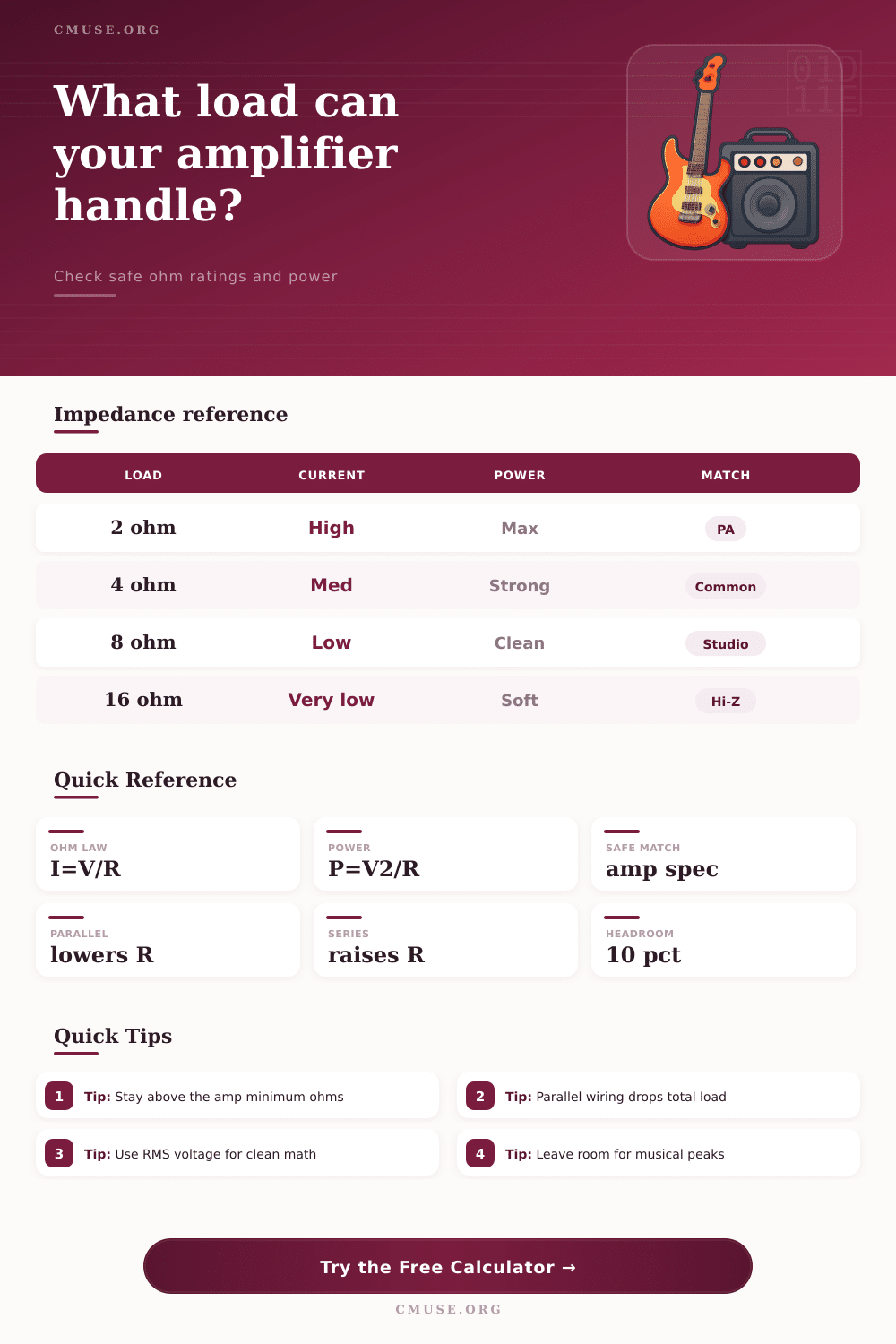
| Load | Current | Power | Match |
|---|---|---|---|
| 2 ohm | High | Max | PA |
| 4 ohm | Med | Strong | Common |
| 8 ohm | Low | Clean | Studio |
| 16 ohm | Very low | Soft | Hi-Z |
| Setup | Wiring | Load | Note |
|---|---|---|---|
| Single cab | 1 x 8 | 8 ohm | Safe default |
| Two cabs | Parallel | 4 ohm | Common match |
| Two cabs | Series | 16 ohm | Higher load |
| Bridge pair | Bridged | 8 ohm | Check amp spec |
2 ohm
Highest
Current demand
4 ohm
Common
Balanced output
8 ohm
Clean
Lower stress
16 ohm
Light
Easy on amps
Amplifier impedance is one of those topics that sounds complicated but is really quite simple when you understand the basics. Speaker impedance is the resistance that speakers offer to the current from the amplifier. Because the current of an amplifier is AC not DC like from a battery, you call it impedance.
Both resistance and impedance are measured in ohms. The higher the value in ohms, the harder it is to pass electricity through it.
What Amplifier and Speaker Impedance Means
Amplifiers are described according to their input and output impedance, as well as power and current values. Two impedances matter in an amplifier: the input impedance and the output impedance. These are concepts, not physical resistors that you could remove or change.
They show values in ohms that depend on the design of the amplifier and the arrangement of parts around the transistor.
For a good amplifier the input impedance must be as high as possible, while the output impedance must be as low as possible. Amplifiers are designed to amplify an input signal. They recieve a weak signal at the input, add gain, and give a stronger version out.
Because of that, values of input and output impedance matter to understand for audio amplifiers. When a preamp with low output impedance feeds a power amplifier with high input impedance, there is no loss of signal level.
Speaker impedance, in ohms, shows how much electrical current it takes from an amplifier. The relationship shows the current that speakers try to draw: current equals voltage divided by impedance. Most speakers are rated at 4, 6, or 8 ohms.
With lower impedance there is less resistance, which helps the speaker convert the signal more well. But a 4-ohm speaker can process music that risks overloading and seriously damaging an 8-ohm amplifier.
Too much current flow heats beyond the ability of the output semiconductors. Modern amplifiers can handle impedances down to 4 ohms, but they go into protection mode at even lower values. Using 6-ohm or 8-ohm speakers is equally safe.
An amplifier can be damaged by very low impedance like 2 ohms, if it was not built for that.
Connecting an amplifier too a speaker with higher impedance than designed gives softer sound at the same level on the dial. Mismatches of impedance also cause weak bass. As with all devices for electrical current, amplifiers have output impedance.
Think of it as a resistor in series with the output, which shows the imperfection of that output stage. Directly related to output impedance is the damping factor. Typical output impedance of a solid state amplifier can be 0.001 ohms, much lower than any speaker.
That helps to minimize interactions between amplifier and speaker.
Matching impedance between amplifier and speaker ensures safe operation and best results. Most modern amplifiers tolerate a mismatch of 2:1, up or down. Makers show the minimum recommended impedance for speakers, usually 8 or 4 ohms.
To avoidDamage, always follow those ratings.