Amplifier Wire Size Calculator
Estimate speaker wire gauge, voltage drop, and safe run length for your amp, load, and cable distance.
8 AWG
0.628 ohm
Best for long runs
10 AWG
0.999 ohm
Very low loss
12 AWG
1.588 ohm
Most room setups
14 AWG
2.525 ohm
Shorter speaker runs
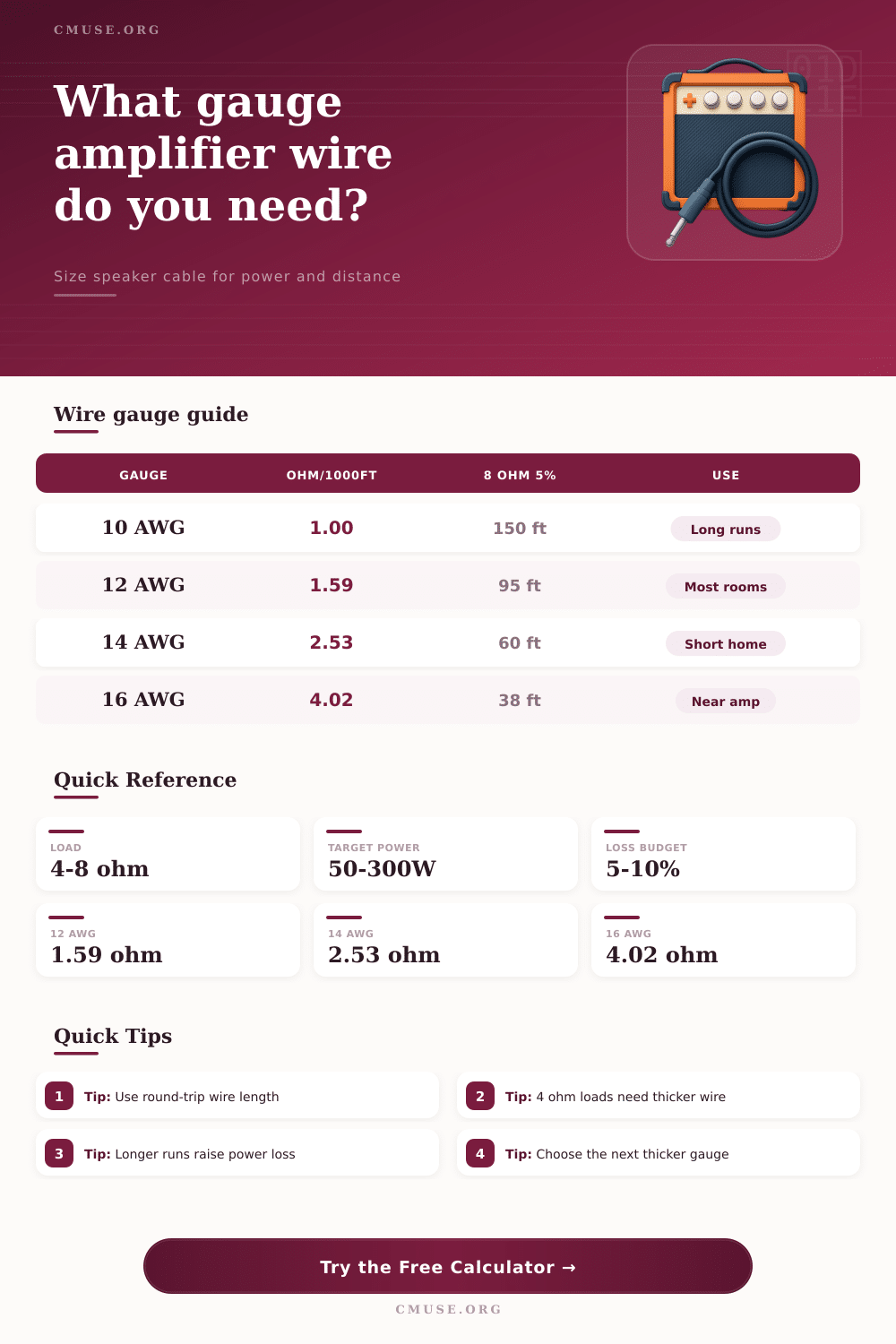
| Gauge | Ohm / 1000 ft | 8 ohm at 5% | Typical use |
|---|---|---|---|
| 8 AWG | 0.628 | 238 ft | Very long runs |
| 10 AWG | 0.999 | 150 ft | Long PA lines |
| 12 AWG | 1.588 | 95 ft | Home theater |
| 14 AWG | 2.525 | 60 ft | Short rooms |
| Scenario | Load | Run | Suggested wire |
|---|---|---|---|
| Desktop amp | 8 ohm | 8 ft | 16 AWG |
| Living room | 8 ohm | 25 ft | 14 AWG |
| Garage stack | 4 ohm | 20 ft | 12 AWG |
| Outdoor pair | 8 ohm | 60 ft | 10 AWG |
Choosing the right size of wire for the amplifier is more important than many folks believe The amplifier requires big power and ground for the needs of the flow. Wires in the circuit must match the load that you lay on it. If you choose wrong size, real problems can happen.
The need of wire for amplifier depends on three main causes. The longer is the cable and the higher the flow, the more thick must be the wire. Little wire has high resistance, which causes big voltage drop even for short distance.
Pick the Right Wire Size for Your Amplifier
Imagine power cable for amp at 12 V from the battery. For instance, if you use too small thikc cable, the voltage at the amplifier can fall to 10 V.
Little AWG number means more thick wire. 1/0 (“one-aught”) is usual name for 0-AWG wire, and 2/0 (“two-aught”) for 00-AWG. In car 12-volt DC audio system 2/0 AWG copper wire gives low resistance for high flow, securing minimal voltage drop and full power to the amplifiers.
For amplifiers of medium to high power (500… 1000 W RMS) you advise 4-AWG wire. The kit of brand name amplifier installation carries 18 feet long pure copper 4-AWG power wire, rated in 175 A and fit for 1750-W system.
According to the length, wires between 4 and 8 AWG work for power and ground. 4 AWG works for the fused distribution block, where 8 AWG can go to more little amp.
Thick AWG wire lowers resistance and helps the amplifier give full power. Fatter wire preserves high frequencies and avoids signal loss. For long distances expand the thicknes in two AWG sizes, to avoid loss.
The longer the way, the thicker the wire for same amperage.
The same rules count for speaker wire as for power wire. Too slim speaker wire can not bear the RMS output of the amplifier. For PA and stereo, more thick and short wire keeps damping factor and control bass drivers.
16, 14 or 12 AWG speaker cable works for 3 feet cable with any instrument amp. Power wire you sell in spools of 50 to 500 feet, with 1/0, 4 and 8 AWG for car amplifiers. Never use too little AWG cable, because it will warm up and can melt the insulation overtime, which causes electrical short.