Headphone Amplifier Calculator
Estimate required power, voltage, current, and gain from headphone sensitivity, impedance, and target loudness.
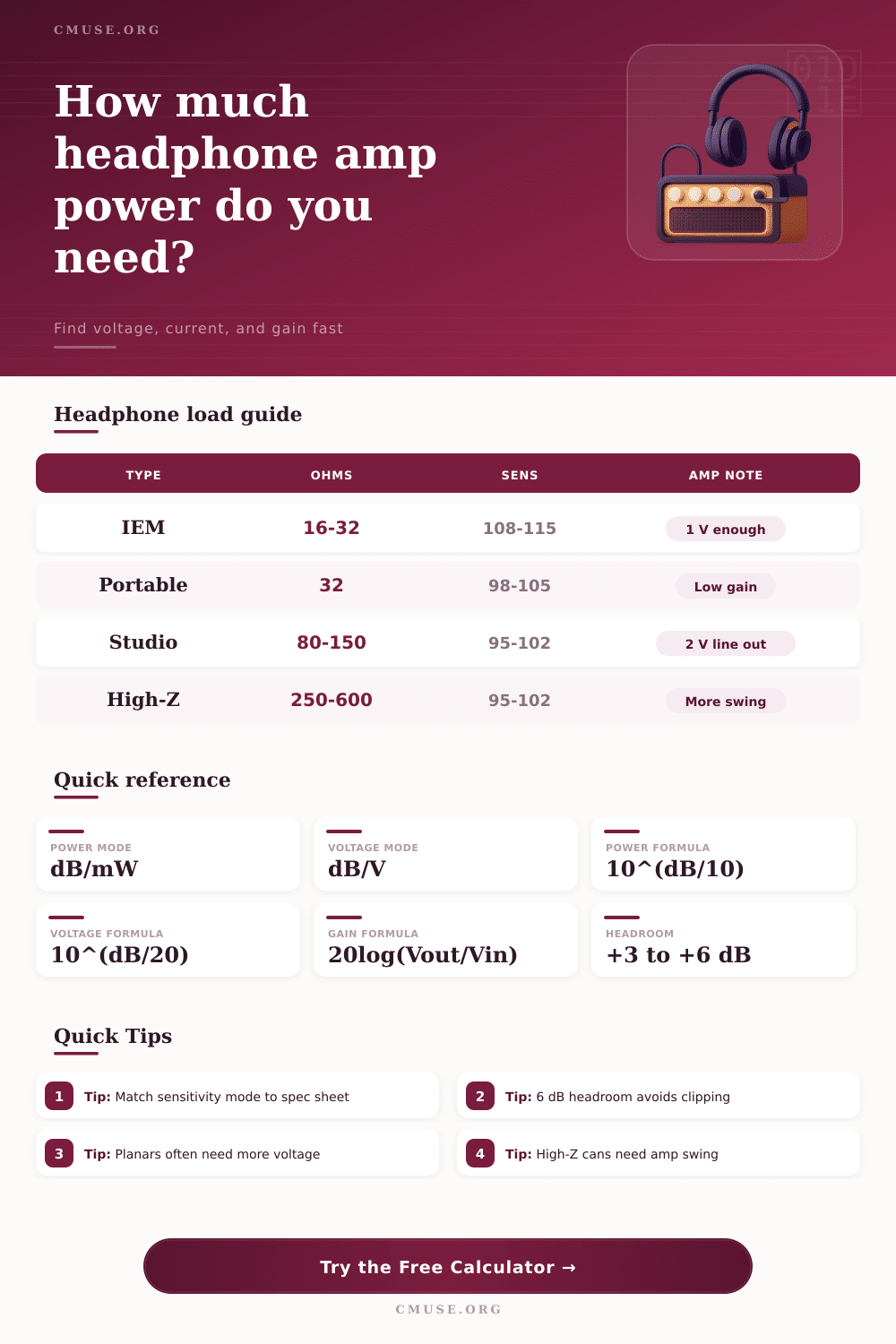
IEM
16-32 ohm
High sensitivity, low swing
Portable
32 ohm
Easy to drive on most sources
Studio
80-150 ohm
Needs moderate voltage
High-Z
250-600 ohm
Needs more amp swing
| Headphone type | Impedance | Sensitivity | Amp note |
|---|---|---|---|
| IEM | 16-32 ohm | 108-115 dB/mW | Low voltage |
| Portable | 32 ohm | 98-105 dB/mW | Low gain |
| Studio | 80-150 ohm | 95-102 dB/mW | 2 V helps |
| High-Z | 250-600 ohm | 95-102 dB/mW | More swing |
| Target SPL | Use case | Needed headroom | Notes |
|---|---|---|---|
| 90 dB | Quiet listen | 0-3 dB | Very safe |
| 95 dB | Normal music | 3-6 dB | Good margin |
| 100 dB | Loud peaks | 6 dB | Common target |
| 105 dB | Short bursts | 6-12 dB | Check hearing |
Headphone amplifier wattage commonly confuse. Rather than speaker amplifiers, that measure according to watts in 8 ohms, headphone amplifiers usually measure according to the output power at various impedance levels #How much power is needed, depend on the sensitivity of the headphones, their impedance in ohms and the wanted loudness in dB SPL.
That amplifier fits to give theoretically 500 watts, do not guarantee, that it will deliver that much against every load. It adapts to the resistance, and only reach its maximum according to the concrete impedance. Some models give more power in high impedance, for instance in 100 ohms, while others keep the same level at all impedance levels, say 10 watts everywhere.
How Much Power Do Headphone Amps Need
Most portable devices reach around 25 to 33 milliwatts in 32 ohms. Simple entry-level digital audio players deliver approximately 50 to 100 milliwatts in 32 ohms. Amplifier as the FiiO E10K issue 200 milliwats in 32 ohms.
One whole watt in 32 ohms already suffice for drive the most of headphones.
The output power changes according to impedance. For instance, the DX3 deliver in 32 ohms 1500 milliwatts, so 1.5 watts. In 300 ohms, as for HD 6XX, it declines to 251 milliwatts.
Amplifier with 5 watts in 32 ohms will give less in 300 ohm load, but that no necessarily does it weak or terrible here.
Some high-power designs deliver even to 6 watts in low impedance, although whether that genuinely is useful for headphones, stay doubtful. Orthodynamic models with very low sensitivities, that require so much energy, are rare. The O2 amplifier yet beats the most of headphones, but new ones as the Atom Amp and Magni Heresy surpass it.
The impedance of headphones as HD600 do not stay the same through all frequencies. Hence the frequency response adjusts according to the output impedance of the amplifier, that ranges from under 0.001 ohms to 120 ohms. If the headphone impedance fall under that of the amplifier, the drivers can overheat and break.
More seriously than pure power is the quality. For find the right amplifier, note the impedance and sensitivity of your headphones, later search model, that delivers the involved power in that impedance.