Speaker Ohm Calculator
Check series, parallel, and mixed speaker loads, then estimate current, power, and cable loss for your amp.
10 AWG
0.999 ohm
Best for long runs
12 AWG
1.588 ohm
Low loss choice
14 AWG
2.525 ohm
Most home systems
16 AWG
4.016 ohm
Short speaker runs
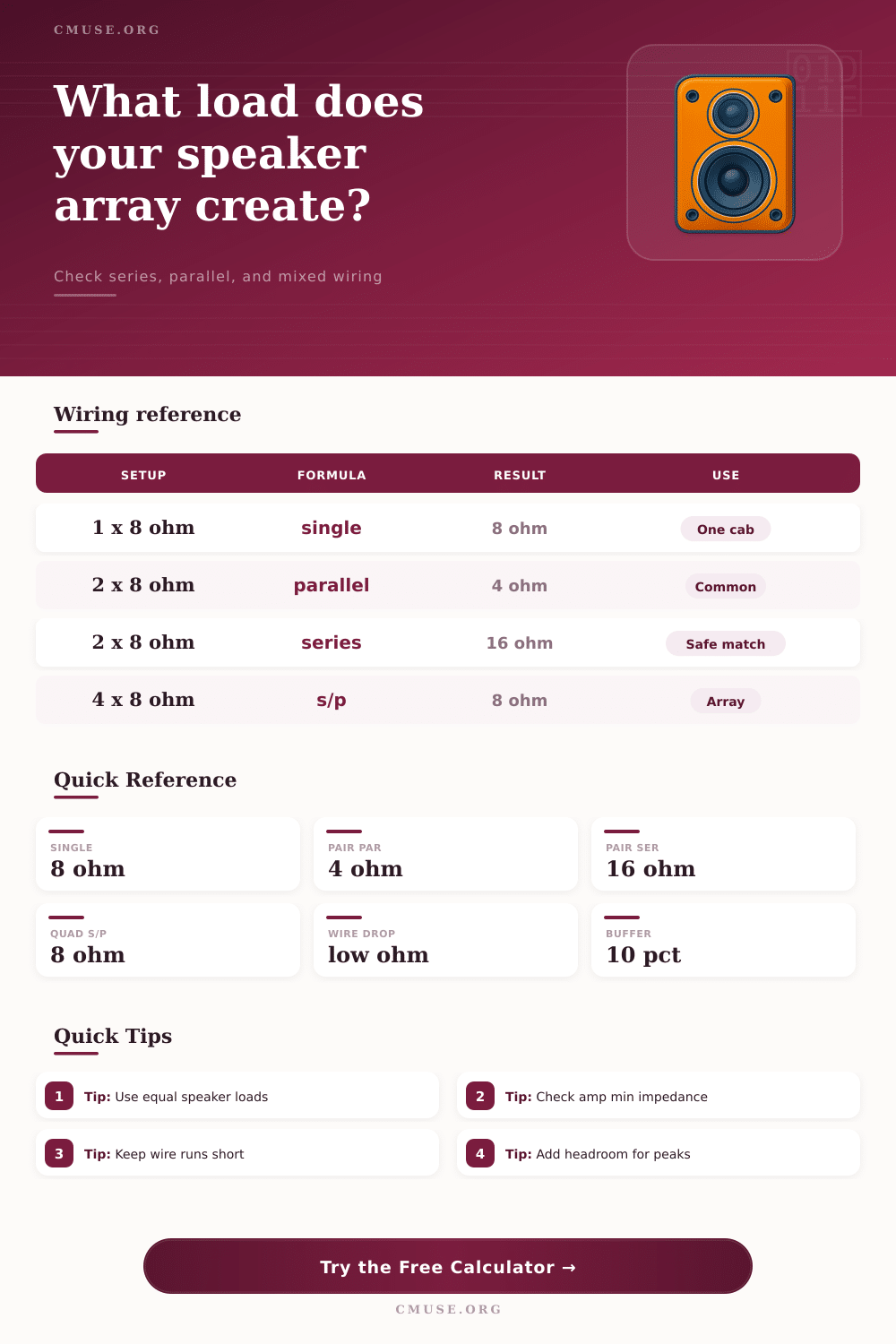
| Setup | Formula | Result | Use |
|---|---|---|---|
| 1 x 8 ohm | 1 speaker | 8 ohm | Single cab |
| 2 x 8 ohm | 8 / 2 | 4 ohm | Parallel pair |
| 2 x 8 ohm | 8 x 2 | 16 ohm | Series pair |
| 4 x 8 ohm | 2 x 8 / 2 | 8 ohm | Series-parallel |
| Set | Layout | Load | Note |
|---|---|---|---|
| Bookshelf pair | Parallel | 4 ohm | Typical home amp |
| Guitar pair | Series | 16 ohm | Safer amp match |
| Quad cabinet | S/P | 8 ohm | Even power split |
| Sub pair | Parallel | 2 ohm | Only stable amps |
The speaker impedance is the electrical resistance that the speakers offer to the flow from the amplifier. “Impedance” shows what limits or blocks the flow of power from a receiver or amplifier to the speaker… It comes from the unique electrical properties of the speaker.
You measure it in ohms and it matters for speakers, AV receivers and amplifiers
What Is Speaker Impedance and Why It Matters
Because the flow from amp is AC, not DC as from a battery, you call it impedance. In a DC circuit, where the flow goes only one way, it matches simple resistance: you count it dividing the voltage number at the source by the flow in the circuit. Speakers on the other hand work with alternating flow, which makes it complex.
Imagine water flowing through a tube. A speaker of low impedance is like a tube with a wide opning, it allows more electrical flow from the amplifier. Like this the amplifier can give more power to the speaker.
Speakers of higher impedance limit the flow more.
Speakers have two main attributes. Sensitivity shows how much sound it can make with a set amount of power. Impedance relates to the flow that the speaker takes from the amplifier at a given voltage.
It depends on the frequency, so although a driver can have a nominal impedance of 8 ohms, that value moves up and down through the audio spectrum of 20 Hz to 20 kHz. Almost all speakers show a ratio of 2:1 or more between minimum and maximum impedance through the whole frequency range.
Amplifiers usually point to a load range, for instance 4 to 8 ohms. Speakers of lower impedance require more flow from the amp. If the amp cannot give that, it will overheat, clip or start protection.
So if your amp handles 6 ohms, avoid speakers for 3 ohms. It is better to use 8 ohm speakers with an amp for 4 ohms, than 4 ohm speakers with an amp for 8 ohms.
4 ohm speakers sound louder before the amplifier clips, if they match in efficiency with 8 ohm speakers. Even little bookshelf speakers reach around 4 ohms in low frequencies.
Impedance does not change the sound quality clearly, two speakers of different impedances will not sound better or worse just because of that. While reconing you can alter the voice coil, and thus the impedance itself. For higher impedance you need more turns of wire in the coil, so longer and thinner wire to keep the weight.
To understand impedance helps to design a good home theatre and ensure good work with the amplifier.