Drum Tuning Calculator
Set batter and resonant head targets, compare note intervals, and check how drum size changes your tuning range.
🥁 Presets
🎮 Inputs
📊 Drum Size Grid
📐 Reference Tables
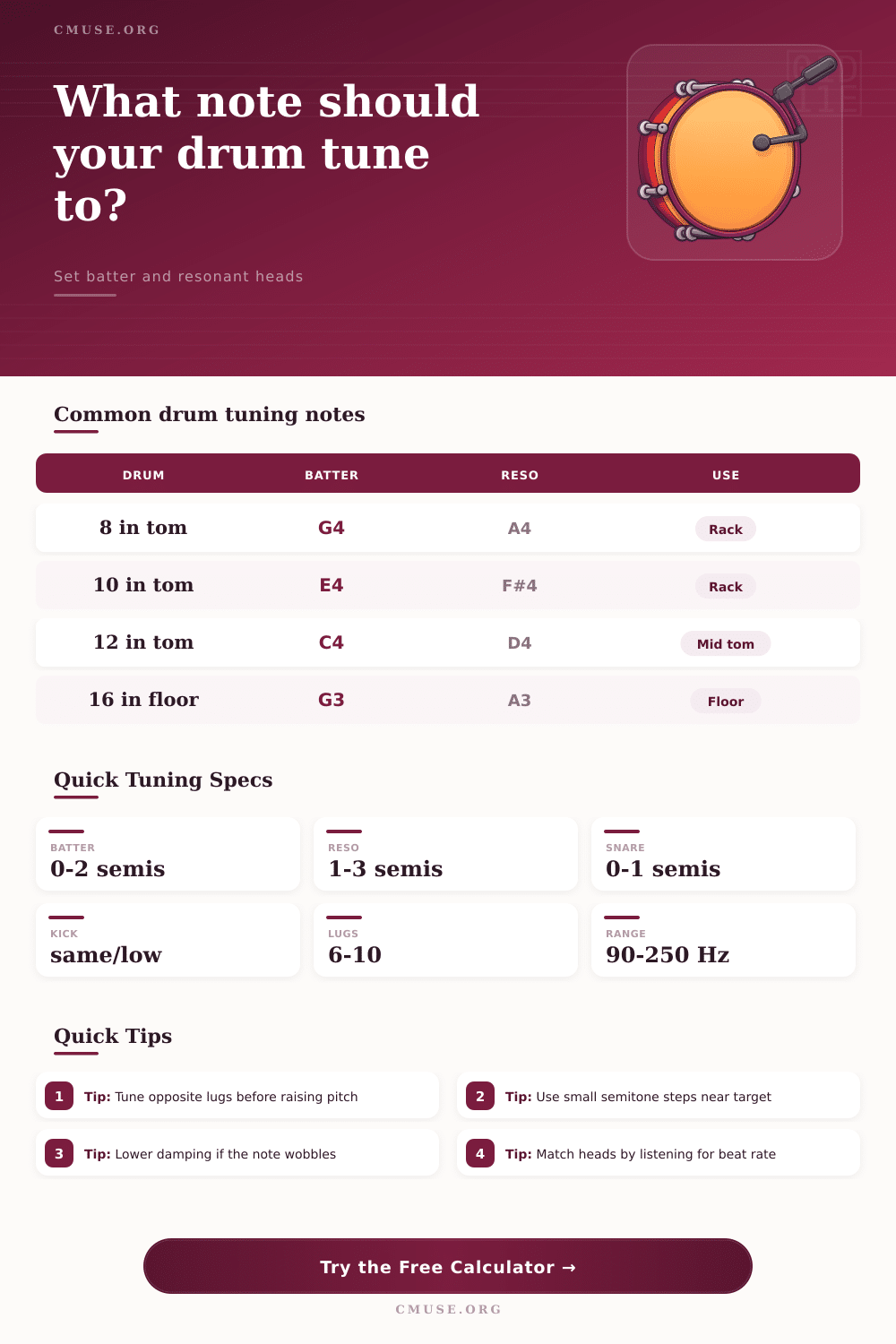
| Drum | Batter | Reso | Use |
|---|---|---|---|
| 8 in tom | G4 | A4 | Rack |
| 10 in tom | E4 | F#4 | Rack |
| 12 in tom | C4 | D4 | Mid tom |
| 16 in floor | G3 | A3 | Floor |
| Head Type | Attack | Ring | Best For |
|---|---|---|---|
| Single-ply | Fast | Long | Open tone |
| Coated | Soft | Warm | Focus |
| Double-ply | Firm | Short | Control |
| Dampened | Tight | Short | Studio |
Drum tuning is the change of the pitch or height of drum. Although most drums are unpitched instruments, each of them has a basic tone and nuances. So that the drums sound well together in the kit and nicely alone, you must set them.
When folks tune drums, they usually do not want a precise note. Rather, they try to remove bad nuances
How to Tune a Drum
The first thing needed is a drum key. It is a tiny tool for tightening or loosening the rods, that rule the pitch of the drum. Tightening the rods, you raise the pitch.
Loosening them, you lwoer it.
Loosen first all rods entirely. Tighten them finger tight between finger and thumb. Later, with a drum key, turn the rods on one side of the drum.
Turn each one the same amount… Half turn, full turn or more. Tune the lugs in a star pattern.
While you put a new drum head, tighten it equally around the edge, so that the pitch at every spot matches. Like this the head sounds the same with itself. Strike a finger or stick beside every lug and listen.
Some will sound a bit higher than others, so match them.
Start at the lowest possible pitch. Detune the batter head until it sounds dead, later raise it only until it resonates. Do the same with the resonant head.
Ideally, tune first the batter head, when the resonant head of the drum is off. For the resonant head you can put the drum on a flat surface and tighten every rod in a star pattern.
Maximum resonance and slow decay is found, when upper and bottom lugs have the same pitch. Weaker resonance and fast decay come from big differences between upper and bottom lugs. Every drum has its own tone range, to that it answers.
In lower configuration the head becomes too loose. Big drums need more tension than little ones.
14-inch snare usually sound higher than 14-inch tom. Because snare are drums, tighten the bottom head quite a lot and tune the upper to the wanted sound. Too tight snare wires choke the resonance.
At kick drums, raise the batter head until wrinkles go, later the upper for a bouncy feeling. Very high front head configuration gives extra punch.
Tuning to intervals, as fourths or fifths between toms, work well. Start at floor tom and go upward, or from smallest tom down. Drum tuning depends mostly on the musical style.
Jazz kits commonly have precise scale tones. Tuning by ear is important for the craft. Practise it often to improve it.