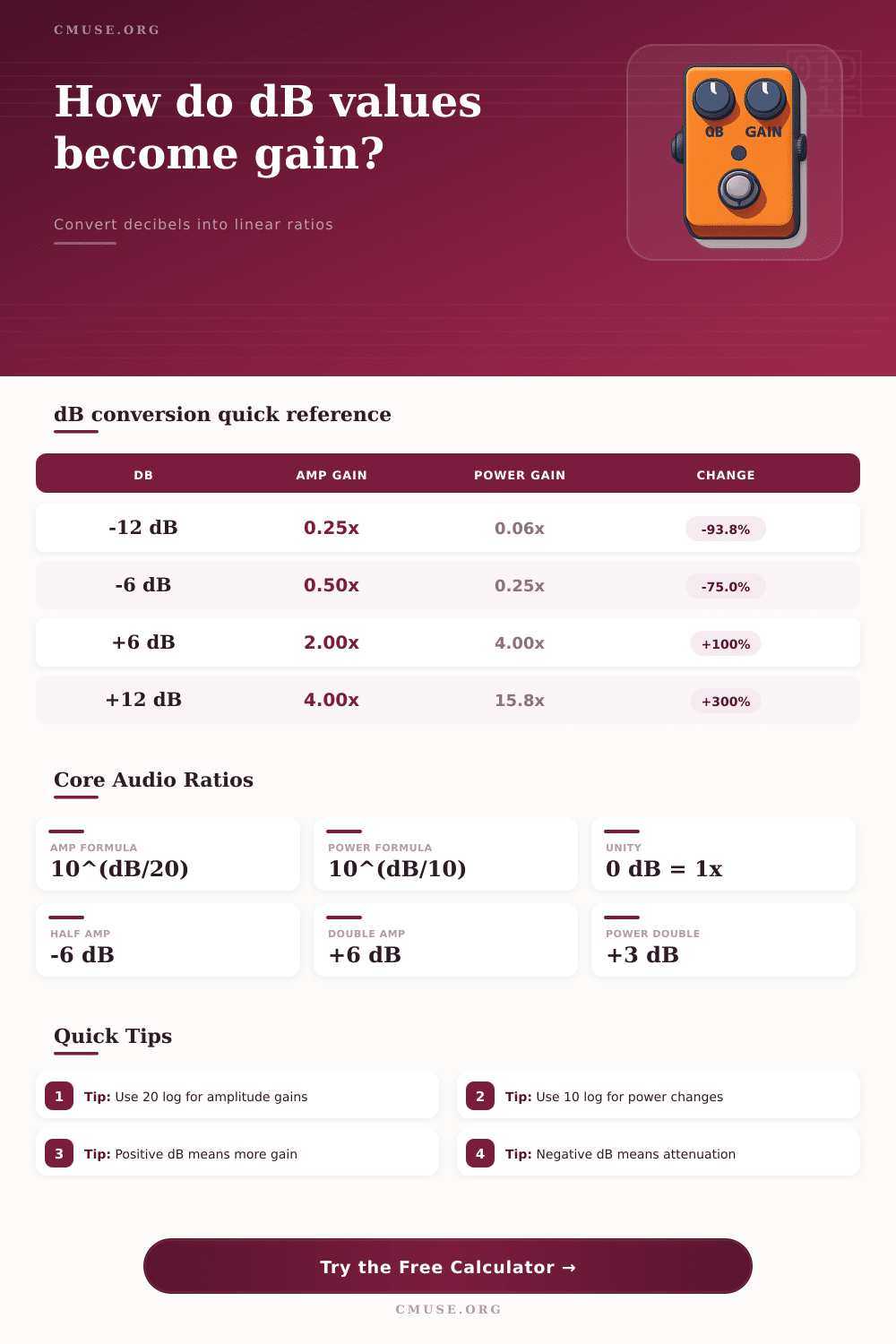
dB to Gain Calculator
Convert decibels into linear gain, power ratio, and output level for audio and signal work.
🔊 Presets
📏 Inputs
📊 Quick Reference
| dB | Amp gain | Power gain | Change |
|---|---|---|---|
| -20 dB | 0.10x | 0.01x | -99% |
| -6 dB | 0.50x | 0.25x | -75% |
| 0 dB | 1.00x | 1.00x | 0% |
| +6 dB | 2.00x | 4.00x | +100% |
Audio gain is basically the amount the signal strengthens or amplifies during its way. Voice of some person sounds entirely different when you shout instead of whisper compared to normal speech That change of loudness causes gain, that alters even the tone of the voice.
Gain relates to the force of audio signal during it passes through amplification circuit. It shows the difference between the input of the input phase and the output of the output phase. You measure it by means of decibels, that is logarithmic scale for compare output and input levels.
What Is Audio Gain?
Here it becomes interesting: every increase of 3 dB double the power, while 6 dB double the voltage amount or quadruple the power. So if amplifier takes 1V input and give 4V output, that is 4-times gain, what matches 12 dB.
Many mix gain with volume, but they accomplish different tasks. Gain operates the input level inside the amplifier, while volume cares about the output level to the speker. Important note: gain forms the tone of the audio way, while volume only decide loudness.
In typical gear they stand in separate places of the amplification chain. In mixer the gain button usually seats up as input control, and the volume fader below as output control.
Here happen with microphones, they naturally give very weak voltage signal, so they require strong magnification to reach usefull level. Here Gain comes to help. Most audio devices operate in line level, but microphones and guitars issue signals under that limit.
Assume that your microphone has weak signal; turning the gain upward, you identify it to sufficient force for mixing desk or audio interface. Rather, with synthesizer plugged in, you maybe will have to lower the gain, for escape distortion.
Good gain cares about balance of levels through the whole signal way. Problem is: if distortion comes early, everything eventual work with defective audio. Similarly, if levels are too low and seize noisy base, it accrues through every following step.
Every stage has its input and output, that you must balance. From my experience, recording level you intend in around -18 dBFS, what is benchmark spot for 24-bit audio.
Gain operates also as limiter for maximum power. Assume that headphones reach apt loudness in only 0.7 volts, but your amplifier can give 7 volts. Lowering gain you can turn volume wholeheartedly without risk explode them.
When you amplify the signal, the noise floor strengthens together with it, so unwanted noises receive same boost as the real sound.