Amplifier Calculator
Estimate voltage, current draw, and output power for common speaker impedance setups.
🔌 Presets
📏 Inputs
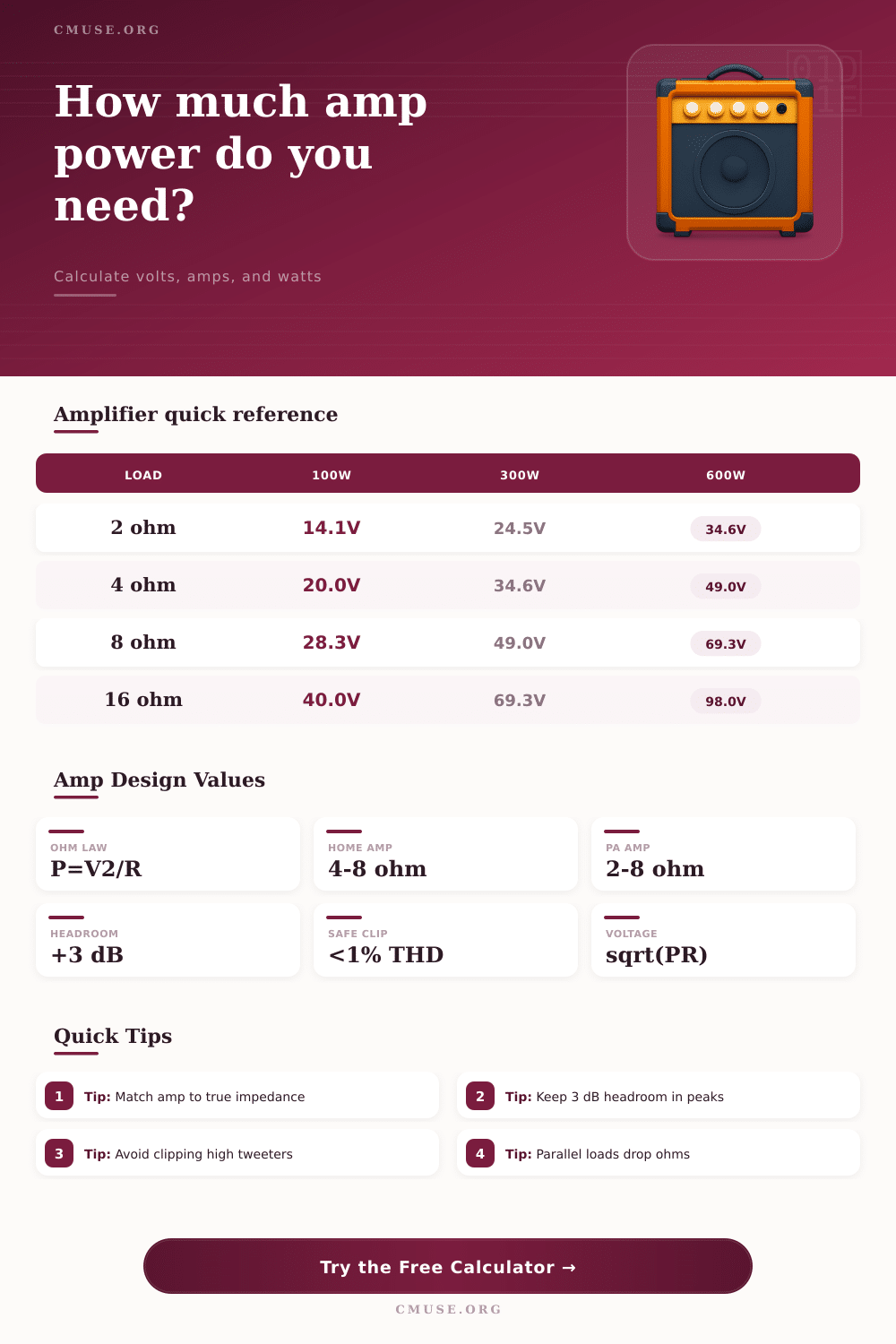
| Load | 100W | 300W | 600W |
|---|---|---|---|
| 2 ohm | 7.1A | 12.2A | 17.3A |
| 4 ohm | 5.0A | 8.7A | 12.2A |
| 8 ohm | 3.5A | 6.1A | 8.7A |
| 16 ohm | 2.5A | 4.3A | 6.1A |
An amplifier is an electronic device or circuit that increases the strength of a signal. It usually increases the voltage, the current, or the power while it keeps the information that the signal carries, like frequency, waveform shape, and phase. Basically it is an electronic circuit that from the power supply takes energy to expand the amplitude of a signal at the input terminals.
Like this you get a stronger signal at the output.
How an Amplifier Works
An amplifier can expand audio, visual, or other signals, giving them more power or voltage. In audio systems you use them to better hear the sound and clarify it, which delivers pleasant listening. Modern audio sources issue signals with enough voltage for small speakers.
But power is lacking. They cannot give the needed current for powerful speakers at reasonable volumes. So you must connect the speakers to an amplifier that expands the analog signal from devices like a CD player or compuler.
Power amplifiers form the muscle that brings big home audio systems to life. A dedicated amplifier in its own chassis with a separate power supply is truly a must-have for audiophiles. Many of them have balanced inputs and outputs.
They have less distortion and better sound quality than AV receivers. A power amplifier delivers maximum power to move the load of a speaker at a given distortion rate.
There are various classes of amplifiers that are worth knowing. In a Class AB push-pull amplifier, each tube does a bit more than half the work. One tube amplifies the positive part, the other the negative from the phase inverter.
That is more efficient. The signal passes through the power tubes to the output transformer and speaker. Class A amplifiers get hot, but that is normal and will knot burn your house.
In bass amplification the first element is the preamplifier. It takes the weak signal of the bass and expands it to medium current and voltage. That helps to lower the noise.
To produce amplified voltage you need three kinds: positive, negative, and grounding voltage or common sink.
Electric amplifiers should not be used with acoustic guitars. Almost every acoustic amplifier gives good sound, if it has a decent pickup system and enough tweaking. An external headphone amplifier can help them reach their best output.
Tube amplifiers sound much better than solid state amps for classical music. A valve amplifier gives musicality and a soundstage that does notrequire you to be rich to enjoy.