Reverb Calculator
Estimate RT60 using room size and absorption to tune your acoustic treatment plan.
🎧 Presets
📏 Inputs
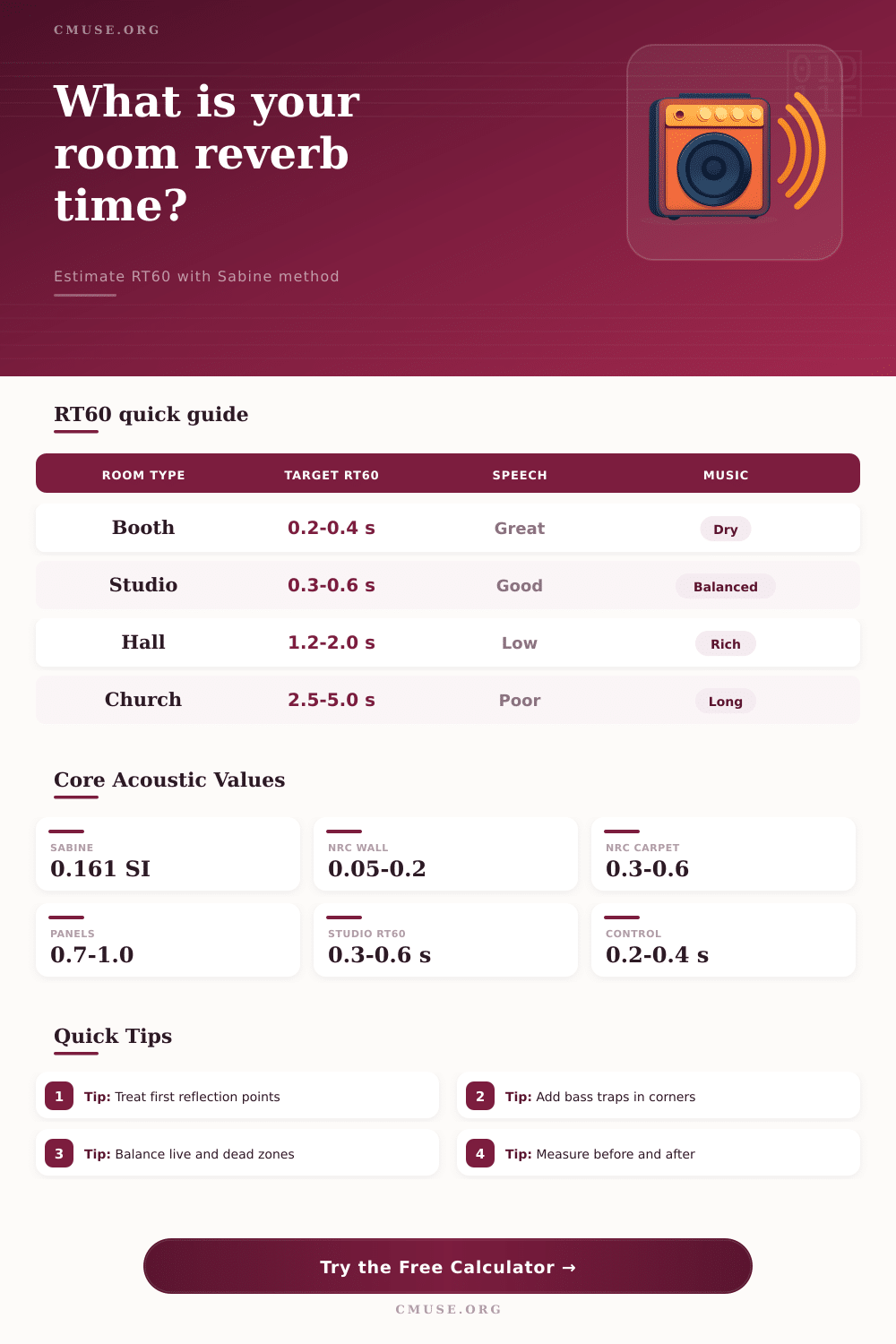
| Purpose | Ideal RT60 | Dry | Live |
|---|---|---|---|
| Voice booth | 0.20-0.35 | Below 0.2 | Above 0.5 |
| Mix room | 0.30-0.50 | Below 0.3 | Above 0.7 |
| Drum room | 0.50-0.80 | Below 0.4 | Above 1.0 |
| Hall music | 1.20-2.00 | Below 1.0 | Above 2.5 |
Reverb time deals mainly with how long sound stays in the air before it fully disappears. You define the reverberation time of a space as the duration after which the sound drops by 60 dB after the signal has stopped. For instance, if sound in a room needed eight seconds to drop from 120 dB to 60 dB, that would be the reverberation time.
Usually you estimate it with one number for a wideband signal from 20 Hz to 20 kHz But it depends on the frequency.
What Is Reverb Time and How to Use It
The reverberation time changes based on the frequency. It is better to split the whole response into standard one-octave or one-third-octave bands than use the full spectrum. In practice it ranges from a few hundred milliseconds in homes to several seconds in big public spaces.
In a church RT60 can last four to five seocnds, while in a living room it probably only reaches one second or even less.
The reverberant sound in an auditorium disappears over time as the sound energy gets absorbed during many bounces against the walls and ceiling. In a more reflective space it lasts longer before dying, and you call such a room “live”. The simplest way to estimate reverb time is with one same absorption coefficient for all surfaces, regardless of frequency.
Small home-sized rooms truly do not have real reverb time, because no random sound field exists above the noise floor at any real frequency.
For music production professional audio engineers commonly set the reverb according to the tempo of the song. The goal is to sync it with the pulse of the track. With a pre-delay and reverb time calculator you easily find out which pre-delay and decay time values match the BPM of a song.
Simply enter the tempo of the track, and the tool counts optimal values four reverb and delay sizes.
The core of the formula is simple. Divide 60,000 by the beats per minute, and that gives the length of a quarter note in milliseconds. At 120 BPM a quarter note lasts 500 ms. The pre-delay for quarter notes would be around 7.81 ms, and the reverb decay around 492.19 ms, for a total of 500 ms.
The decay time parameter decides how long it takes for the reflections in the space to lose their energy. A common mistake during mixing is using too long a reverb time. For natural room sounds it is usually better to choose a shorter time with higher level.
Pre-delay and early reflections can give the feeling of a big space without too much lengthening the real reverb time. The denser a mix becomes, the lessclarity you get with longer reverbs.