🎹 Piano Practice Calculator
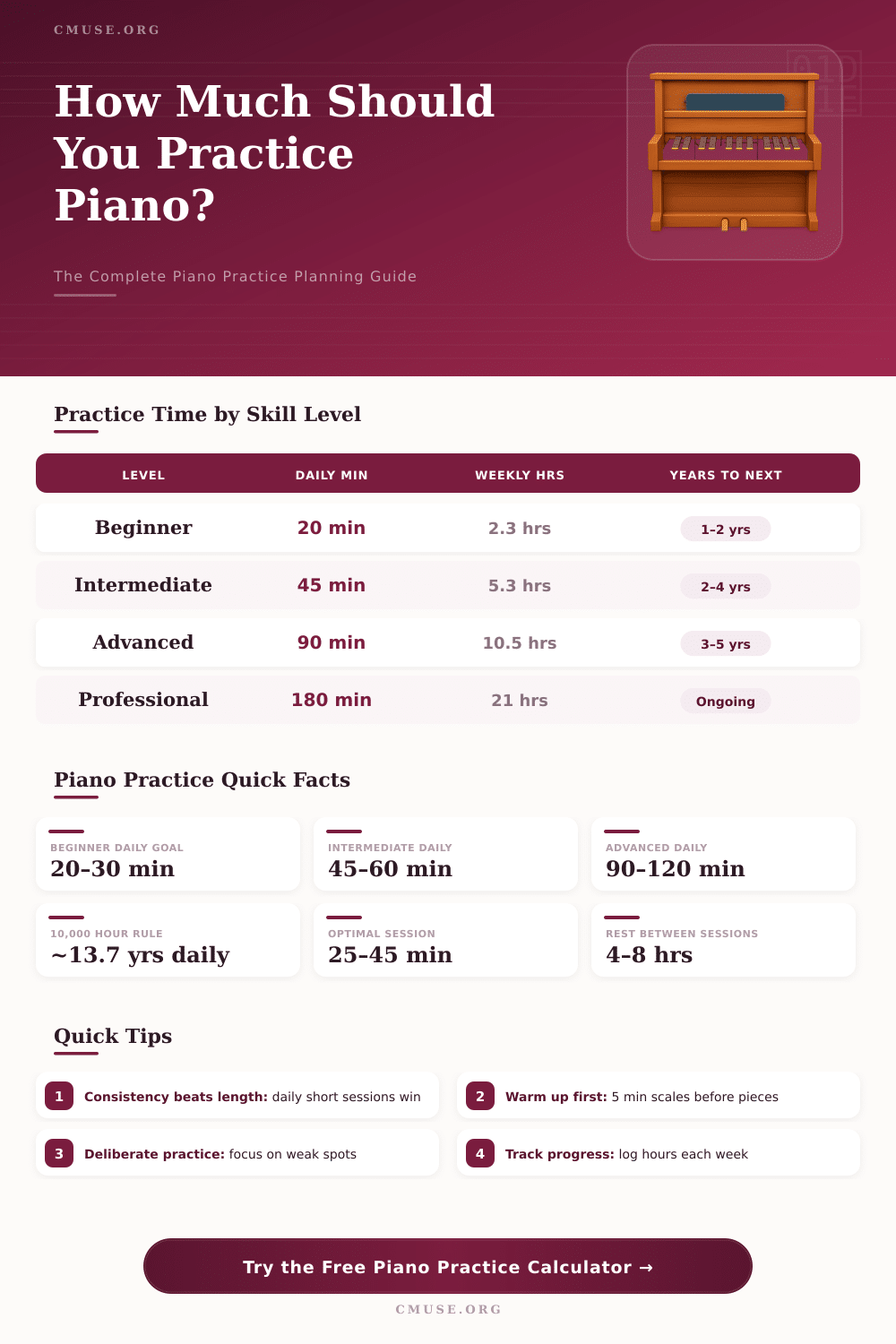
Calculate your ideal daily practice time, weekly hours, and milestone timelines based on your level and goals
| Level | Total Hours | At 30 min/day | At 60 min/day |
|---|---|---|---|
| Solid Beginner | 150–300 hrs | 10–20 months | 5–10 months |
| Intermediate | 500–800 hrs | 2.7–4.4 yrs | 1.4–2.2 yrs |
| Upper Intermediate | 1,000–1,500 hrs | 5.5–8.2 yrs | 2.7–4.1 yrs |
| Advanced | 2,000–3,500 hrs | 11–19 yrs | 5.5–9.6 yrs |
| Professional | 5,000–10,000 hrs | 27–55 yrs | 13.7–27 yrs |
| Daily Minutes | 3 Days/Week | 5 Days/Week | 7 Days/Week |
|---|---|---|---|
| 15 min | 0.75 hrs | 1.25 hrs | 1.75 hrs |
| 20 min | 1.0 hrs | 1.67 hrs | 2.33 hrs |
| 30 min | 1.5 hrs | 2.5 hrs | 3.5 hrs |
| 45 min | 2.25 hrs | 3.75 hrs | 5.25 hrs |
| 60 min | 3.0 hrs | 5.0 hrs | 7.0 hrs |
| 90 min | 4.5 hrs | 7.5 hrs | 10.5 hrs |
| 120 min | 6.0 hrs | 10.0 hrs | 14.0 hrs |
| Session Length | Warm-Up | Main Focus | Repertoire |
|---|---|---|---|
| 20 min | 3 min | 12 min | 5 min |
| 30 min | 5 min | 17 min | 8 min |
| 45 min | 7 min | 25 min | 13 min |
| 60 min | 10 min | 35 min | 15 min |
| 90 min | 10 min | 55 min | 25 min |
| 120 min | 10 min | 75 min | 35 min |
Find the right amount of time for Piano Practice is not easy, there is not one size that works for all. Whether something works depends on your level of skill, on your age and honestly, on how much time you can safely spend every day.
If you recently start around 20 to 30 minutes daily is a good start. Longer sessions often seem boring to newcomers, when they still struggle with basic things, and that boredom can quickly kill the reason. Most piano teachers that I met advise at least 30 minutes a day, for five or six days in the week.
How Long Should You Practice Piano Each Day
Children between 7 and 11 years widely last sessions in the range of 30 to 45 minutes. Similarly happens with older children that only start their piano adventure.
When you already passed the most basic starting phase, 30 to 45 minutes almost daily usually works well. Here is the key point: with focused practice, you can learn quite a lot of hard pieces only by means of 30 minutes of evreyday work. After some weeks of steady action, the whole bit comes together, and you are ready to present it before an audience.
Many teachers will push to fit the everyday practice to the length of your lesson. For most adults, that means something between 45 minutes and one hour. Even so, spending 1.5 to 2 hours allows you to warm up nicely each time, what gives space for real progress.
Some folks share it: practice during 1.5 hours, pause properly, and later again 1.5 hours.
Even only 10 minutes have value, when the time is tight. At more advanced stages, one our daily helps to keep your skills sharp, while you learn new ones. One to two hours maybe do not sound a lot, but it truly is enough, if you plan it.
The secret? Practice less, think more during the time that you have.
Studies point to around two hours daily as ideal, with four hours as safe maximum, before you start to lose speed. What truly matters is being steady instead of long sessions. You can work nine hours sometimes, but steady everyday action is what truly forms solid skill.
Splitting your session in parts makes a big change. One good plan: 30 minutes for pieces that you already know, 30 minutes for something new, and later another 30 for scales, rhythm exercise, reading notes, theory and ear training. A good method is to first pick out the most hard parts, before playing the whole thing from the start.
Going over those hard spots at different moments in your session helps them click.
Having a fixed practice plan is important. Some days you will have more time than others, and that is perfectly fine. Caring about a real target.
For example preparing a test or show; gives the push to stayactive and reach targets. In the end, the steadiness of your everyday work beats the length of sessions always.