🎵 Xylophone Bar Length Calculator
Calculate precise bar lengths for any note — build a perfectly tuned DIY xylophone
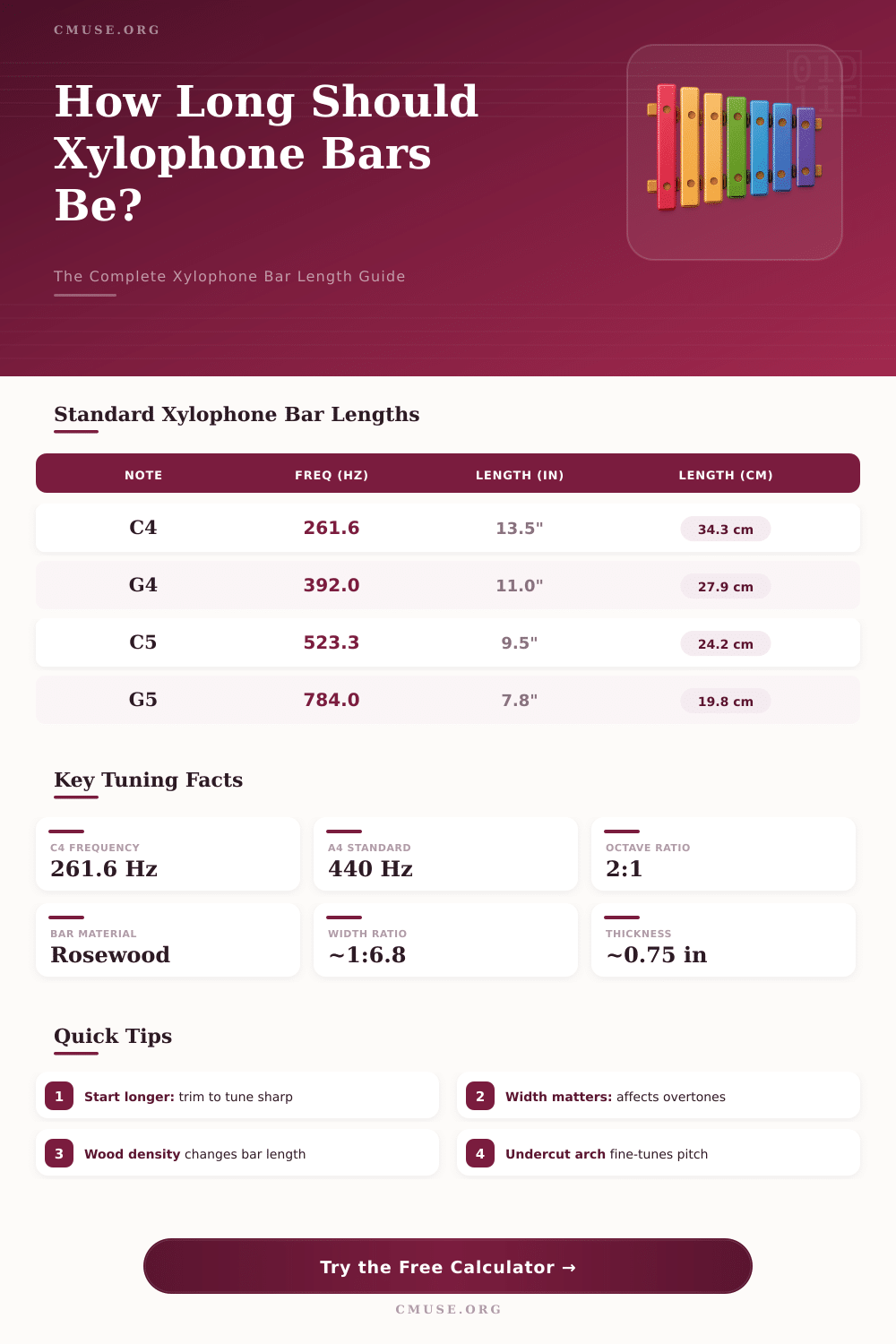
The xylophone bar length ranks among the main factors that determines the pitch that it makes. Bars with bigger length give deeper sounds, the opposite happens with shorter ones that sound higher. Because of the shorter way of the sound through the wood, they have faster spread so they hear in higher range.
One arranges the bars according to order from the deepest until the highest, forming like this a scale for music. Hit, each bar vibrates and generates stable ripples in clear frequency.
How Xylophone Bar Length Changes Pitch
The relation between frequency and xylophone bar length obeyed a set model. The frequency relates to the reverse of the square of the length. Like this, even tiny changes in the size cause clear change in the sound.
To lower the note a bit, it is enough to remove around three percent from the xylophone bar length, what could be needed. Instruments like orchestral bells, glockenspiels and xylophones all use bars with almost same profiles.
One finds in a typical xylophone 44 set bars from rosewood. They range in length from 5.3 until 17.3 inches. Each of them measures 1.6 inches across the bar and 0.9 inches in thickness.
The bars rest like keyboards, where the half-notes in a separate group are raised a bit above the main line of the natural sounds.
Wood even so is not an ideally matching material. Things like density, fiber and structural differences all alter the final hearing. Traditional xylophones from wood give warm and echoing tone.
Bars from synthetic materials tend too discharge clearer and piercing sound. One commonly cups the bottom part of xylophone bars to improve the sound and the shape itself. So, simply counting the outer length by means of basic rules does not always work well.
The shaping requires to carefully change both the length and the thickness of every wooden bar to reach the wanted accuracy. One requires a firm base or stone to set the bars during the work, and a ruler helps to measure every one exactly. One way to build a xylophone is to cut the main pieces in fit size, for instance 15 cm, and later trim from that.
Using rulers simplifies thewhole task.
Under each bar usually rest resonating tubes. They are made of empty tubes from metal or PVC. Also they differ in length, with bigger ones under the deep bars and smaller ones under the high.
The most deciding factor for the real frequency of any bar or tube is its length. Starting from the standard tuning sound at 440 Hz, one can compile the fit lengths for the other notes. Adjusting them well is the key to making an instrument that truly sounds good.