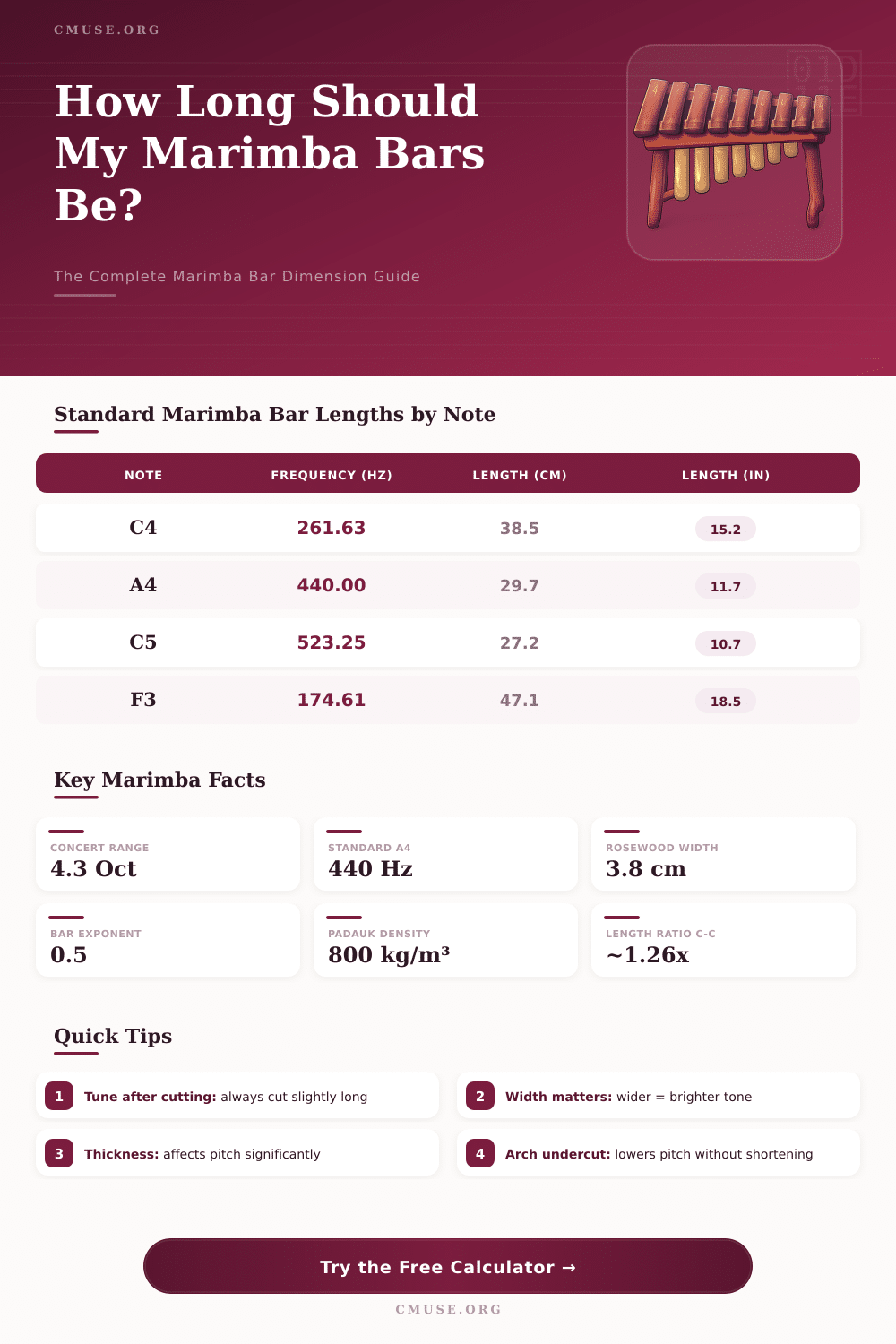
🎵 Marimba Bar Length Calculator
Calculate precise bar lengths by note, material, and tuning system for marimba building
| Note | Frequency (Hz) | Length (cm) | Length (inches) | MIDI # |
|---|---|---|---|---|
| C3 | 130.81 | 57.3 | 22.6 | 48 |
| D3 | 146.83 | 54.1 | 21.3 | 50 |
| E3 | 164.81 | 51.1 | 20.1 | 52 |
| F3 | 174.61 | 49.6 | 19.5 | 53 |
| G3 | 196.00 | 46.8 | 18.4 | 55 |
| A3 | 220.00 | 44.2 | 17.4 | 57 |
| B3 | 246.94 | 41.7 | 16.4 | 59 |
| C4 | 261.63 | 40.5 | 15.9 | 60 |
| D4 | 293.66 | 38.2 | 15.0 | 62 |
| E4 | 329.63 | 36.1 | 14.2 | 64 |
| F4 | 349.23 | 35.1 | 13.8 | 65 |
| G4 | 392.00 | 33.1 | 13.0 | 67 |
| A4 | 440.00 | 31.3 | 12.3 | 69 |
| B4 | 493.88 | 29.5 | 11.6 | 71 |
| C5 | 523.25 | 28.6 | 11.3 | 72 |
| D5 | 587.33 | 27.0 | 10.6 | 74 |
| E5 | 659.25 | 25.5 | 10.0 | 76 |
| F5 | 698.46 | 24.8 | 9.8 | 77 |
| G5 | 783.99 | 23.4 | 9.2 | 79 |
| A5 | 880.00 | 22.1 | 8.7 | 81 |
| Thickness (in) | Thickness (cm) | Pitch Effect | Typical Use |
|---|---|---|---|
| 0.50 | 1.27 | Lowers pitch ~15% | High-octave bars |
| 0.625 | 1.59 | Lowers pitch ~10% | Upper-mid bars |
| 0.75 | 1.91 | Lowers pitch ~6% | Mid-range bars |
| 0.875 | 2.22 | Standard reference | All-purpose |
| 1.00 | 2.54 | Raises pitch ~6% | Bass bars |
| 1.25 | 3.18 | Raises pitch ~12% | Deep bass bars |
| Instrument Type | Range | Bars | Low Note Freq | High Note Freq |
|---|---|---|---|---|
| Concert Marimba | A2 – C7 | 61 | 110.00 Hz | 2093.00 Hz |
| Standard 4.3 Oct | A2 – C6 | 52 | 110.00 Hz | 1046.50 Hz |
| 4-Octave | C3 – C7 | 49 | 130.81 Hz | 2093.00 Hz |
| 3.5-Octave | F3 – C7 | 43 | 174.61 Hz | 2093.00 Hz |
| 3-Octave Soprano | C4 – C7 | 37 | 261.63 Hz | 2093.00 Hz |
| Bass Marimba | C2 – F4 | 30 | 65.41 Hz | 349.23 Hz |
The Marimba Bar Length is among the main factors that determines what tones one can get from it. Various sizes and weights cause different pitches. The shorter the bar, the higher pitch it gives.
The formula that binds the Marimba Bar Length to the wanted frequency comes from theory about a model of bar free at every end.
How Marimba Bar Length Affects Pitch
Marimba bars usually are made of rosewood or from some synthetic wood substitute. One cuts them to size for the intended note. Later one improves the tuning by cutting wood from the bottom of the bar.
The bottom of many bars are clipped in the middle, and that helps with the shape.
For custom built five-octave marimba detailed specs count for every bar from C2 until C7, with inclusion of Marimba Bar Length, width, thickness and thickness at the arch center. The base bars of C2 until D#3 have bigger thickness than usaul. One glues extra wood to the bottom edges to lower the vibration level, while one keeps at least quarter-inch thickness in the arch center.
In one marimba from a commercial film one cut the bars with lengths between 24.5 and 37.5 cm, width of 4.5 cm and thickness of 2.25 cm. Five-octave Majestic marimba use bars from Honduran rosewood with sizes of 41 until 82 mm. Basic marimba can reach 12 feet of length with 24 especially big bars, all from Honduran rosewood.
If one starts with a bar of 50 cm, and then cut every next note 1 cm shorter, one would end with C6 long 13 cm. A bar of 12 cm is about the shortest that one can actually make. At a 21-inch bar the width ranges between 2.75 and 3.5 inches.
Broad bars give richer sound, but they can make sum pieces almost unplayable. With broad bars the single-octave runs below in the range become hard.
Many makers use roughly same-width bars in the lowest octave. Even so between makers the spacing for every bar on the bar frame varies, what alters the gap between bars.
Every bar rests on its own resonance tube. The length and diameter of the resonance tubes carefully match the pitch of the nearby bar. In more modern marimbas wooden resonators are replaced by PVC tubes.
The length of those resonators adjusts to the frequency that the bars produce.
While tuning the basic tone should rest within ± one to two cents. The first overtone should rest within ± five cents. If the starting pitch of a bar goes past the intended pitch, one can lower it by shaping.
But if it is way too high the bar would be so thin in the center thatit could easily split.