🎵 Organ Pipe Calculator
Calculate pipe length, frequency, harmonics & tuning for open and closed organ pipes
Fundamental Length
Equivalent Pitch
Stopped Length
Octave Length
ft/s at 20°C
m/s at 20°C
Per Open End
Length Ratio
| Note | Freq (Hz) | Open Length (ft) | Open Length (m) | Closed Length (ft) | Closed Length (m) | Standard Stop |
|---|---|---|---|---|---|---|
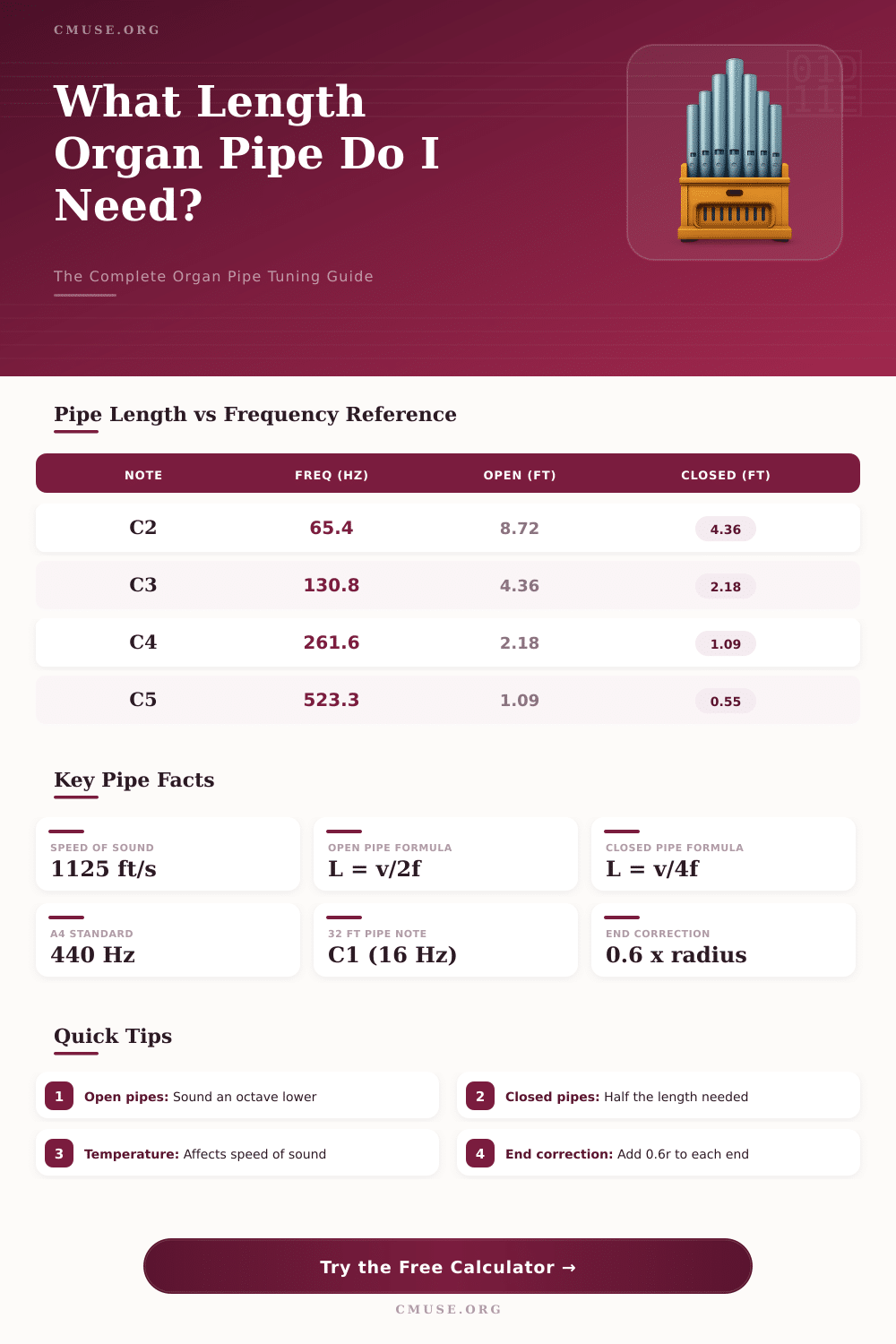
| C1 | 32.70 | 17.22 | 5.25 | 8.61 | 2.62 | 32 ft Open |
| C2 | 65.41 | 8.61 | 2.62 | 4.30 | 1.31 | 8 ft Open |
| G2 | 98.00 | 5.74 | 1.75 | 2.87 | 0.87 | 5-1/3 ft Quint |
| C3 | 130.81 | 4.30 | 1.31 | 2.15 | 0.66 | 4 ft Open |
| E3 | 164.81 | 3.41 | 1.04 | 1.71 | 0.52 | 3-1/5 ft Tierce |
| G3 | 196.00 | 2.87 | 0.87 | 1.44 | 0.44 | 2-2/3 ft Nasard |
| C4 | 261.63 | 2.15 | 0.66 | 1.08 | 0.33 | 2 ft Octave |
| A4 | 440.00 | 1.28 | 0.39 | 0.64 | 0.20 | 1-3/5 ft Larigot |
| C5 | 523.25 | 1.08 | 0.33 | 0.54 | 0.16 | 1 ft Piccolo |
| C6 | 1046.50 | 0.54 | 0.16 | 0.27 | 0.08 | 1/2 ft Mixture |
| Stop Name | Foot Length | Lowest Note | Pipe Type | Pitch vs 8 ft | Typical Use |
|---|---|---|---|---|---|
| Sub Bass | 32 ft | C1 (16 Hz) | Closed | 2 octaves below | Pedal |
| Open Diapason | 8 ft | C2 (32.7 Hz) | Open | Unison | Manual |
| Bourdon | 16 ft | C1 (16 Hz) | Closed | 1 octave below | Pedal/Manual |
| Octave / Prestant | 4 ft | C3 (65.4 Hz) | Open | 1 octave above | Manual |
| Gedackt / Stopped Flute | 8 ft | C2 (32.7 Hz) | Closed | Unison | Manual |
| Quint / Nasard | 2-2/3 ft | G3 (98 Hz) | Open | 12th above | Manual |
| Super Octave / Piccolo | 2 ft | C4 (130.8 Hz) | Open | 2 octaves above | Manual |
| Tierce | 1-3/5 ft | E4 (164.8 Hz) | Open | 17th above | Manual |
| Larigot | 1-1/3 ft | G4 (196 Hz) | Open | 19th above | Manual |
| Trumpet | 8 ft | C2 (32.7 Hz) | Reed | Unison | Manual |
| Harmonic | Open Pipe | Closed Pipe | Frequency Ratio | Musical Interval |
|---|---|---|---|---|
| 1st (Fundamental) | f = v / 2L | f = v / 4L | 1x | Fundamental |
| 2nd Harmonic | f = v / L | Not present | 2x | Octave above |
| 3rd Harmonic | f = 3v / 2L | f = 3v / 4L | 3x | Octave + 5th |
| 4th Harmonic | f = 2v / L | Not present | 4x | 2 Octaves above |
| 5th Harmonic | f = 5v / 2L | f = 5v / 4L | 5x | 2 Oct + Major 3rd |
organ pipe forms the sound-making part of the pipe organ. When pressed air, usually called wind is pushed through it, it makes sound. Every such pipe matches to one particular note from the musical range.
Because each of them only makes one fixed tone, one arranges them in groups, that one calls ranks. In one rank all pipes have the same tone and strength.
How a Pipe Organ Makes Sound
Pipe organ is made up of four main parts: keyboard or several keyboards, pipes that create the sound, device that delivers air under pressure, and system that binds the keys to the pipes so that wind arrives to them at the right moment. The keyboard part does not make sound. Only when air flows in the pipes, music sounds.
Bellows pump air through wind pipelines and into wind chests. The wind chest keeps the air at steady pressure, ready for use when one presses a key. Every pipe stands above that hollow wind chest.
Pressing a key, one opens a valve that allows air to enter in the right pipe. The pipe either receives wind or stays silent. There is no in-between speed as on the piano.
Various materials and shapes of pipes give different sounds. Some pipes copy the sound of other instruments. Every particular sound is called a stop.
Like this a three-stop organ allows you to choose between three different sounds. The stops one controls by means of knobs, that helps the player decide which sound to use. Switching diffrent stops, one turns on various groups of pipes when a key is pressed.
Also, traditional pipes are made from wood, zinc or tin, but there also existed special pipes. Some had adjustable parts for making a series of sounds. Others used moving membranes for various vibrating effects or adjustable holes for controlling the pressure.
Some were designed four research into how the position of the mouthpiece affects the sound or how the size and shape of the pipe changes the hearing.
In the physical world, organ pipe tubes serve as a classic example for showing standing waves, harmonies and resonance. The natural frequency of the vibrating air column in a pipe is inversely proportional to the length of that column. The ends of an organ pipe reflect the sound wave in it.
Open pipes have two open ends and follow other rules than closed pipes. Actual design of a pipe is very complex, because even small changes in diameter affect both tone and sound.
Medieval organs did not have a way to separate different ranks during play. All pipes sounded together. One considers the pipe organ the most ancient and biggest instrument in musical history.
In one single press of a key, dozens of pipes of various sizes cansound at the same time, filling the room with strong music.