🎵 Recorder Hole Placement Calculator
Calculate precise finger hole positions for any recorder key, tube length, or bore diameter
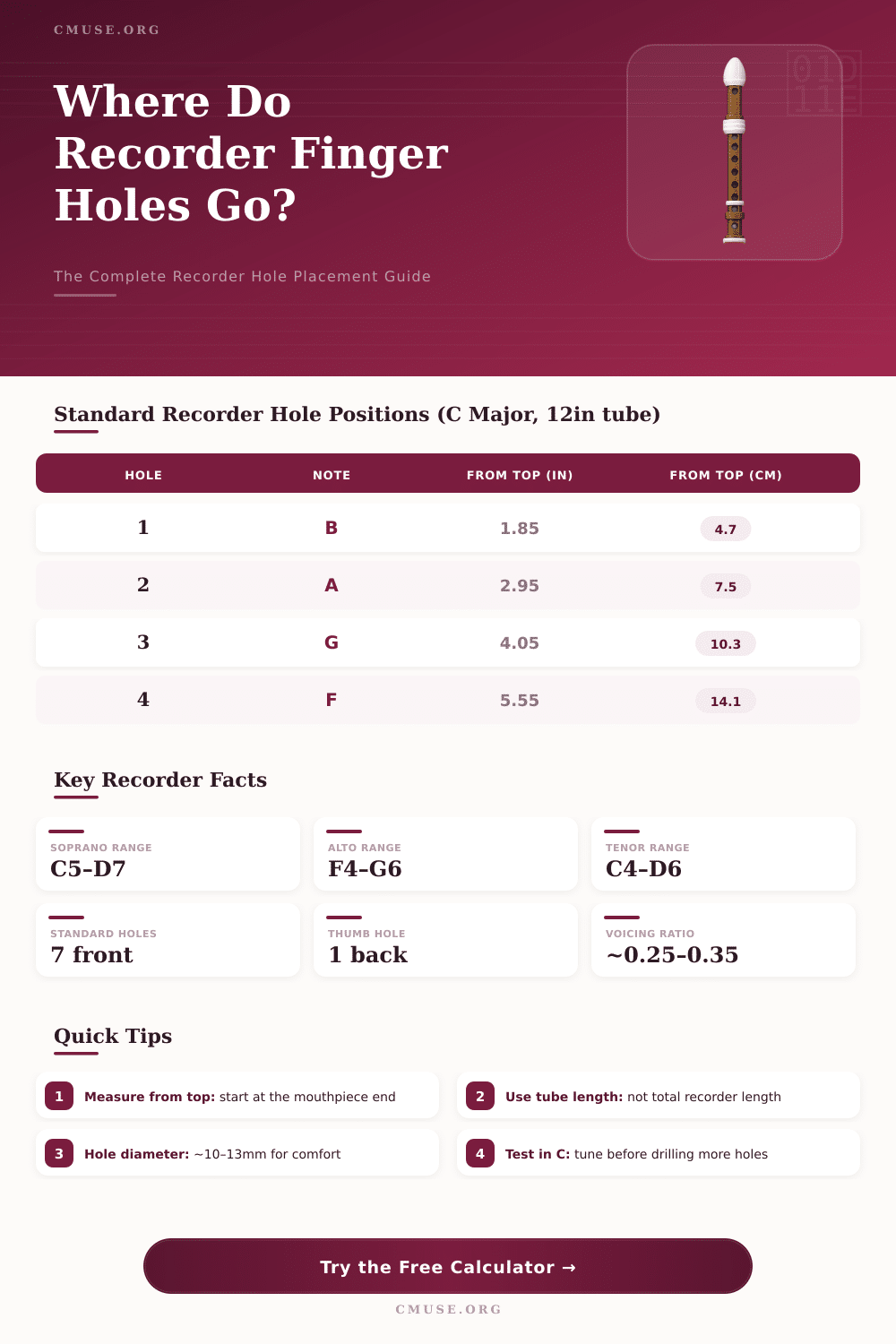
| Hole # | Note (C Recorder) | Ratio (from top) | Soprano (cm) | Alto (cm) | Tenor (cm) |
|---|---|---|---|---|---|
| Thumb (back) | Upper octave | 0.050 | 1.5 | 2.4 | 3.2 |
| 1 (index L) | B | 0.200 | 6.1 | 9.4 | 12.6 |
| 2 (middle L) | A | 0.280 | 8.5 | 13.2 | 17.6 |
| 3 (ring L) | G | 0.360 | 11.0 | 16.9 | 22.7 |
| 4 (index R) | F | 0.440 | 13.4 | 20.7 | 27.7 |
| 5 (middle R) | E | 0.530 | 16.2 | 24.9 | 33.4 |
| 6 (ring R) | D | 0.630 | 19.2 | 29.6 | 39.7 |
| 7 (pinky R) | C | 0.740 | 22.6 | 34.8 | 46.6 |
| Recorder | Lowest Note | Frequency (Hz) | Tube Length | Wavelength |
|---|---|---|---|---|
| Sopranino F | F5 | 698.5 Hz | ~22 cm | ~49 cm |
| Soprano C | C5 | 523.3 Hz | ~30.5 cm | ~65 cm |
| Alto F | F4 | 349.2 Hz | ~47 cm | ~98 cm |
| Tenor C | C4 | 261.6 Hz | ~63 cm | ~131 cm |
| Bass F | F3 | 174.6 Hz | ~90 cm | ~196 cm |
| Great Bass C | C3 | 130.8 Hz | ~120 cm | ~262 cm |
| System | F# / Bb Method | Hole 4 Style | Best For | Hole 6 Offset |
|---|---|---|---|---|
| Baroque (English) | Fork fingering | Split pair | Early music, classical | Slight offset –2% |
| German | Simple half-hole | Enlarged hole 4 | Beginners, schools | Standard |
| Equal Temperament | Fork fingering | Standard | Modern ensemble | Standard |
| Meantone | Fork fingering | Narrowed | Renaissance music | +1.5% shift |
The placement of holes in recorder has a long history, rooted in trial and failure. That instrument already existed for centuries, and the first makers found the places of holes through experiments. Later, people explained the math about the vibration of air in tubes of certain length.
This meant to exactly count Recorder Hole Placement for any tonal scale.
Where to Put Holes on a Recorder
It is possible to see a clear tie between the place of a tonal hole and its needed size. When one moves a hole more down the body of the recorder, the sound stays same only if one makes it bigger. On the other hand, if a hole slides more upward, it must shrink to keep the pitch.
Notes of the upper octave depned more on the true size than on the depth of the hole in the tube.
The inner form of the body plays a big role too. Old recorders had a round form, while those from the baroque era are cone shaped. From that difference, the distances between holes differ in both styles.
Some old models of recorders have only one set of bottom holes, what means that one played them with left hand up and right below. Renaissance or medieval versions commonly arrange the holes along a direct line, with smaller holes for little fingers. The unused hole one closes with wax, what means playing too the left.
Some recorders allow the player to turn the bottom part for better comfort. The position of the foot joint moves based on the played note. Without need of F-sharp, the bit stays where it works best for F. When a half tone is needed, one moves it to cover whole or half hole.
Keys became needed for bigger recorders. Instruments bigger than tenor require at least one key, so that the player can reach all eight holes. One sometimes adds them also to little recorders, what loosens the hand and helps in better Recorder Hole Placement and size of holes.
There are online calculators that help to plan Recorder Hole Placement for flutes from PVC tubes, whistles or recorders. They count based on the base note measure of the instrument, so work for any mouthpiece. Artificial intelligence programs give values for gaps between holes, if one enters right data like length and diameter of the opening.
Instruments of ocarina type are simple in this regard, because the position of holes matters less than their size.
Fork fingering is another method tied to Recorder Hole Placement. If the hole under the tonal is closed with a finger, the sound drops flat by a half tone. Half cover with the thumb requires moving only less than a quarter of the hole width.
The skin of thethumb helps so that the real covered area adjusts barely.