🎵 Mountain Dulcimer Fret Calculator
Calculate exact fret positions for any scale length using the 17.817 equal temperament formula
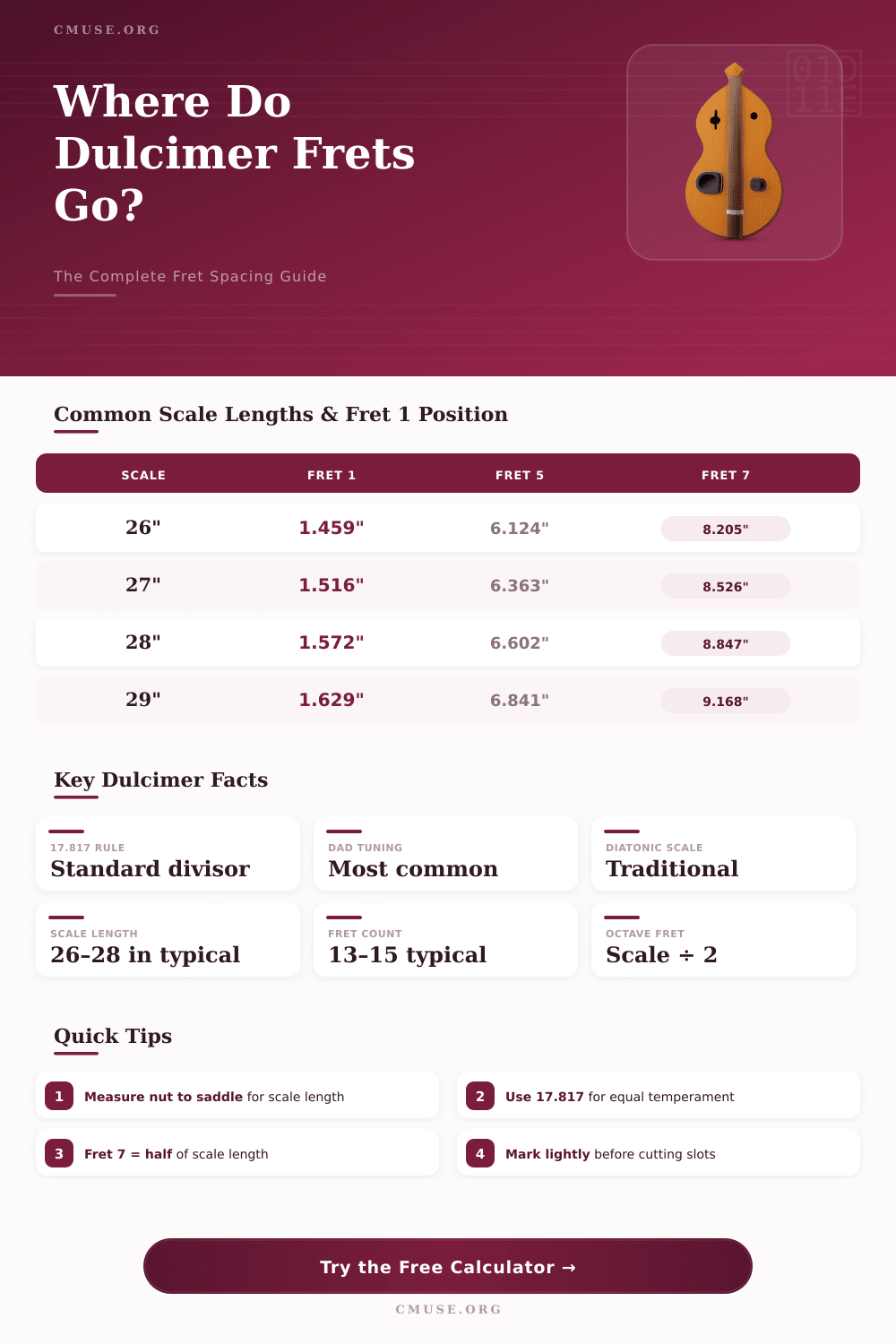
| Scale Length | cm | Fret 1 (in) | Fret 5 (in) | Fret 7 (in) | Octave Fret (in) |
|---|---|---|---|---|---|
| 24" | 60.96 | 1.347 | 5.656 | 7.582 | 12.000 |
| 25" | 63.50 | 1.403 | 5.892 | 7.898 | 12.500 |
| 26" | 66.04 | 1.459 | 6.124 | 8.205 | 13.000 |
| 27" | 68.58 | 1.516 | 6.363 | 8.526 | 13.500 |
| 28" | 71.12 | 1.572 | 6.602 | 8.847 | 14.000 |
| 29" | 73.66 | 1.629 | 6.841 | 9.168 | 14.500 |
| 30" | 76.20 | 1.685 | 7.080 | 9.489 | 15.000 |
✔ Highlighted rows are most common for mountain dulcimer. Octave fret = scale ÷ 2.
| Fret # | Distance from Nut (in) | Distance from Nut (cm) | String Note (D String) | Interval |
|---|---|---|---|---|
| 1 | 1.516 | 3.851 | D#/Eb | minor 2nd |
| 2 | 2.947 | 7.485 | E | major 2nd |
| 3 | 4.298 | 10.918 | F | minor 3rd |
| 4 | 5.573 | 14.155 | F#/Gb | major 3rd |
| 5 | 6.776 | 17.211 | G | perfect 4th |
| 6 | 7.912 | 20.096 | G#/Ab | tritone |
| 7 | 8.985 | 22.822 | A | perfect 5th |
| 8 | 9.999 | 25.397 | A#/Bb | minor 6th |
| 9 | 10.957 | 27.831 | B | major 6th |
| 10 | 11.863 | 30.132 | C | minor 7th |
| 11 | 12.720 | 32.308 | C#/Db | major 7th |
| 12 | 13.531 | 34.370 | D (octave) | octave |
| 13 | 14.298 | 36.317 | D#/Eb | minor 9th |
| 14 | 15.025 | 38.163 | E | major 9th |
| 15 | 15.713 | 39.911 | F | minor 10th |
| Layout Type | Fret Count | Notes Available | Use Case |
|---|---|---|---|
| Diatonic (traditional) | 13–15 | 7 per octave | Folk, Appalachian, traditional tunes |
| Chromatic (6+ extra) | 18–22 | 12 per octave | Contemporary, modal, jazz |
| Semi-chromatic (half frets) | 15+ | 8–10 per octave | Celtic, expanded modal playing |
| VSL Diatonic | 13 | 7 per octave | Beginners, simple folk melodies |
Build the right gaps between the Mountain Dulcimer Fret ranks between the most difficult tasks for making such instrument. The spacing matters a lot… Even little change in the whole length of the strings can mess up the whole arrangement.
Here the main point: dulcimers are stringed instruments similarly to a piano that lacks all black keys. The Mountain Dulcimer Fret spots sit in places that set the main scale grade in the instrument itself. If you add an extra Mountain Dulcimer Fret, then you will be able to play a mixed scale starting at the nut.
How to Place Frets on a Mountain Dulcimer
Or since the third Mountain Dulcimer Fret and you find other important scale ready here. That odd style shows everywhere on instruments of dulcimer-type, hence it naturally received the name “dulcimer spacing“.
Now about full fret setups, like those you strip on cigar box guitar, they work otherwise. The frets close bit more, while they head to the body. Dulcimers do not follow that pattern, because they are not full.
The most many dulcimers sit between 24 and 28 inches for the scale length. For exactly figuring the spacing of frets, you need the vibrating length of the string, measured from the nut until the bridge. Here is an old math method that went around: share the string length by 17.81715385, and you receive the distance of the nut to the first Mountain Dulcimer Fret.
There are charts that describe the placing for almost any scale length of 8 until 32 inches, shared in eight-step parts. Every Mountain Dulcimer Fret is pointed by means of three different measures, distance to the prior Mountain Dulcimer Fret, distance directly to the nut and distance of the prior to the bridge. Having won from those guides really simplifies the building process.
The 6½ Mountain Dulcimer Fret and its octave pair, the 13½ Mountain Dulcimer Fret, became the most common additions. They already are standard part of the most many dulcimers today. Having an instrument equipped with the extra 1½ and 6½ frets does make a difference.
Some makers also include a Mountain Dulcimer Fret between the nut and the first, sometimes called “half fret”, together with the 1½. That allows to access some extra notes when you need them. Books about dulcimers issued by the 2000s favor the 1.5, 8.5 and 15.5 frets a bit.
What really stands out in the Mountain Dulcimer Fret spacing of dulcimer? It almost bans playing out of tune. That forgiving trait makes it such a joyful, easy instrument for learning.
If your dulcimer bears double melody strings, they must be quite a lot near one to the other so that one finger can press them down without trouble. Something broader then an eighth of inch between them and your finger could slip, players can regularly do that. For the height of strings, aim for something roughly equal to the thickness of a cent at the first Mountain Dulcimer Fret, later raise it until it reaches thethickness of a nickel at the seventh Mountain Dulcimer Fret.