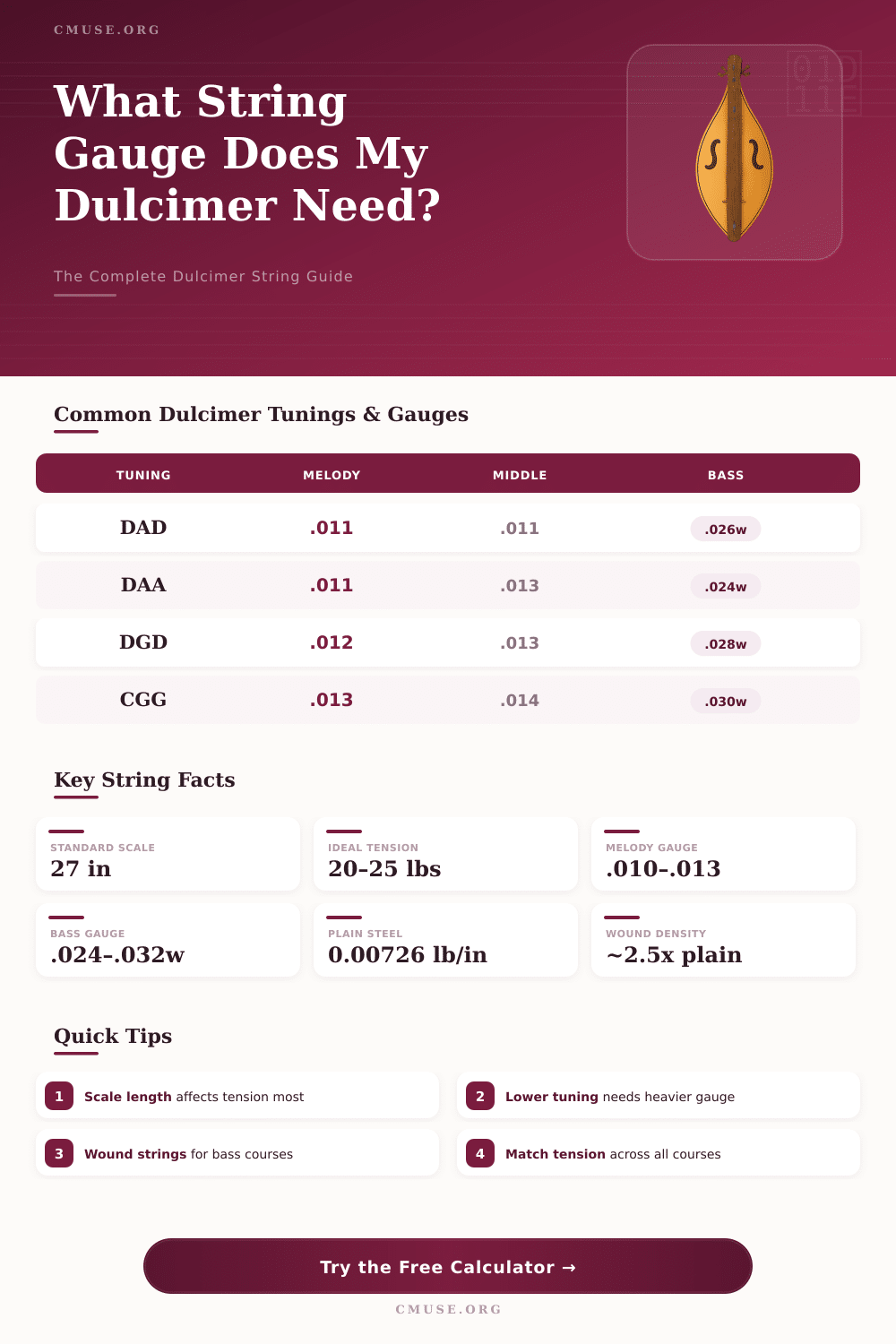
🎵 Dulcimer String Gauge Calculator
Find the perfect string gauges for your mountain dulcimer based on scale length, tuning, and desired tension
| Tuning | Melody (.xxx) | Middle (.xxx) | Bass (.xxx) | Scale 26.5" Tension Est. |
|---|---|---|---|---|
| DAD (Standard) | .011 | .011 | .026w | 21–23 lbs avg |
| DAA (Ionian) | .011 | .013 | .024w | 20–22 lbs avg |
| DGD (Modal) | .012 | .013 | .028w | 22–25 lbs avg |
| CGG (Baritone) | .013 | .014 | .030w | 21–24 lbs avg |
| EAE (Sawmill) | .010 | .013 | .022w | 19–22 lbs avg |
| EBE (High) | .010 | .012 | .020w | 18–21 lbs avg |
| CGC (Low Baritone) | .014 | .016 | .032w | 22–26 lbs avg |
| Scale Length | vs. 26.5" Standard | Gauge Adjustment | Example Melody Gauge |
|---|---|---|---|
| 24.0" (610 mm) | –2.5" shorter | Go heavier by ~.001–.002 | .013 |
| 25.0" (635 mm) | –1.5" shorter | Go heavier by ~.001 | .012 |
| 26.5" (673 mm) | Standard | No adjustment | .011 |
| 27.0" (686 mm) | +0.5" longer | May go lighter by ~.001 | .011 |
| 28.0" (711 mm) | +1.5" longer | Go lighter by ~.001 | .010 |
| 29.0" (737 mm) | +2.5" longer | Go lighter by ~.001–.002 | .010 |
| Material | Unit Weight (lb/in) | Relative Density | Tone Character |
|---|---|---|---|
| Plain Steel | 0.000726 × d² | 1.0x (reference) | Bright, clear |
| Wound Steel (80/20 Bronze) | ~2.1–2.4x plain | Higher mass | Warm, full |
| Phosphor Bronze Wound | ~2.2–2.5x plain | Higher mass | Warm, slightly dark |
| Nickel Wound | ~2.0–2.3x plain | Medium-high | Balanced, smooth |
| Stainless Steel | ~1.05x plain | Slightly higher | Very bright |
| Nylon / Synthetic | ~0.35–0.45x plain | Much lower | Soft, mellow |
| Note | Octave | Frequency (Hz) | Common Course |
|---|---|---|---|
| C3 | 3 | 130.81 Hz | Bass (CGG, CGC) |
| D3 | 3 | 146.83 Hz | Bass (DAD, DAA) |
| G3 | 3 | 196.00 Hz | Middle (DGD, CGG) |
| A3 | 3 | 220.00 Hz | Middle (DAD, DAA, EAE) |
| B3 | 3 | 246.94 Hz | Middle (EBE) |
| D4 | 4 | 293.66 Hz | Melody (DAD, DGD) |
| E4 | 4 | 329.63 Hz | Melody (EAE, EBE) |
| G4 | 4 | 392.00 Hz | Melody (CGG) |
| A4 | 4 | 440.00 Hz | Reference / DAA melody |
The strings for dulcimer are basically only guitar strings, only with other arrangement. Strangely, one almost always will sell them with very lightweight diameter, what not always works. Hence commonly more well buy separate strings according to your desire about diameters.
Here the key cause: dulcimer instruments differ a lot according to design, construction and configuration. Rather to guitars, where any good set of strings works without problem, for dulcimer one does not find one solution for all. That makes it hard to guess from outside, what materials and diameters one used for a particular dulcimer during its original performance.
How to Choose Dulcimer Strings
Before changing string, you must learn what diameters the instrument requires for every note. Every model is different, but happily many makers issue printed guides with plans about configuration and details about strings.
For typical three-string dulcimer set to DAD or CGC, I found one combination with diameters around.012,.015 and.024. Other commonly used variant flips that to.024,.016 and.012. For some four-string sets one commonly chooses slim steel string, usually two.011, one.013 and wound.022 for the base.
The Martin M640 from nickel for dulcimer have diameters of about.012 until.022. There is also a set for plucking that goes.009,.010,.012 and.023W. For standard DAA or DAD setup, Dulcimer String Gauge diameters as 12/12/14/22W show quite commonly.
The order in which one lists the diameters of strings, can really confuse. Usually one starts with the low bass string, later the middle, and finally the melody. Hence, when setup one writes as DAD, the first letter indeed points to your bass.
Three things decide the quality of strings: its length, the mass that it bears, and the tension that you add. Scale length around 27.5 inches is very commonly used. If you choose heavier and thicker, you need more tension to push it vibrate well.
That results in louder, clearer sound and less noise from frets, although it tires more the hands. Less heavy, slimmer strings need less tension. They are easy to play and give warm, rich sound with longer duration, but maybe a bit more fret noise.
Dulcimer instruments already are gentle, and one must use less harsh tension then on guitar.
For play with drone note, heavier diameters for the melody string really project. Most players like nickel-wound bass, but phosphor bronze or mixes from bronze and brass work also. If your dulcimer have scale length between 26 and 27 inches, lay the middle string to.016 and the double melody to.013 commonly well result.
McSpadden suggest diameters 12, 12, 16 and 26 for 26-inch scale in ddAD, that is quite heavy for ashort instrument.
A Dulcimer String Gauge tool or micrometer perfectly works for checking diameters of dulcimer strings. No special stuff is needed. Simply measure your old ones to check what diameters work.
The Strothers string choice calculator is handy, but warning: it commonly suggests a bit too light, so choose one or two steps bigger than offered usually more well works.